Inventory loss: accounting and tax treatment in Colombia

Inventory loss: accounting and tax treatment in Colombia
No small business owner wants to get that call: someone broke into the warehouse overnight, a storage rack collapsed, a short circuit burned part of the stock, or an entire batch expired because it never rotated. Within hours, the inventory that appeared on the stock ledger is no longer physically there or can no longer be sold. What hurts first is the money; what worries owners afterwards is how to record the loss in the books and what may happen with taxes. This article explains, in plain language for owners of small and medium businesses in Colombia, the two sides of a physical inventory loss: the accounting side and the tax side, and what you should do from day one to keep everything documented.
Inventory loss is more common than people think: internal and external theft, fires, water damage, expired goods, shipping errors that are never recovered, items that go missing and show up months later. When the goods disappear or become unusable, they stop being an asset available for sale and the company absorbs a cost. Understanding how that loss is recorded and which supporting documents to keep makes the difference between a loss that only hurts your pocket and one that is properly supported in your books and before the DIAN tax authority, if that agency asks questions later.
What is a physical inventory loss and how is it different from impairment?
It helps to separate two situations that are sometimes confused. Impairment happens when the merchandise still exists but its value has gone down: it went out of fashion, was partially damaged, or its selling price no longer covers its cost. In that case, what gets adjusted is the value of the asset, but the goods are still in the warehouse and the business can still sell them, even at a lower price. A physical loss is different: the goods disappeared or became completely unusable, so there is nothing left to sell or to adjust. In Colombian accounting terms, both events are reflected in the records, but in different ways and with different documents, as explained below.
Typical examples of a physical inventory loss include:
- Theft of merchandise, committed by outsiders or by your own staff.
- Destruction by fire, flooding, an accident, or structural damage to the warehouse.
- Mass expiry of a batch that could not be sold in time and must be discarded.
- Contamination or total damage that rules out any sale, even at clearance prices.
- Loss or an inventory difference that cannot be explained or located after the physical count.
In all these cases the accounting effect is essentially the same: the merchandise must leave the asset side of the balance sheet. What changes is the documentation that supports each cause and the way the loss is demonstrated to the authorities, if it ever comes to that.
The accounting side: writing the goods off and recognizing the expense
In accounting, inventory is an asset: it represents the merchandise the business expects to sell in the normal course of operations. When that merchandise disappears or is destroyed, the asset ceases to exist and must be removed from the records. That operation is called a write-off: the value of the lost goods leaves the inventory balance and no longer appears on the stock ledger, because there is no physical stock left to back that balance. Keeping goods that no longer exist on the books inflates your assets and gives a misleading picture of the business.
The counterpart of that write-off is an expense for the period. The loss is recognized in the income statement when it occurs and is documented, without waiting to sell anything or to collect from an insurer. In practice, the amount written off is the cost at which the merchandise was recorded: its purchase or production cost, the same amount shown on the stock ledger. You do not write it off at the selling price, but at what it really cost to have that merchandise in the warehouse.
If the merchandise was insured, the portion the policy will cover does not become a loss for the business: that portion is recorded as a receivable from the insurance company, in other words, an asset for the claim. Only the difference not covered by the policy, because of deductibles, exclusions, or insufficient insured amounts, remains as an expense for the period. This way, the books reflect both what was lost and what the company expects to recover.
Here is a simple example. A small business suffers the theft of merchandise with a recorded cost of 5,000, expressed in thousands of pesos. The basic accounting entry to write the inventory off and recognize the loss is the following:
| Account | Debit | Credit |
|---|---|---|
| Expense for inventory loss (theft) | 5,000 | |
| Merchandise inventory (written off from the stock ledger) | 5,000 |
If the merchandise was insured and the insurer agrees to cover 4,000, the entry is split in two: what the company expects to receive and what it actually loses. The entry would be:
| Account | Debit | Credit |
|---|---|---|
| Receivable from the insurance company | 4,000 | |
| Expense for inventory loss (uncovered portion) | 1,000 | |
| Merchandise inventory (written off from the stock ledger) | 5,000 |
These are illustrative examples; the exact accounts depend on each company's chart of accounts and on the conditions of each policy. The key point is the logic: the inventory leaves the assets, the loss is recognized as an expense for the period, and the insured portion remains as a right to receive money.
Supporting documents: building the loss file
No accounting entry stands on its own. Accounting is built on supporting documents, and an inventory loss requires a minimum file showing what happened, when it occurred, with which merchandise, and for what value. That file is what allows you, months later, to explain the entry to a new accountant, to a statutory auditor, or to the DIAN. The recommended supporting documents are:
- The accounting entry and the stock ledger removal, with the unit and total value of the written-off merchandise.
- A write-off or destruction report signed by the warehouse manager, the accountant, and at least one witness, with the date, the cause, and the detail of the affected products.
- In case of theft, a copy of the police report filed with the competent authority.
- Photographs or videos of the condition of the merchandise, whenever they can be taken safely.
- Reports from the insurer or the adjuster, if there is a policy and a claim was filed.
- Emails, meeting minutes, or internal communications showing how and when the loss was detected.
- The periodic physical inventory report in which the difference between the stock ledger and the actual stock was identified.
This file is not red tape: it is the proof that the loss actually happened. Without it, any later explanation is just words, and the recorded expense has no support.
Physical loss versus impairment: do not mix them up in your records
| Aspect | Impairment of value | Physical loss |
|---|---|---|
| What happens to the goods? | They still exist but are worth less. | They disappeared or became unusable. |
| Typical accounting entry | Adjustment of the inventory value for impairment or net realizable value. | Full write-off of the inventory and recognition of the loss expense. |
| Is there anything left to sell? | Yes: the goods can be sold, at a lower price. | No: there is no saleable goods. |
| Key documentation | Support for the recoverable value and the cause of the drop in value. | Write-off report, police report if there was theft, and evidence of the cause of the disappearance. |
Confusing the two situations leads to recording errors: adjusting the value of merchandise that actually disappeared, or fully writing off merchandise that only lost value, distorts the inventory balance and the expense of the period. Good inventory control, with periodic counts and up-to-date records, helps you identify which of the two actually happened.
The tax side: proof is everything
Here is a golden rule for the income tax in Colombia: the fact that a loss is recognized as an expense in the books does not mean it is automatically deductible. Accounting and taxation are separate levels and, although they start from the same entry, each has its own requirements. The accounting expense reflects an economic reality; the tax deduction is a benefit granted when conditions are met, among them being duly proven.
In terms of general principles, an inventory loss can give rise to a deduction in the income tax when it is duly proven. Proven means that the taxpayer can show, with the accounting records and the supporting documentation, that the loss existed, that it was caused by an identifiable event, and that its amount matches the real value of the lost merchandise. The DIAN has the power to request that proof when it reviews the income tax return. If the taxpayer cannot support the loss with the documents, the deduction can be disallowed, with the additional tax, the interest, and the penalties that this implies. That is why the file is put together on the day of the loss, not when a request arrives.
In the case of theft, proof requires an additional and essential element: the police report filed with the competent authority. It is not enough to say that the merchandise was stolen; the report must have been filed and a copy kept together with the rest of the file. In losses caused by destruction, such as fires or mass expiry, the destruction or write-off report, signed by those involved, plays a central role in showing what was destroyed and why.
This article deliberately sticks to those general principles. It does not discuss specific articles of the Colombian Tax Statute, nor does it mention percentages, caps, or special procedures, because those details change with the rules in force and because each case depends on its own circumstances. The responsible recommendation is to review the current regulation with your accountant before taking a position on the income tax return.
What the business owner needs to understand is the full logic: the loss is recorded in the books because it happened and it affects the result of the period; for it to be deductible in the income tax, it must be proven with accounting records, reports, and, in case of theft, with the police report filed with the authority. The file you put together on the day of the loss is what allows you, months later, to support the deduction before the DIAN. If the file does not exist, the loss depends entirely on what an auditor says about it, and that is a risk no business should take.
Practical tips to protect your business
- Always document, without exception: a report signed by everyone involved, photographs when applicable, a police report if there was theft, and an orderly copy of the whole file.
- Separate and isolate the damaged merchandise before writing it off, so it does not mix with healthy stock or get sold to a customer by mistake.
- Review your insurance policies in advance: know what they cover, what they exclude, and what you must do in the first hours after an incident so you do not lose the right to claim.
- Carry out periodic physical inventory counts and compare them with the stock ledger: small differences detected in time prevent big surprises at year end.
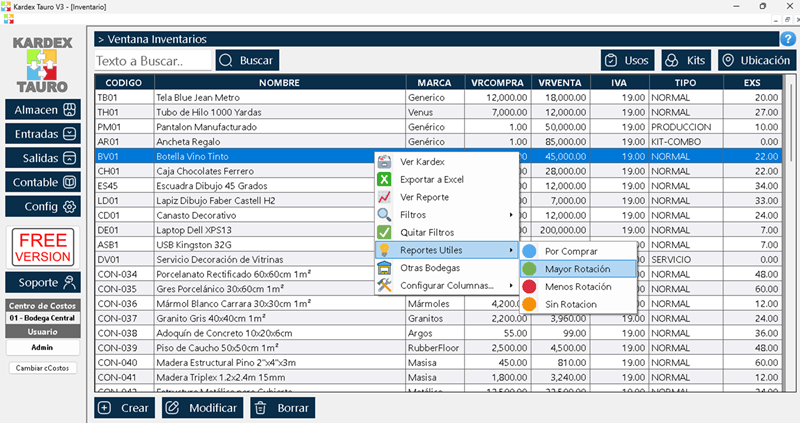
- Use inventory control tools such as Kardex Tauro, which let you keep the record of entries and exits up to date and quickly detect any difference between what the system says and what is actually in the warehouse.
- Train your warehouse staff so they know what to do when something happens: who to notify, what to secure, and what not to touch until the loss is documented.
In the end, managing an inventory loss comes down to one sentence: what is not documented does not exist. The accounting entry writes the merchandise off and recognizes the expense for the period; the supporting documents, the report, and the police report, when applicable, let you defend the deduction before the DIAN; and permanent control, with periodic physical counts and a management system such as Kardex Tauro, reduces the chances that the next loss catches you by surprise. Orderly books, timely documentation, and professional advice are the best protection for any Colombian small business facing an inventory loss.
This article is for educational purposes; the tax treatment of each loss depends on your specific case and on the rules in force: consult your accountant.