Inventory software for accountants: how to recommend it to your clients

Inventory software for accountants: how to recommend it to your clients
If you keep the books for small and medium businesses, you know the scene. The closing date arrives, you ask for the ending inventory, and the client says they have not counted it yet, or that they "kind of" know how much merchandise they have. The record is in a spreadsheet that has been out of date for two months, and nobody remembers who made the last adjustment or why. The closing slips, you push, the client gets defensive, and the figures end up built on assumptions that nobody wants to explain later.
That scenario is not just the client's problem. It is a problem with the accounting information, and that makes it yours. This article explains why a public accountant should have an opinion about how clients control inventory, what minimum features an inventory software needs so that closings stop being an ordeal, and how to present the recommendation so the client does not receive it as another expense. It also includes a scoring table to evaluate options by criteria instead of by price or by the flashiest advertisement.
Unreconciled inventory: the problem that lands on your desk
Inventory does not appear in the accounting records by magic. It appears because someone recorded purchases, sales, and adjustments, and because those records are valued with a costing method. When the client has no formal control, the symptoms are almost always the same:
- Closings that run late. The balance sheet and the income statement depend on ending inventory. Without that figure there is no closing, and the client "does not know how much merchandise they have" because it was never recorded on time.
- Surprise adjustments that destroy declared profit. The physical count reveals shortages accumulated over months, the adjustment is booked all at once, and the period's profit collapses with nobody able to explain when the merchandise was lost.
- Poorly calculated cost of sales. Without a valued inventory card per movement, cost is estimated with percentages or with gut feel, and gross margin stops being reliable.
- The client's inventory does not match the books. The owner swears certain merchandise exists, the records say otherwise, and the gap grows every month.
Every one of those symptoms ends the same way: in a figure your firm stands behind. That is why it pays to attack the cause instead of putting out fires at every closing.
Why the accountant should have an opinion about the client's inventory control
The reason is simple: inventory is part of the financial statements your firm prepares. If merchandise is overstated, equity and profit are overstated; if cost of sales is wrong, gross profit means nothing. The accountant cannot simply take the figure the client hands over and record it, especially when experience shows that figure is usually wrong.
The accountant is also the person with the most technical authority to raise the subject. A store or warehouse owner knows their business, but not necessarily valuation methods, the difference between physical and book inventory, or what an accounting assistant needs to reconcile. When you give an opinion about the client's inventory system you are not invading their operations; you are protecting the quality of the information you will use, and that reduces your own professional risk.
That does not mean becoming the client's warehouse manager. It means setting minimum rules: how purchases and sales are recorded, how often physical counts happen, who authorizes adjustments, and which documents back every movement. A well-chosen inventory software makes those rules enforce themselves, without depending on anyone's memory.
What to ask of an inventory system so your life gets easier
Before comparing brands, define what you need. These are the functions that solve the closing pains described above:
- Automatic valued inventory card per movement. Every purchase and every sale must generate its movement with its cost, with no parallel spreadsheets.
- Natural integration with cost of sales. The system must feed the cost of what was sold consistently with the valuation method you use, so the income statement does not depend on manual calculations.
- Control by warehouse or cost center. If the client has several stores or warehouses, you need to know what is in each one, not a single global number.
- Physical counts with documented adjustments. The system must let you record the count, compare it with the book balance, and generate the adjustment with its justification and the person responsible.
- Valued stock reports and slow-moving items. You need the valued ending inventory for the closing, and you also need to see which merchandise has been idle for months, because that is an accounting risk.
- Export to Excel. For your work papers and for the schedules that back the figure, nothing replaces downloading the data and working on it.
The moment of truth: what happens when an invoice is finalized
The quickest test of an inventory system is a single question: what happens when the client sells and invoices? If discounting the merchandise or recording the movement requires a separate task after invoicing, the control will fail, because that task will be forgotten. The right system performs the discount and the record in the same act of invoicing.
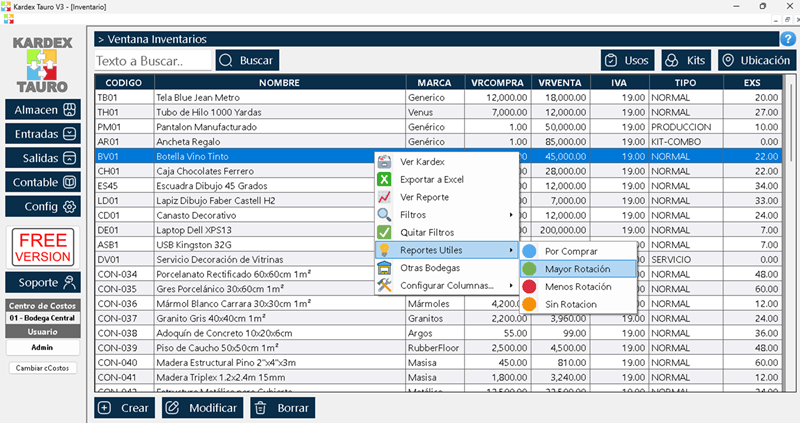
A concrete example of that logic is Kardex Tauro: when an invoice is finalized, the system discounts stock and generates the inventory card movement automatically, and it handles several warehouses or cost centers. The assistant does not depend on someone remembering to record the sale afterward, and at closing the book balance reflects what was actually sold.
When you evaluate options, run the test with a real case from the client's business: a purchase, a sale, a return, and a physical count. The system that survives that test with automatic and consistent records is the one that will save you hours of reconciliation.
Criteria for evaluating inventory software, with scores
To avoid deciding by impressions, build a table with the criteria that matter and assign each one a weight. This proposal can be adjusted to the type of client and the size of their operation:
| Criteria | What to check in practice | Suggested weight |
|---|---|---|
| Ease of use for the client | Can the owner or the person in charge record a purchase or a sale without your help? How many screens and fields does each operation require? | 20% |
| Accuracy of the valued inventory card | Does it generate the movement with its cost for every purchase and sale? Does it respect the chosen valuation method? Can the card be checked per product? | 20% |
| Automation when invoicing | Does it discount stock and record the card when the invoice is finalized, or does it demand extra manual steps? | 15% |
| Warehouses or cost centers | Does it separate stock by store, warehouse, or cost center? Can reports show each one separately? | 10% |
| Physical counts and adjustments | Does it have a counting window that compares what was counted against the balance? Are adjustments documented with a person responsible? | 10% |
| Reports and export | Does it deliver valued stock and slow-moving items? Does it export to Excel without losing format or data? | 10% |
| Migration from Excel | Can the product catalog and current balances be imported, or does everything have to be typed from scratch? Does the vendor help with the first load? | 5% |
| Vendor support | Who do you call when something fails in the middle of a closing? Are backups, updates, and a clear contract in place? | 5% |
| Total cost | What do license, implementation, training, and annual renewal cost? Local or cloud, and who is responsible for the data? | 5% |
Score each criterion, multiply it by the weight, and add. The winning option is not always the cheapest or the flashiest: it is the one the client will actually use every day and the one that hands you reconcilable information at closing.
How to present it to the client without making it feel like an expense
The client is not buying software; they are buying a business that works better. When you present the recommendation, talk about what it costs them not to have the control, not about technical features:
- Hours of closing time saved. With valued inventory up to date, the monthly closing goes from days to hours, and that also reduces fees for last-minute reconciliations.
- Less risk of objections and surprise adjustments. A shortage detected month by month is manageable; a shortage accumulated over a year destroys profit in one blow and attracts questions nobody wants to answer.
- Better information for credit. A valued and reliable inventory supports credit applications, leases, and negotiations with suppliers.
- Fewer internal arguments. With movements recorded and counts documented, missing merchandise stops being one person's word against another's.
If the client asks for an example, you can mention options that already solve the essentials. For physical counts, Kardex Tauro has a physical count window with adjustments: the count against the book balance and its regularization are recorded in the system and not in a notebook. Systems with that logic, at a reasonable license price, are a good starting point for the shortlist.
The final message is simple: proposing inventory software is not selling the client an expense; it is protecting the profit they declare and the signature your firm puts on those figures. Whoever understands that stops seeing inventory as a warehouse problem and sees it for what it is: a central piece of financial information.