Cloud inventory software vs local software: pros and cons for your business

Cloud inventory software vs local software: pros and cons for your business
If you are reading this, you have probably spent months tracking your inventory in a spreadsheet, and you already know that phase is over: the numbers never balance, what the file says does not match what is on the shelves, and every month-end close turns into a small crisis. The way out seems obvious: buy software. But the moment you start comparing options, the first fork appears, and it is not between brands but between two philosophies. On one side there is cloud inventory software, paid through a monthly subscription, with your data stored on the provider's servers. On the other side there is local inventory software, installed on your own computer or on your business network, usually paid annually or as a one-time license, keeping the information in your hands.
Both options have passionate defenders who will sell you their strengths and play down their weaknesses. This article does not play for either team: it is an honest, criterion-by-criterion guide on how to choose, written for a small business owner who wants to decide with real information. We are going to look at what each model actually costs over 1, 3 and 5 years, what happens to your data if the provider raises prices or shuts down, who is responsible for backups, how fast day-to-day work feels, and what happens when the internet goes down. At the end I will not tell you there is a universal winner: I will leave you the numbers, a comparison table and two realistic cases, so the answer is yours, based on your connection, your budget and how much you value keeping control of your data.
What each option really means
Cloud inventory software is a program you reach over the internet, almost always through a browser. You pay a monthly or annual subscription, usually per user, and all your information —products, costs, movements, sales history— lives on the provider's servers. Your only job is to use it: updates arrive automatically, you can log in from any device with a connection, and there is nothing to install at your office.
Local inventory software is installed on a computer at your business or on a server inside your own network. The database is yours and lives on your equipment. Payment is usually annual, or a one-time license with a periodic maintenance fee for updates and support, and the program keeps working even when the internet fails, because it does not depend on any external server to operate.
Between the two extremes there are middle-ground options worth knowing before you decide. Some local programs offer an optional server mode: instead of a single machine working alone, several computers —even at different locations— connect to the same database, directly between devices or through a virtual private network. That nuance breaks the myth that "local" means one machine and zero mobility, and it will come up several times in this comparison.
The real cost over 1, 3 and 5 years
Here is the classic trap of this comparison. Cloud is advertised with a low monthly fee, while local software is advertised with a purchase price that looks high. But a business does not pay for one month: it pays every month, for years. And local software is not a single payment forever either: it almost always includes an annual maintenance fee to keep receiving updates and support.
Let us use generic numbers, because every provider quotes differently but the order of magnitude is the same. A cloud subscription for a small business usually costs between 20 and 60 dollars per user per month. With two users at 40 dollars each, that is 960 dollars in the first year. An annually licensed local program typically falls between 200 and 500 dollars a year depending on the modules, and if it is sold as a one-time license the typical value is 400 to 900 dollars, plus annual maintenance of between 15% and 25% of the license value. With those numbers, the comparison table looks like this:
| Criterion | Cloud inventory | Local software |
|---|---|---|
| Cost in year 1 | 12 accumulated monthly payments: little per month, but the full year adds up (example with 2 users: ~USD 960) | Annual payment or one-time license plus maintenance: higher up front, no monthly fee |
| Cost in year 3 | Three years of accumulated subscription; if the price rises, everything that follows rises too | The annual payment repeats, or only the maintenance if it was a one-time license |
| Cost in year 5 | The accumulated subscription has already far surpassed the cost of a local license | Usually the more economical option at 5 years, with reasonable maintenance |
| Internet dependence | Total: no connection means no system, no invoicing, no stock queries | None to operate: everything lives on your own network |
| Data control | Data lives on the provider's servers; you depend on its policies and its continuity | Data lives on your equipment; you decide who can access it |
| Backup | The provider does it for you, but it depends on its contract and on reaching your account | You do it: the 3-2-1 rule and a monthly restore test |
| Data entry speed | Every movement travels to the server: it depends on your connection | Immediate response on small networks; smoother entries and counts |
| Working offline | Stops if the internet or the service goes down | Keeps operating normally during an outage |
| Updates and support | Automatic and centralized: always on the latest version | Applied when you decide, according to your maintenance plan |
| Remote and multiuser access | From anywhere with internet and credentials; ideal for several locations | On your local network; with server mode or VPN you also connect locations |
The conclusion of this exercise is not that local is always cheaper: it is that cloud has a growing, relentless cost —every month adds up, and if the provider adjusts its price, it adjusts everything that follows— while local concentrates the expense up front and tends to stabilize. Check the fine print on both sides as well: with cloud, the per-user price goes up the day you add your first extra employee; with local, neglected maintenance leaves the system outdated and unsupported. Always quote with your real number of users and over 5 years, not over one month.
Internet dependence: the point that divides the two worlds
For many businesses, this is the most decisive criterion of all. Cloud inventory dies without a connection: if the internet goes down, you cannot invoice, record receipts, check stock or balance the cash register. And it is not an exotic problem: in many areas, even in cities, connectivity fails several times a day or disappears for hours at the worst possible moments, exactly when you need it most.
Local software, on the other hand, keeps operating normally during an outage, because everything it needs lives on your own network. Receiving merchandise, shipping orders, making sales and running counts never stop. When the connection comes back, the system does not even notice. If your business must keep operating no matter what —a shop, a hardware store, a workshop, a point of sale— ask yourself how much each hour without a system costs you, and whether you are willing to pay that bill every time your internet provider has a bad day.
That said, let us be fair to cloud: the mobility is real. Checking inventory from home, from a trip or from your phone is an advantage that pure local does not give you. So the right question is not "cloud or local?" but "does my business need to keep working even without a connection, or does it need to be reachable from anywhere?". If you sell online or move between locations, remote access weighs heavily; if your operation lives behind a counter, it weighs little.
Who owns your data and what happens if the provider changes the rules
With cloud, your data sits on servers that are not yours. In practice that means you accept the provider's terms: what it does with your information, who can access it, and what happens if the contract ends. If the provider shuts down, you are left with whatever you managed to export in time. If it raises its price by 30% in year three, your alternatives are migrating your entire history to another system —a slow, painful process— or paying. And if the export it offers comes in a proprietary format, leaving hurts even more.
With local software, the data is genuinely yours: it is on your disk, at your office, and only you decide who gets to see it. If the provider disappears, your system and your history keep working, because the tool is already yours. The trade-off is that the responsibility is yours too: if you do not protect that information with backups and with care on your network, nobody else will. For many small business owners that trade is worth it; for others, it is exactly the burden they do not want to carry.
Backups: the 3-2-1 rule and who actually follows it
Let us talk about backups, because it is where both options look more alike than their salespeople admit. The gold standard is called 3-2-1: three copies of your information, on two different types of media, with one copy outside your premises, in case of fire, theft or a dead hard drive.
With cloud, the provider backs up your data… in theory. But you do not know how often, and if you lose access to your account —a rejected payment, a block, a service shutdown— your data may technically be "safe" while you still cannot reach it. With local software, nobody backs up for you: without discipline, one damaged hard drive can erase years of inventory history. The practical recommendation applies to both cases: require automatic copies, keep one copy off-site and, once a month, prove that you can restore. A backup you have never restored is not a backup: it is a hope.
Data entry speed and the pace of everyday work
Inventory is fed by small, constant movements: every receipt of merchandise, every sale, every issue, every count adjustment. In a cloud system, each of those movements has to travel to the provider's server and come back. With a good connection the wait is almost imperceptible; with a slow or congested connection, every entry is felt, and at peak hours —when the whole neighborhood shares the same internet— the system can become maddening.
With local software the response is immediate, because the server is a few feet away, on your own network. Capturing a 50-line receipt, scanning products during a cycle count or entering sales one after another is noticeably smoother. That is not magic: it is network physics. If your operation demands fast data entry for many hours a day, this criterion weighs more than any sales brochure suggests.
Updates, support, multiuser access and remote access
On updates, cloud wins by design: the provider rolls them out to all its customers, you always run the latest version and you pay nothing extra for it. The flip side is that you do not choose when: an interface that changes overnight or a feature that is modified without notice can throw your team off. Local software updates when you decide, usually within your maintenance plan; the flip side is that if you do not renew, you stay on an old version, without improvements and without bug fixes.
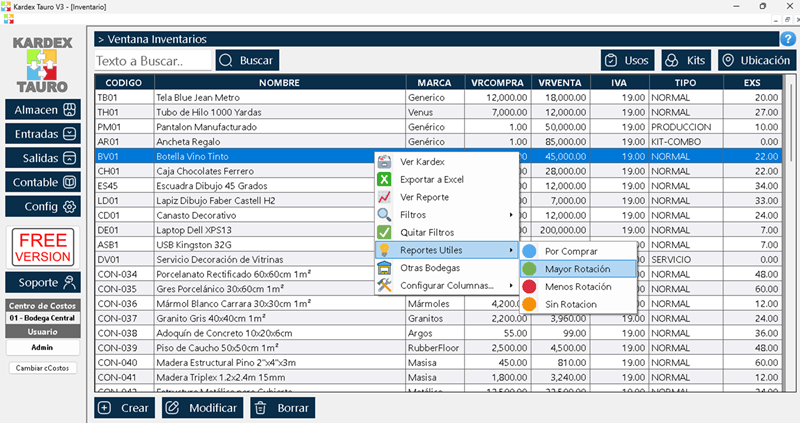
On multiuser access and permissions, both options are on par: both support several users with different access levels, and both let you define who views, who edits and who only consults. The difference is scope. Cloud shines when users anywhere need to reach the same system without installing anything. Local requires computers to be on the same network —or connected through a VPN— although some programs close that gap with an optional server mode that connects several computers or locations over the same database; Kardex Tauro, for example, follows that local-plus-optional-server scheme, so your data never leaves your control. With that in mind, local stops being a synonym for outdated.
Two realistic cases to ground the decision
Abstractions do not decide for you; concrete cases do. Let us look at two common profiles.
Case 1: one location and unreliable internet. Picture a neighborhood shop, a hardware store or a workshop with a single point of sale, where the internet drops several times a week and the owner serves customers, invoices and dispatches at the same time. With cloud inventory, every outage paralyzes the register: there is no way to check prices or record a sale. With local inventory software, the business stays whole: it sells, invoices and balances without depending on anyone, and its data lives on the shop's own computer. For this profile, the scale tips clearly toward local.
Case 2: several locations and a good connection. Picture a business with two or three points of sale, a central warehouse and an owner who reviews the numbers from home or from the street. Here cloud shows its best face: one system, always synchronized, reachable from anywhere. But notice the nuance: if the connection is good and the technical setup is light, a local program with server mode also connects the locations over the same database, with the advantage that the information never leaves your control. The decision stops being technical and becomes personal: would you rather pay a subscription forever, or take responsibility for your own server?
| Case | Business profile | What suits it best |
|---|---|---|
| One location, unreliable internet | Shop, hardware store or workshop with a single point of sale | Local software: keeps operating offline with your own data |
| Several locations, good connection | Business with two or three points of sale and a central warehouse | Cloud, or local with server mode if you want to keep your data |
| Physical store + online sales | Mixed business shipping from the store | Needs real-time synchronization; evaluate the integration carefully |
Six questions to decide in your specific situation
- How many hours a month does your internet go down, and at what times of day?
- How much would you pay in total over 3 and 5 years with each option, using your real number of users?
- If the provider shuts down or raises prices, can you take your data with you, and in what format?
- Who will run the backups, and who will prove every month that they can be restored?
- How many people and locations need to work on the same inventory, and from where?
- Would you rather pay a monthly fee forever, or pay for a period and own the tool?
Conclusion: there is no universal winner
The honest answer is that each model solves one problem and creates another. If your internet is stable, your cash flow tolerates a monthly expense and you value checking inventory from anywhere, cloud is a perfectly reasonable choice. If your connection fails, you want to pay less over 5 years and you prefer to feel that your data is yours, local inventory software will give you more peace of mind. And if what you want is precisely the middle ground —working without depending on the internet, keeping your information and still connecting several computers— there are options like Kardex Tauro, a program that runs in local mode with your own database and offers an optional server mode for when the business grows and more computers or locations appear.
Do not buy the prettiest ad: buy the system that still works on the day the internet goes down, the one that does not keep you up at night over your data, and the one that fits your cash flow. Compare with the table in this article, answer the six questions and choose calmly. Either route is better than keeping your inventory in a spreadsheet.