Selling via WhatsApp and Instagram: how to keep stock under control

Selling via WhatsApp and Instagram: how to keep stock under control
The order arrives on WhatsApp mid-morning. The customer sends a photo of the product, asks if it is available, negotiates the price a little and closes with "hold it for me, I will pay later". You say yes, type "held" next to the message and keep answering the chat. Hours later a courier picks up the bag and everyone is happy. The only thing nobody did was record the sale anywhere.
If that scene repeats ten or twenty times a day across WhatsApp, Instagram and Facebook, the end of the month is always the same: the inventory does not match, you do not know how much you sold or how much you earned, and products the catalog says you have are no longer on the shelf. Selling through social media is a great opportunity because of the reach it gives, but chat is a poor record-keeping system. This article organizes the topic into practical rules so that selling through WhatsApp and Instagram does not turn inventory control into chaos.
The real problem: the sale gets trapped in the conversation
No business selling through social media starts out intending to lose control. The mismatch builds up slowly, one unrecorded sale at a time. What is said in a chat does not discount stock: the product physically leaves, the money lands in the account, but no record reflects the movement. Over time, reality and the "truth" of the business drift apart: the owner believes there are twelve units of an item and the shelf holds only seven.
The way out is not quitting social selling or trusting your memory "because there are only a few orders". The way out is treating every order like a document, with the same care a physical store gives an invoice. And it does not have to be complicated: the rules below work with a notebook and a pencil, and they get much easier when stock ledger and inventory software does the work for you.
Rule 1: write down every accepted order before setting the merchandise aside
The first rule is the most important and the most ignored one. The order must be written down at the exact moment you accept it, when you answer "yes, I will sell it to you", not when you deliver it. A notebook is enough: date, customer, product, quantity, agreed price and payment method. That note is the origin of the whole process: without it, the order only exists in the conversation and disappears as soon as new messages arrive.
- Date and time: lets you reconcile against the day's movements later.
- Customer and contact: to locate the order if the courier or the payment is delayed.
- Product and quantity: what leaves the shelf, with no ambiguity.
- Agreed price: the chat price, which is not always the catalog price.
- Status: held, paid, delivered or returned.
Writing it down later, "when there is time", is the same as not writing it down. Fresh information takes thirty seconds to record; remembered information gets mixed up, skips orders and blends with the records of other days.
Rule 2: mark merchandise that is set aside as held
Setting a product aside in a corner with no mark at all is the perfect setup for a double sale: another customer arrives, the product looks available, it gets sold again, and the first buyer is left waiting for an order that no longer exists. The right habit is to mark the merchandise the moment you set it aside: a note with the customer's name and the date attached to the product, or moving the item from the "available" column to the "held" column in the notebook. The shelf should tell the truth at a glance.
A hold is not a favor to the customer: it is an inventory decision. While a product is held, it is not available to anyone else, and the business needs to know that at all times.
Rule 3: when you deliver, turn the order into a registered sale
Delivery is the most delicate moment in the process because it is when money and merchandise change hands. If nothing is recorded there, the sale is lost forever: the customer paid, the product left, and the business has neither the incoming money nor the stock movement anywhere.
The rule is simple: every delivered order must become a registered sale that discounts stock, the way a system with integrated invoicing does. In practice, delivery is a single movement: the order moves from "held" to "delivered", the payment method is noted and, when required, the invoice is issued. If payment is cash on delivery, the sale and the payment are recorded together, at the same moment.
Rule 4: record courier returns when the goods come back in
The courier comes back with the bag: the customer did not answer, the address was wrong, or they simply changed their mind. If that merchandise reappears on the shelf without being recorded, the notebook keeps saying it was sold and the mismatch doubles: the money from a sale that never happened is missing, and there is an extra product that the records show as sold.
That is why the return is recorded the moment the goods come back in: the sale is cancelled, the product returns to "available" and the reason is noted. Ten seconds of recording prevent a confusion that takes much longer to sort out later.
Rule 5: the daily reconciliation is the business thermometer
Reconciling is not a big-retail ritual. Ten minutes at the end of the day answer the three questions that matter: how much did I sell today, how much money did I receive, and how much merchandise left? If the three figures match, the day is healthy. If they do not, the error is hunted down with the day's records at hand, not with the memory of three weeks ago.
| Check | What is compared | What it reveals |
|---|---|---|
| Money | Day's sales vs. cash and transfers received | Payments still pending, wrong prices applied |
| Stock | Delivered orders vs. units that left the shelves | Deliveries never registered, double sales |
| Holds | Pending orders vs. merchandise set aside | Held items sold by mistake |
Daily reconciliation is what turns record-keeping into control. A day with a difference is fixed in minutes; a month of accumulated differences is rebuilt with luck and headaches.
Rule 6: your photo catalog must reflect availability
For the customer, the Instagram or Facebook catalog is the store: what they see is what they believe they can buy. Promising a sold-out product does not only create a return: it wastes conversation time and wears down trust. The practical rule: a sold-out product is marked as sold out or removed from the showcase the same day it runs out, and it comes back once restocking is confirmed.
That requires someone to own the catalog and review it daily. It is not a design or marketing task: it is an inventory task, because the catalog is, in practice, the first filter of your stock.
How to organize a digital catalog so every product is identifiable
For a chat order to become an inventory movement, the product in the photo must be identifiable in your system. The simplest way: give every product a short code and put it in the photo or in the post description. When an order arrives with a screenshot, the code lets you find the item in your records in seconds, without guessing by color or model.
For products with variations, size or color, the code, or at least the description, should include that information so that two similar posts do not lead to confusion. An afternoon spent organizing the catalog is worth it: it is the same information that later feeds the photos, the orders and the inventory.
Holding an item in chat is not the same as recording it in a system
"Hold it for me" said over WhatsApp is a commitment between two people; it is necessary, but it is not a record. The record is the note that stays in the notebook or in the system and lets you know, at any moment, how many orders are pending, what merchandise is set aside and what was delivered. Confusing the promise with the record is exactly the point where the inventory starts to fall apart.
You can hold an item in chat and record it in the notebook; they are not mutually exclusive. What cannot happen is the chat "hold" being the only trace of the order.
A daily routine that keeps control in place
For all of this to work without depending on willpower, assign each task to a moment of the day:
| Time | Task | What it achieves |
|---|---|---|
| Morning | Post or update catalog availability | No one offers sold-out products |
| During the day | Log every accepted order and set merchandise aside with a mark | No order lives only in the chat |
| Deliveries | Turn the order into a registered sale and log returns | Stock is discounted at the moment of delivery |
| Evening | Reconcile the day's sales, money and stock movements | Discrepancies are caught the same day |
The routine does not have to be perfect from day one. Start with rule 1, writing orders down, and add the rest one at a time. What matters is that recording always happens before delivery, and that reconciliation always happens on the same day.
Stock does not organize itself: start this week
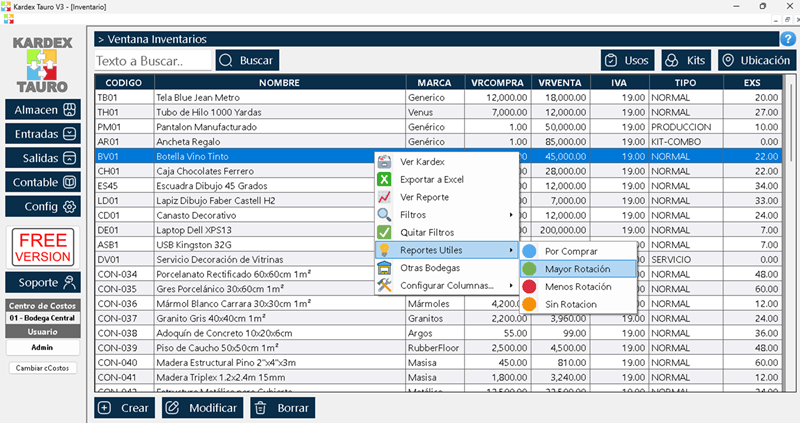
Stock ledger and inventory software like Kardex Tauro automates a good part of these rules: products are identified with codes, orders that become sales discount stock instantly, and the stock ledger keeps the history of every movement. But no tool works if the discipline of recording does not exist, and discipline pays off much more when recording is fast.
The best time to organize your inventory is not when it already fails to match: it is today, before the next WhatsApp order becomes another unrecorded sale.