Overselling online: why it happens and how to avoid it in your store

Overselling online: why it happens and how to avoid it in your store
Picture this: on an ordinary Monday you open your store with 5 units of a product that sells well. By closing time you check the numbers and find out that you sold 7: three at the counter, two online, one through WhatsApp, and another one that came out of a poorly handled return. The problem is not selling a lot. The problem is that you only had 5, and now two customers are left without their order. This situation has a name: overselling. In this article I will explain why it happens, what it really costs and how to avoid it with simple changes to your inventory routine.
Overselling is not a minor bookkeeping error or something that only happens in large warehouses. It is an everyday risk for any business that sells through more than one channel without keeping stock up to date. And although it looks like a numbers problem, it is really a trust problem: every order you cancel for lack of stock tells a customer that your store cannot be relied on.
What overselling is (and why you almost never see it coming)
Overselling happens when you sell or accept more units than you actually have available. If you have 5 units and commit 7 across the store, the website and WhatsApp, you have oversold 2 units: two customers paid and will not receive their product, or will receive it late and after a complaint.
The most dangerous thing about overselling is that it almost never announces itself. No alarm goes off when the system accepts an order you cannot fulfill. The system simply believes you have stock, because the information feeding it is incomplete. Overselling is discovered by surprise, almost always at the worst moment: when the customer asks where their order is, or when the marketplace charges you a penalty for failing to deliver.
To understand it well, it helps to separate two concepts that get mixed up in practice: physical stock (what is really on your shelf or in your back room) and logical stock (what your system believes is there). Overselling happens when the second is larger than the first for long enough for someone to buy more than you can deliver.
The most common causes of overselling
Almost every case of overselling is explained by a combination of the same causes. Identifying them in your operation is the first step toward eliminating them:
- Outdated stock: nobody recorded the sale made in the physical store, so the system keeps offering units that no longer exist.
- Channels that do not talk to each other: the store, the website and WhatsApp keep separate counts, and none of them knows what the other one sold.
- Returns that never go back into stock: the customer returns the product, the assistant leaves it on the shelf, but nobody registers it back into inventory.
- Forgotten layaways and holds: you set units aside for a customer, the promise is forgotten, and those units end up being sold twice.
- Unregistered WhatsApp sales: the order is confirmed by chat, delivered, and never touches the stock records.
- Counting errors: the opening inventory was already wrong, and everything built on top of it starts out off.
- Dead time between the web sale and the manual deduction: the order arrives today, but the stock is deducted tomorrow, and another sale slips into that gap.
What an oversold order really costs you
When you run out of stock, the first instinct is to fix the order no matter what. That urgency has a price, and it is usually higher than it looks:
- Cancellations and refunds: you lose the sale, the online payment fee and the time you already spent on the order.
- Angry customers who do not come back: a customer whose order you cancel does not just stop buying that product; they start doubting your whole store.
- Damaged reputation on marketplaces: platforms penalize fulfillment failures with alerts, temporary suspensions and worse positions in search results.
- Urgent shipping that eats the margin: to save the order you send the product by express courier and pay a freight cost that is higher than the profit on the item.
- Hours of customer service: every oversold order generates messages, calls and complaints that nobody had budgeted for.
Add all of that up and you will see that one oversold order costs far more than the margin of a single unit. That is why it is worth preventing it with the same discipline you use to protect your cash.
A concrete case: you had 5 units and ended up owing 2
Let us walk through a numerical example step by step. A product has 5 units at the start of the day. Several things happen during the day, and not all of them get recorded:
| Step | What happens | Recorded? | Stock in the system | Real physical stock |
|---|---|---|---|---|
| 1 | Opening: 5 units available | — | 5 | 5 |
| 2 | 3 units are sold in the physical store | No | 5 | 2 |
| 3 | 2 units are sold on the website | Yes | 3 | 0 |
| 4 | A web customer returns 1 unit; it stays on the shelf | Not registered | 3 | 1 |
| 5 | 1 unit is sold through WhatsApp (the returned one) | No | 3 | 0 |
| 6 | The website still shows 3 units and accepts 2 more orders | Yes | 3 | 0 |
At the end of the day the system says there are 3 units available, but the truth is that the shelf is empty. The website sold 2 units that do not exist: overselling by 2. Nobody did anything wrong on purpose; the records simply did not tell the whole story.
What does the fix look like when you apply each record on time? Like this:
| Step | Missing record | How to fix it | Corrected stock |
|---|---|---|---|
| 2 | Sale of 3 units in the store | Deduct at the moment of the sale | 5 to 2 |
| 3 | Web sale of 2 units | Automatic deduction from the order | 2 to 0 |
| 4 | Return of 1 unit | Register the product back into inventory | 0 to 1 |
| 5 | WhatsApp sale of 1 unit | Record it as a channel sale | 1 to 0 |
| 6 | The website no longer shows stock | The new order is rejected on time | 0 to 0 |
The difference between the two scenarios is not the number of sales: it is information. When every movement is recorded at the moment it happens, the system and reality never drift apart, and the website stops selling exactly when the stock reaches zero.
How to avoid overselling in your store
The good news is that overselling can be prevented without expensive technology. It is a matter of order and clear rules:
- Use a single source of truth for stock: one central record where the store, the website and WhatsApp consult the same number, instead of three different lists.
- Record every movement on the spot: sales, returns, adjustments, shrinkage and layaways are noted when they happen, not at the end of the day or whenever someone finally has time.
- Separate stock by channel if there is no synchronization: if your website does not connect with the store, give each channel its own batch and do not let them mix.
- Keep a safety margin on slow channels: if the website deducts stock hours late, publish fewer units than you actually have.
- Check published availability against reality every day: a five-minute reconciliation in the morning catches the gap before it turns into cancellations.
- Set a policy for layaways and chat sales: everything you promise comes out of stock, no matter where it is recorded.
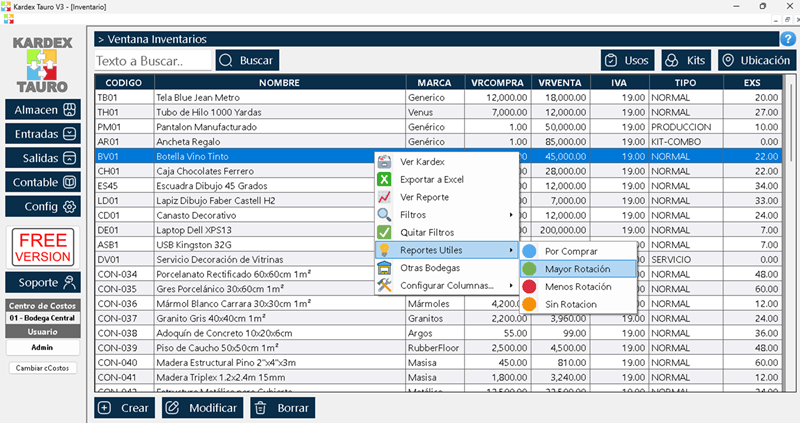
If your operation is already large or sells through several channels at once, it is worth relying on an inventory and stock control system that centralizes those figures. Tools such as Kardex Tauro exist precisely so that the stock you see is the stock you have, without depending on anyone's memory.
What to do when overselling has already happened
Even with discipline, a sale can slip through one day. When you detect overselling, act fast and follow a clear policy, in this order:
- Confirm the scope: how many orders are affected and which product or products are missing.
- Choose the best way out for each order: cancel with a sincere apology and an immediate refund, look for the product at another location or with a nearby supplier, or offer an equivalent replacement with an incentive.
- Communicate before the customer asks: a proactive message with a concrete solution weighs far more than a late apology.
- Record the lesson: review why the movement slipped through and adjust the routine so it does not happen again.
Canceling with an honest apology is usually better business than an express shipment that leaves your margin at zero, especially when the customer values transparency and keeps buying from you afterwards.
Real-time stock is not a luxury: it is the foundation of online sales
Every time your store sells through more than one channel, stock becomes the heart of the operation. An inventory system such as Kardex Tauro helps that heart beat in real time: a single figure, updated with every movement and consulted by every channel before promising a sale.
The next time you see 5 units on the screen, ask yourself: does that number know what the store sold an hour ago? Does it know what a customer returned this morning? If the answer is no, today is a good day to start recording every movement as it happens. Overselling is an information problem, and information problems are fixed with habits, not with luck.