How to negotiate payment terms with suppliers without running out of stock

How to negotiate payment terms with suppliers without running out of stock
Paying cash upfront looks like the cheapest way to buy, and many times it is the most expensive. Every dollar you pay today for merchandise that will sell in thirty days is money that stops working in your business: it does not buy more inventory, it does not cover payroll, it does not answer an emergency. The payment terms a supplier gives you, on the other hand, are real financing: they deliver the goods and wait for their money while you turn them into sales. That is why negotiating payment terms is not a luxury for large companies; it is one of the most direct levers a business has to improve its cash flow without taking out a loan.
But trade credit is not free. The credit price is usually higher than the cash price, and early payment discounts exist precisely to reward those who do not use the terms. Between the two extremes there is a concrete negotiation: how many days you wait, how much you pay for waiting and what you offer the supplier in return. This article covers what can be negotiated, how to decide between an early payment discount and credit, how to ask for longer terms without damaging the relationship, and how all of it shows up in your inventory.
Why supplier payment terms finance your inventory
When a supplier sells to you on thirty-day terms, they are effectively lending you the merchandise for a month. If the price does not change, that loan carries no interest, and no bank will offer you anything similar. The ideal cycle of a trading business is to buy, sell, collect and pay the supplier with the money from the sale. If the terms you get are longer than your days of inventory plus your days to collect, your inventory finances itself: you never use your own capital to support it.
Let us use simple numbers. If your merchandise turns in twenty days and your customers pay in ten, you need about thirty days of coverage between paying for the purchase and receiving the money from the sale. With eight-day terms, you put your own money in for most of the cycle. With thirty-day terms, you barely break even. With forty-five-day terms, the supplier finances the whole cycle and you have room to absorb delays. That is why every step up in terms is worth more than it seems: it does not save an expense, it frees working capital that compounds with every purchase.
That explains why payment terms are so valuable and also why suppliers charge for them: when credit raises the price, that loan has a cost, and that is where the real negotiation starts. Your job is not to get the longest terms possible, but the terms whose cost is lower than what that money produces inside your business.
What you can negotiate with a supplier
Most people believe that negotiating payment conditions means asking for more days and that is it. In reality there are several levers, and the best negotiation combines them according to your cash flow and the risk the supplier is willing to take.
- The number of days. Moving from cash to eight, fifteen, thirty or sixty days. Each step compounds with your sales cycles and should be requested in stages, not all at once.
- Early payment discount vs list price on credit. The supplier has a list price for credit sales and a lower price if you pay immediately. The decision between the two is not about trust; it is about numbers.
- Minimum volume for a better price. Committing to a monthly or quarterly quantity can lower the unit price or improve the terms without touching the price. Volume reduces the supplier's risk, and they reward it.
- Partial deliveries paid on receipt. Instead of one large order on credit, several smaller shipments that you pay when they arrive. They ease your cash, lower the supplier's risk and make them more flexible with you.
These levers combine. A supplier who will not give you sixty days may give you thirty with a volume commitment, or an early payment discount that suits you better than the extra days. The mistake is to focus only on the number of days and lose sight of the total cost of the purchase and the effect on your cash.
The classic dilemma: five percent off for cash or thirty days with no discount
The most common scenario in supplier negotiations is this: supplier A sells the merchandise at $1,000 per unit if you pay cash, with a 5% early payment discount, and also at the $1,000 list price if you accept thirty days of credit. In simple terms: you pay $950 today or $1,000 within a month. Which is better? There is no universal answer, because the answer depends on how much your own money earns.
Let us look at the decision in cash terms. If you take the credit, you do not pay $950 today; you pay $1,000 thirty days from now. Paying cash is equivalent to earning $50 on every $950 advanced for a month, about 5.26% monthly. If your business makes more than 5.26% a month on every dollar of cash, through merchandise that turns and leaves a margin, paying cash is expensive: that money earns more buying inventory than it does saving the discount. If, instead, your money sits idle in a low-yield account, or the supplier charges a higher markup than the discount for using the terms, paying cash may be the right call.
| Option | When you pay | Cost of the purchase | Effect on your cash |
|---|---|---|---|
| Cash with a 5% early payment discount | Today, on delivery | $950 for every $1,000 purchased | Immediate cash outflow; you recover the money only when you sell and collect |
| 30-day credit, no discount | 30 days after delivery | $1,000 for every $1,000 purchased | You keep the money for a month; if the goods are already sold, you pay with the sale |
| 60-day credit, no discount | 60 days after delivery | $1,000 for every $1,000 purchased | Your cash supports almost two sales cycles before paying; key when your customers also buy on credit |
The table shows that the difference between the options is not only the price: it is where the money comes from. With thirty days of credit and a twenty-day turnover, you pay the invoice with what you already collected from your customers. With cash, every purchase competes with payroll, rent and the next purchase, and a slow sales streak becomes a cash problem, not a price problem.
A practical rule so you do not get it wrong: convert any discount into its monthly equivalent and compare it with what your money earns inside the business. If the discount for paying cash is smaller than what that money earns in a month, take the credit and put the cash where it produces more. If the discount beats what the money earns in your business, pay cash and keep the savings. And never decide by looking only at the list price: a discount that leaves you without liquidity costs more than the credit terms that avoid it.
How to ask for better terms without losing the supplier
The supplier is not your enemy: they are your supply partner, and they also need predictability. Asking for terms is not asking for a favor; it is making a commercial proposal that benefits both sides if it is presented well. The difference between a request that is accepted and one that is rejected is almost never the size of your business; it is how you ask.
- Use your payment history as your argument. If you have paid on time for a year, that fact is worth more than any promise. Present it with numbers: invoices paid on time, accumulated amounts, years of relationship. The supplier does not give you credit because they like you, but because they have evidence that you will pay.
- Start with short terms and grow. Ask first for eight or fifteen days on a small order, comply religiously, and ask for thirty days afterwards. Credit is earned in stages; asking for sixty days in the first conversation raises suspicion, not trust.
- Commit to volume or frequency. Offering fixed monthly orders, or consolidating your purchases with one supplier, reduces their risk and gives them a reason to offer a better condition without feeling pressured.
- Offer something concrete in return. Paying by bank transfer on the due date itself, scheduling orders in advance, picking up the merchandise at their warehouse or receiving e-invoices are small gestures that save them work and open the door to better terms.
- Put the agreement in writing. A simple email or letter confirming the terms, the price and the discount prevents misunderstandings when the salesperson, the owner or the company policies change.
What not to do when negotiating payment terms
As important as knowing how to ask is knowing what ruins a negotiation. These four mistakes are the fastest way to destroy a good track record with suppliers.
- Do not stop paying in order to negotiate. Delaying an invoice does not give you power; it takes away your track record. The supplier remembers it and charges for it later: in the next price, in shorter terms, or simply by not shipping to you in peak season.
- Do not switch suppliers for an extra day of credit. Better terms do not compensate for a higher price, inferior quality or unreliable deliveries. Compare the whole offer: price, terms, quality, delivery times and return policy.
- Do not ask for terms you cannot honor. Asking for sixty days and paying at seventy-five destroys the agreement and closes the door to better conditions in the future. Ask for what you can honor even in a bad month.
- Do not separate the terms from the price when deciding. Sometimes it makes sense to pay more on credit and sometimes to pay less in cash. The answer lies in your cash flow, not in habit or in what your neighbor does.
What better terms do for your inventory
With better terms, cash stops being the brake on your assortment. You can receive merchandise that turns even when this month's sales have not been collected yet, keep the lines your customers expect complete, and take advantage of a buying opportunity without breaking your fixed payments. In practice, the right terms turn inventory into an asset that pays for itself, instead of a hole that competes with payroll.
But credit does not justify overbuying. Supplier credit is not free money: it is a debt that also has to be paid, and merchandise that does not sell is paid for anyway, with the markup hidden in the list price. The purchasing rule does not change: you buy what you are going to sell, and the terms only give you the air to do it without strangling your cash.
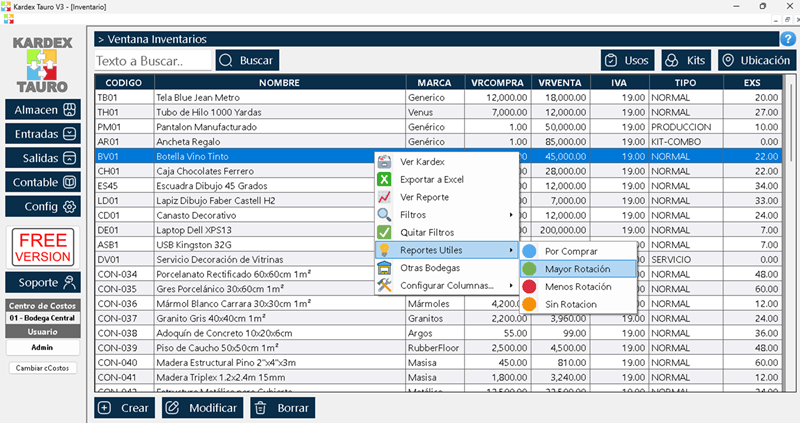
For the terms to work in your favor, you need to know, before every order, how much you owe, to whom, and what falls due each week. When you keep that control precisely, the negotiation changes tone: you ask with numbers, not with need, and you can show the supplier your history because you have it recorded. Keeping an organized record of your purchases and payments is the foundation of that conversation, and tools such as Kardex Tauro let you record each supplier's conditions, see your accounts payable due dates and review your stock levels in one place.
Payment terms are part of your purchasing strategy
Negotiating payment terms is one of the purchasing decisions with the best return you can make this month. Supplier terms finance your inventory and free up your cash; the early payment discount is decided with a simple calculation against what your money earns; credit is requested with a track record, in stages and in writing; and it is used to keep assortment that turns, not to pile up merchandise that sleeps.
Start with the supplier you buy the most from and with whom you have the best payment record: schedule the conversation, bring your numbers and propose a short first step. When terms become part of your purchasing routine, inventory stops being an expense you have to cover and becomes a tool that works for your cash flow. Record every agreement, honor it, and follow up on your due dates with the same discipline with which you follow up on your stock: that combination, with good inventory control like the one offered by Kardex Tauro, is what separates a business that always has merchandise from one that is always short on cash.
