Supplier returns: how to record the outbound movement and the credit note

Supplier returns: how to record the outbound movement and the credit note
You received the order, gave it a quick look and put it away in the storeroom. Two days later, while getting a shipment ready, you find five damaged units and three more you never ordered. You call the supplier and he says there is no problem: send them back and he will replace them or credit them. You set them aside in a corner, the carrier picks them up, and that is where the matter ends. The supplier did record his credit note. Your inventory and your accounts payable did not.
That scene repeats itself every week in dozens of businesses, and it is one of the most common reasons the stock ledger does not balance and you end up overpaying. A supplier return is a double movement: it takes merchandise out of your inventory and, at the same time, it changes what you owe your supplier. If you record only half of it, or none of it, the information falls out of balance on both fronts. This article walks you, step by step, through how to record the inventory outbound movement for the return and how to apply the credit note, so that the storeroom, the stock ledger and the supplier account all tell the same story again.
What a supplier return is and why it affects inventory
A supplier return is the shipment back of purchased merchandise that cannot stay in your business because it arrived damaged, because it does not match what you ordered, or simply because it is surplus. From an operational point of view it is not a plain "send the boxes back": it is an inventory outbound movement with the same control requirements as a sale or a dispatch. Every outbound movement needs a document, a date, an exact quantity and a reason, and a return is no exception.
The second half of the movement is almost always financial. When the supplier accepts the return, he responds in one of three ways: he sends replacement merchandise, he credits the value against the invoice, or he refunds the money. All three options change something in your records: the replacement comes in as inventory, the credit note reduces what you owe, and a refund is a cash receipt. If the outbound movement of the merchandise is recorded but the supplier's response is not, or the other way around, the balance breaks just the same.
The golden rule is simple: nothing leaves the storeroom without a document, and nothing the supplier credits goes unrecorded. Applying that rule to every return, no matter how small, keeps small errors from piling up into inventory differences you can no longer explain.
The most common reasons for returning merchandise
Before recording anything you need to know why the merchandise is being returned, because the reason defines the treatment. The most frequent cases are:
- Merchandise damaged in transit or at delivery: dented boxes, broken packaging, products that arrived in poor condition. This is the typical case that requires evidence: photos of the damage and a check against the invoice.
- Supplier error in quantity: he sent more units than ordered, or an extra line that was not on the purchase order.
- Wrong reference or specification: the model, color, size or version is not the one purchased. This happens often with spare parts, fabrics and products that differ by very similar codes.
- Quality or manufacturing defects: the product does not work, is incomplete, or does not meet the conditions agreed when the purchase was negotiated.
- Ordered by mistake or duplicate purchase: merchandise was requested that was not really needed, due to an internal mix-up or because the same thing was ordered twice.
Each reason should be written down in the return record. It may look like a detail, but it is what later lets you answer questions such as which supplier fails most often or which product gets damaged most in transit. Without the recorded reason, that information is lost.
The classic mistake: returning "by word of mouth"
The most expensive mistake in this process is not returning late; it is returning without recording anything. The merchandise leaves the storeroom, the supplier receives it, issues his credit note and considers the matter closed. In your business, none of that was written down, and the consequences show up weeks later, when they are already hard to explain:
- The stock ledger still shows 25 units when the storeroom only has 20 in good condition. Every physical count from then on will show a difference you cannot justify.
- The accounts payable balance stays at its full amount even though the supplier already issued the credit note. When the payment date arrives you overpay, or you end up claiming a balance that nobody fully understands afterwards.
- The damaged merchandise still appears as available. Someone may dispatch it to a customer by mistake, and the supplier return suddenly becomes a customer return too, with its replacement and its claim on top.
- Cost of sales and profit end up miscalculated, because the inventory you use to value your business includes units that are no longer usable or no longer there.
- If you want to claim weeks later, you have nothing to support it: without an outbound document or delivery evidence, the supplier can deny ever receiving the merchandise, and technically he would be right.
None of these problems is solved with a good memory. They are solved with records: the outbound movement is entered on the day the merchandise leaves, and the credit note is applied on the day the supplier issues it.
Step by step: how to record a supplier return
The correct process has five moments. If you follow them in order, the return gets recorded with no loose ends:
- Set aside and inspect the merchandise to be returned. Remove it from the sales or dispatch area and put it in a separate place, clearly identified: how many units, of which product, and for what reason. If it is damage or a defect, keep the record with photographs and, if the volume justifies it, with a written report. Compare quantities against the purchase invoice or delivery note so you neither return too much nor too little.
- Notify the supplier and agree on the response. Before moving a single box, confirm with him whether the return will be settled with a replacement, a credit note or a refund. Ask for the agreement in writing, even a simple email: that is what later supports your record and prevents misunderstandings about who covers the freight or how soon the replacement will arrive.
- Record the inventory outbound movement for the return. When the merchandise actually leaves, whether the supplier picks it up or you ship it, record an inventory outbound movement of the type "supplier return", supported by its document: the return slip issued by your company or the credit note issued by the supplier. This outbound movement is what takes the units out of the stock ledger.
- If the replacement arrives, record it as an inbound movement, not as a new purchase. When the supplier sends the replacement, that merchandise enters inventory as a replacement for the return, without creating new debt. If you record it as a purchase, you will owe twice for the same product and the inventory will be inflated.
- Adjust the accounts payable balance with the credit note. If the invoice is not paid yet, the credit note reduces what you owe and is reflected in the supplier balance. If the invoice was already paid, the credit note becomes a credit balance or a refund that you must collect or apply to the next purchase.
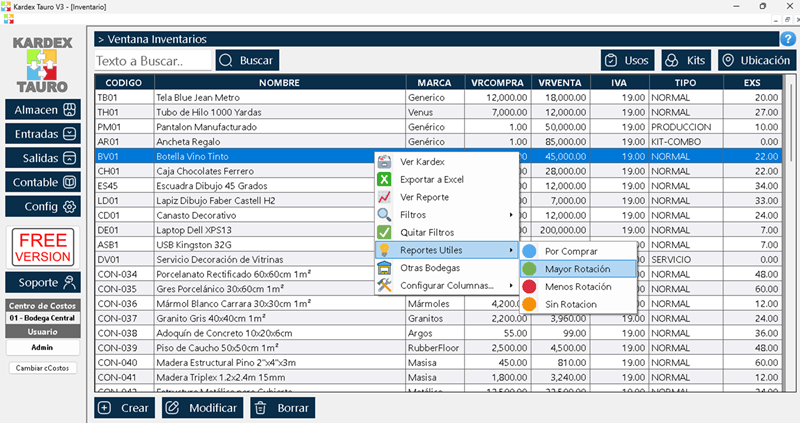
The key to the whole process is recording the inventory outbound movement and the effect on the supplier account together, each with its document. An inventory system such as Kardex Tauro lets you record the return as an outbound movement and, if the replacement arrives, as an inbound movement, so the stock ledger and the supplier balance update at the same time, without relying on anyone's memory.
Example with numbers: returning 5 damaged units
Let's put the process in context. You bought 30 LED lamps at $20,000 each; the supplier invoiced $600,000 and the invoice is not paid yet. You have already sold 5 lamps and you have 25 units left in the storeroom. While checking an order you notice that 5 of those units arrived damaged in transit. The supplier accepts the return and issues a credit note for $100,000, agreeing that the merchandise will be returned and that the amount will be deducted from the pending invoice. This is what the complete record looks like:
| Stage of the record | Reason for the return | Outbound document | Effect on stock | Effect on the supplier account |
|---|---|---|---|---|
| Stock before the return | No issues: 25 units available | Purchase invoice No. 118 for 30 units | 25 units in the stock ledger | Outstanding balance: $600,000 |
| Set-aside and inspection | 5 units damaged in transit | Photographic evidence and internal report; no outbound document yet | No movement: the stock ledger still shows 25 | Unchanged: still $600,000 |
| Outbound movement for the return | Supplier return for damaged merchandise | Return slip No. 7 issued by your company | Inventory outbound of 5 units: stock drops from 25 to 20 | The returned value is pending application |
| Credit note applied | Credit agreed for the 5 damaged units | Supplier credit note No. 204 for $100,000 | No further movement: 20 units | The balance is reduced to $500,000 |
| Stock after the return | Process closed | Documents filed: return slip No. 7 and credit note No. 204 | 20 units available, correct | Balance payable: $500,000, correct |
Read the table row by row and you will see the principle we talked about: stock goes from 25 to 20 units only when the outbound movement is recorded, and the debt goes from $600,000 to $500,000 only when the credit note is applied. Before the complete record, your information said you had 25 units and owed $600,000; after the record, it says 20 units and $500,000, which is exactly what is in the storeroom and what is really owed.
Which documents support the return
Depending on the case, two or three documents take part in a return. It helps to be clear about what each one is for:
| Document | Who issues it | What it is for |
|---|---|---|
| Return slip | Your company, when handing over the merchandise | To support the inventory outbound movement: quantity, product, date and reason of the return |
| Supplier credit note | The supplier, when accepting the return | To support the credit: the amount deducted from your debt or the right to the replacement |
| Carrier waybill or delivery note | The transport company | To evidence that the merchandise was delivered to the supplier or put in transit |
The practical rule is this: the document that supports the inventory outbound movement is the one your company generates, the return slip; the document that supports the credit is the supplier's, the credit note. If the supplier receives the merchandise but does not issue a credit note, your return slip signed by him or by the carrier is your only proof that the return took place: keep it and file it together with the original invoice. When the credit is applied, the credit note deserves the same care as a purchase invoice, because it is the document that justifies why you paid less or why you have a credit balance.
Return with replacement vs. return with credit note
The record changes depending on what the supplier agreed to. The most common case for damaged merchandise is replacement: the supplier sends replacement units. There the full flow has two inventory movements: the outbound movement of the damaged units, which takes them out of stock, and the inbound movement of the replacement when it arrives, which restores it. Between the return and the arrival of the replacement your stock is reduced, and that is correct: during those days you really have less merchandise available. The inbound movement of the replacement should be linked to the original return, so it is clear that it is not a new purchase and that it does not create additional debt.
The second case is the credit note: the supplier does not send replacement merchandise but deducts the value from the invoice. Here inventory only sees the outbound movement for the return; the financial effect lives in the supplier account, where the credit note reduces what you owe or leaves a credit balance. If the credit note is for less than the invoice, you pay the difference; if it is for more, the supplier owes you or refunds the money.
There is also the mixed case, and it is more common than it looks: the supplier replaces part of the merchandise and credits the rest. For example, he replaces 3 of the 5 damaged units and issues a credit note for the other 2. The record combines both treatments: outbound of the 5 units, inbound of the 3 replacement units, and a credit for the value of the other 2. What matters is that every piece is documented so the final balance is exact.
Special cases: partial returns and returns on an already paid invoice
Partial return. You do not always return the whole order. If out of 30 received units you return 5, the outbound movement is for 5 units and the credit is for the value of those 5. It sounds obvious, but the typical mistake is returning "in your head": the supplier account is credited an amount that does not match the units that actually left, or 5 units leave the stock ledger while the credit is negotiated for 8. Quantity returned and credited value must be consistent unit by unit, and the outbound document must reflect exactly what went out.
Return on an already paid invoice. This is the case where the financial record does change. If you already paid the invoice, there is no pending accounts payable balance to deduct the credit note from, so the credit cannot simply "reduce the debt": it becomes a credit balance with the supplier or a right to get the money back. If the supplier refunds, you record the cash receipt; if you prefer to apply it to the next purchase, the credit balance stays as a prepayment. In inventory the treatment does not change: the outbound movement for the return is recorded the same way, and so is the replacement if it arrives. The difference is in the financial effect, and it is the scenario where it matters most to know who owes whom and with which document, because there is no pending invoice left to adjust the account on its own.
In all these cases the logic is the same: the return must generate an inventory outbound movement supported by its document and, when applicable, an inbound movement when the replacement arrives. A system such as Kardex Tauro brings order to that process by recording the outbound movement for the return and the inbound movement of the replacement with their documentation, so the inventory never says one thing while reality says another.
How to keep returns from unbalancing the stock ledger
Returns will keep happening: they are a normal part of buying and selling. What you can control is that none of them leaves an incomplete trail. These practices almost eliminate return-related discrepancies:
- Inspect the merchandise when you receive it. It is much easier to claim visible damage on delivery day than three weeks later, and the supplier knows it. A quick check of packaging and quantities on receipt prevents most surprise returns.
- Always return with a document. Return slip or credit note, never "by word of mouth". If the return has no paperwork, as far as your inventory is concerned it did not happen.
- Record on the same day. Enter the outbound movement the day the merchandise leaves and the credit note the day it arrives. Late entries are the main source of differences, because between the real date and the recorded date the stock says something that is no longer true.
- Reconcile each supplier account at least once a month. Compare your invoices, credit notes, payments and returns against the supplier's statement. A difference caught on time takes minutes to resolve; one caught six months later can cost money.
- Record the reason for the return. With accumulated data you can identify, in time, suppliers that fail often or fragile products that are worth sourcing elsewhere or packaging differently.
Conclusion
Returning merchandise to a supplier should not be a headache, but it stops being one only when the process is recorded from start to finish: the inventory outbound movement with its document, the credit note applied to the supplier account and, when the replacement arrives, the inbound movement. Every well-recorded return is one less inventory difference at the next count and one supplier balance that matches without argument. The goal is not to return less, but to return well: with evidence, with documents and with the stock ledger updated the same day.