Customer return policy: how to control its impact on your inventory

Customer return policy: how to control its impact on your inventory
A customer walks up to the counter with a bag and asks to return a product bought last week. What happens in the next ten minutes decides three things: whether that customer comes back to buy, how much money leaves the cash register, and whether your store's inventory still tells the truth. Most shops handle that moment with pure improvisation: the employee accepts because the customer insists, or refuses because they do not know what else to do, and the returned product ends up in a box under the counter until someone decides its fate.
That box under the counter is the real problem. Every badly managed return is a piece of inventory that exists physically but that no record recognizes: it is not in sellable stock, it is not in shrinkage and it is not in the customer's hands. The system says one thing, the stockroom has another and the cash register does not balance either. This article explains how to build a published customer return policy and how to process every return for what it is: an inventory operation with an incoming entry, a document and a classification decision.
The improvised policy costs more than the return itself
The first mistake is not technical; it is a matter of judgment: letting every return be settled "depending on who is serving". When the policy depends on the person, the customer who returned something yesterday with one employee and today finds another one gets different treatment for the same case. That creates complaints, bad feeling inside the team and, above all, two silent losses: money leaving without control and merchandise coming back in without a record.
There is also a cash problem. If the salesperson can decide on the spot whether to refund in cash, exchange the product or issue a store credit, the end-of-day reconciliation becomes a puzzle: products leave the counter, merchandise comes back to the shelf and nobody wrote anything down. A written, short and visible policy solves this at the root. It does not need to be a ten-page legal document: it needs to state, on one sheet, what is accepted, within what period, under what conditions and how the customer is compensated.
What your return policy should say
A practical return policy is built on four questions. The first is the period: how many days do you accept returns from the date of purchase? The second is the proof requirement: the receipt or invoice of the sale. The third is the product condition: which states you accept — new, unused, with original packaging and tags, no signs of use — and which you reject outright. The fourth is the form of compensation: exchange for another product, credit note or cash refund. With those four answers in writing, anyone on the team handles a return the same way the owner would.
It is also wise to list exceptions in advance: underwear, personal hygiene products, clearance items or merchandise marked as final sale. And there is a point almost nobody defines: factory defects are treated differently from a change of heart by the customer. A defective product is not the buyer's fault, and the policy should say so, because the difference between "not accepted" and "defective" is the difference between losing a customer and keeping one.
The flow of a return through your inventory
When a return comes in, deciding whether to accept it is not enough. You also have to decide what happens to the product and leave a record the same day. This is the flow we recommend for every case, and it works the same in a neighborhood shop as in a store with several branches:
- Check the product against the policy. Is it within the period? Does it have a receipt? Does its condition match what you accept? If the answer to any point is no, the return is declined calmly and with the reason explained.
- Decide the compensation. Depending on the situation and on what your policy defines: exchange for another product, credit note or refund. This decision affects the cash register too, not only the shelf.
- Classify the returned product. It goes back into sellable stock, it goes back as damaged and moves to shrinkage or spoilage, or it is not accepted and goes home with the customer.
- Record the inventory entry the same day. Merchandise that becomes sellable again must be added back to that product's stock; damaged merchandise must be recorded as shrinkage, not stored "just in case".
- Issue the document and balance the cash register. A credit note if there was a sales invoice, or the record of the exchange, and the day's reconciliation must reflect the money that went out.
Step 4 is the one almost everyone skips, and it is the heart of this article: an accepted but unrecorded return is the same as giving stock away into thin air. The product goes back to the shelf, someone sells it later and that entry was never recorded; at the end of the month the physical count finds the difference and nobody knows where it came from.
Exchange, credit note or refund: set the rule
The three options do not cost the same or affect the cash register the same way. The exchange for another product keeps the money from the sale inside the business: one item goes out and another comes in, and any price difference is charged or refunded. The credit note also keeps the sale, but turns it into a balance in favor of the customer to be used later, and you must control those notes as if they were money, because they are. The cash refund is the most expensive option: the money leaves the register the same day and, if the product does not re-enter properly classified, the loss is double.
A practical rule widely used in retail: exchange or credit note when the customer simply changed their mind; refund only when the law or your own policy requires it — for example, a defective product with no replacement available — or when the customer asks for it and your policy allows it within the period. What matters is not which rule you choose, but that there is only one and that it is in writing.
Sample policy: four situations on the table
So the policy does not stay in theory, here is an example applicable to a store with an eight-day return period. Adjust it to your business, but keep the columns: situation, product condition, resolution and effect on stock.
| Situation | Period | Product condition | Resolution | Effect on stock |
|---|---|---|---|---|
| New product with receipt | Within 8 days | Unused, original packaging and tags | Exchange for another product or credit note | Re-enters sellable stock the same day |
| Used product | Any | Signs of use or no packaging | Not accepted | None: the product does not come in; the customer keeps it |
| Damaged by the customer | Any | Broken or damaged by mishandling | Not accepted | None: the damage is not the store's responsibility |
| Factory defect | Within the period or warranty | Fails without misuse | Immediate exchange for a new unit and return of the damaged one to the supplier | The replacement goes out; the defective unit goes to the supplier return, not to your own shrinkage |
Note the last row: a factory defect is not your business's shrinkage. If you record that product as your own loss, you are absorbing a cost the supplier should pay. The correct classification is another outflow — a return to supplier — and its record must distinguish it from real shrinkage. That detail, repeated month after month, is the difference between a business that absorbs other people's defects and one that charges them back.
Return abuse can be managed too
There is a kind of customer who does not return because the product failed, but because they learned that your store accepts everything. The classic signs: the same customer returning frequently, returns without a receipt that was "lost", products coming back with weeks of use, or a purchase followed by a partial return of almost the whole order. This is not about hounding customers; it is about having data.
The requirements policy does half the work: no receipt, no return, period. The other half is recording every return with the name of the person making it. When you can see the full history — how many returns per customer, per product and per month — the pattern shows up by itself: a customer who returns eighty percent of what they buy is not a difficult customer; they are a cost that your return policy should treat with stricter rules, such as limiting receiptless returns to one per semester or excluding them from certain benefits. A customer who only buys on sale and returns the rest is buying from your carelessness, not from your business.
Record shrinkage the same day
A product that comes back damaged does not get better with time. If it is not recorded as shrinkage or spoilage the same day it is accepted, the usual thing happens: it stays stored, it gets mixed with good merchandise, someone sells it by mistake and the customer comes back to complain — now with reason. Shrinkage is an inventory movement like any other: it has a date, a cause and a person responsible. Recording it on time does not avoid the loss, but it makes it visible, and what is visible can be controlled.
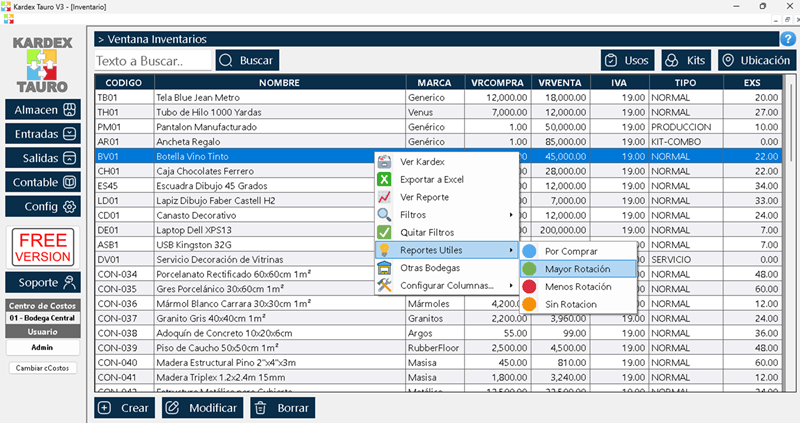
Every accepted return must re-enter the inventory with its record on the same day; it cannot stay in a box under the counter waiting for someone to "check it later". With Kardex Tauro, that inventory entry — or the shrinkage record — is done on the spot, with the product, the quantity and the cause, and the stock tells the truth again before the shift ends. That is one minute of work that saves you the end-of-month mismatch.
A credit note and a direct exchange are not the same thing
When the original sale was invoiced, the return is documented with a credit note that cancels that invoice fully or partially. That document is what makes everything balance: the invoice is offset, the cash register reflects the money that went out and the inventory records the entry. If in your business the return is settled with a direct exchange and no invoice in between — the customer brings the product, takes another one and that is it — the risk is that the swap is never documented and the physical count goes off without an explanation.
The concrete recommendation: even when the exchange is direct and of equal value, leave a written record of the entry and the exit. Those are two movements — the product that comes back and the product that goes out — and if you only watch one, the inventory lies. The record does not have to be an electronic invoice: a simple return log with date, product, quantity and reason is enough for the system and the stockroom to agree again.
Closing: a well-managed return protects your cash and your relationship
A well-managed customer return is not a loss: it is a controlled operation. The published policy removes the conflict from the counter — the employee does not negotiate, they apply a rule — and the same-day record keeps the inventory accurate. A customer who received clear, fair treatment comes back to buy; one who got a "depends on who is serving" goes off to tell their story somewhere else.
Review your counter today: do you have a written, visible return policy? Were last week's returns recorded, or are they sitting in the box under the counter? Start by publishing the policy and by recording every inventory entry and every shrinkage item the same day. With the flow in order — check, decide, classify, record and document — returns stop being a hole in your cash register and become one more part of your business's control. If your store handles dozens of daily movements, inventory and stock ledger software that records entries, exits and shrinkage without depending on anyone's memory is the difference between balancing the month in one afternoon or in a week of reconciliations.
