Warehouse locations: how to code every shelf to find anything instantly
Warehouse locations: how to code every shelf to find anything instantly
If you have ever heard the phrase 'it should be around there, in the back' inside your own warehouse, this article is for you. That phrase, repeated several times a day, is no small detail: it is the difference between shipping an order in five minutes and taking half an hour to do it. Multiplied by dozens of orders every day, searching no longer costs minutes; it costs hours of wages paid to find boxes that should be exactly where the system says they are.
The solution does not require hiring more people or building a bigger warehouse. It comes from order: giving every storage space a unique code, labeling it clearly and recording in the system which product lives at each code. In this article we show you how to design a practical warehouse location system that works equally well in a facility with 200 positions or 2,000, and how to use it to cut search time, speed up counts and ship without errors.
The real problem: 'it is around there' costs money
When a warehouse worker cannot find a product, it is not only their time that is lost: the picker is delayed, the carrier waiting for the goods is delayed and, in the worst case, the customer receives an order that is late or incomplete. In an operation with no defined locations, every order can mean walking entire aisles and checking boxes one by one. If each search takes ten minutes and there are forty searches a day, you are burning almost seven hours of labor every day just on locating merchandise.
The problem gets worse over time. Products that come in and go out keep changing places, the memory of 'where I left it last time' becomes outdated and the knowledge stays locked in the heads of one or two senior workers. The day they are absent, the whole warehouse turns into a puzzle: nobody knows what sits on each shelf and orders get delayed one after another.
A location system removes that uncertainty at the root. It turns 'somewhere around there' into an exact address that anyone can read in the system, walk to and verify in seconds, with no reliance on anybody's memory.
What a location is: the postal address of every space
A location, also called an address or a slot, is a unique code that identifies one physical storage space. It works like a postal address: if every box had its own address, nobody would need to remember where anything is; they would only need to read the label to know exactly where to go.
The most common format in organized warehouses has four levels: ZONE-AISLE-RACK-LEVEL. For example, location A-03-02-01 reads like this: zone A, aisle 03, rack 02, level 01. Each segment narrows the search area: first you reach the right zone, then the aisle, then the rack and finally the exact level where the box is. Instead of checking hundreds of positions, the worker only verifies a handful.
Simpler formats exist for small warehouses — for example B-12-4: block B, column 12, level 4 — and longer ones for operations with deep racking, where a fifth segment indicates the position inside the rack (front or back). What matters is not the format but three basic rules: the code must be unique (two spaces never share an address), hierarchical (each segment goes from general to specific) and physically labeled at the space itself, not only inside the system.
How to design the scheme for your warehouse
Before printing the first label, define the code structure with a simple floor plan of the warehouse. A typical design has five layers, from general to specific:
- Zones. Divide the warehouse by function: receiving, general storage, shipping, returns, and quarantine or damaged goods. That way, incoming merchandise never mixes with goods waiting to ship and held products are never shipped by mistake.
- Aisles. Number aisles consecutively (01, 02, 03...) starting from one fixed end. If you prefer, use odd numbers on one side and even numbers on the other: workers find their way much faster.
- Racks. Identify each rack inside the aisle with a sequential letter or number. If aisle 03 has eight racks, they run from 01 to 08 or from A to H.
- Levels. Number levels from bottom to top (01, 02, 03...). Level 01 is always the floor: counting from the ground feels natural to workers and avoids confusion when racks have different heights.
- Positions. In racking deep enough for several boxes, add a final segment (front or back, or 1 and 2) that indicates exactly which box should be picked.
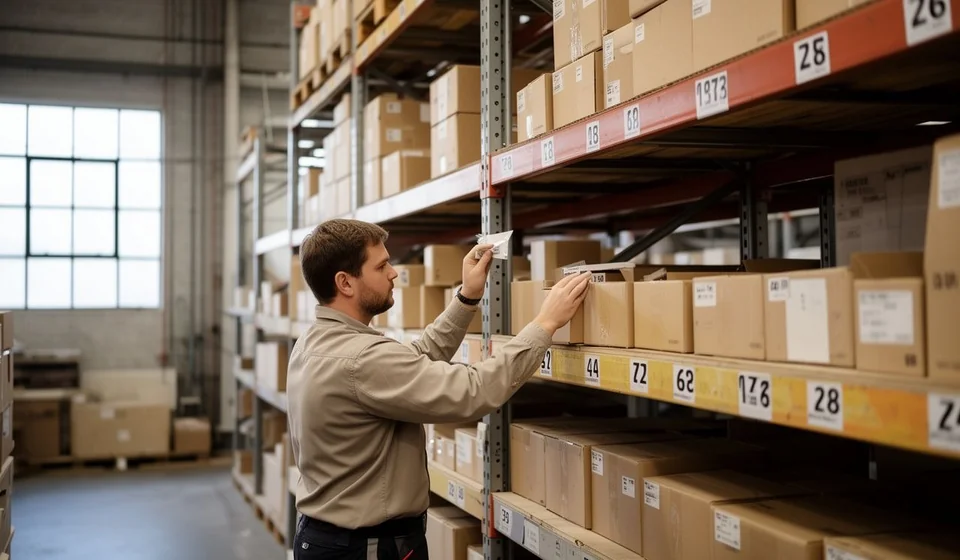
Once the structure is defined, label every space with its full code, in a visible place at eye level, with large type and good contrast. Labels wear out and get hit by forklifts: use durable material, check them on daily rounds and replace damaged ones, because an illegible label sends the warehouse back into chaos even when the system is perfect.
If your warehouse has double-faced racking, accessible from two aisles, treat each face as an independent rack and keep the numbering continuous along the route. That way, codes are understood while walking down the aisle, with no need to check a floor plan.
A practical coding example
Take a warehouse with four zones: A (general storage), R (receiving), D (shipping) and C (quarantine and returns). The full code will have four segments:
| Segment | What it indicates | Example |
|---|---|---|
| Zone | Area function | A |
| Aisle | Aisle number | 03 |
| Rack | Rack letter or number | 02 |
| Level | Height, from the floor up | 01 |
Location A-03-02-01 is therefore in the general storage zone, aisle 3, second rack, floor level. If the rack holds two boxes in depth, the full address would be A-03-02-01-F (front) or A-03-02-01-B (back). The same scheme can be printed on labels and on shipping orders, so that everyone speaks the same language.
How to assign products to locations: the art of slotting
Having codes is only half the job; the other half is deciding which product lives at each code. That assignment, known as slotting, drives much of the operation's efficiency and deserves careful planning. Some practical rules:
- Fast movers closest to shipping. High-turnover products should live in the hot zone, near the door or the shipping area, to shorten the travel distance of every order.
- Heavy items, low. Heavy boxes belong on the lower levels: less physical strain, fewer injury risks and less damage from falls.
- First to expire, first in front. For products with expiration dates, assign the front position to the merchandise closest to expiring. This supports FEFO (first expired, first out) and reduces losses from spoilage.
- Slow movers, up and away. Low-turnover products can occupy the high levels and the farthest zones, because they are visited only a few times a day.
- Items picked together, close together. Products that usually ship in the same order should sit in neighboring aisles, to shorten the picking route of every order.
A practical way to start is to classify products into three groups by shipping volume: type A (a few products that concentrate most of the outbound movement), type B (medium turnover) and type C (rarely shipped). A items get the best locations in the hot zone; B items take intermediate positions; and C items, the high levels and the less accessible corners. Review this classification periodically, because a product that is C today can become A tomorrow if demand shifts.
Here is an example with six typical products of a grocery warehouse:
| Product | Turnover | Weight | Assigned location | Reason |
|---|---|---|---|---|
| Cooking oil (case) | High | Medium | D-01-01-01 | Fast mover: hot zone next to shipping, low level. |
| Rice (25 kg bag) | High | Heavy | D-01-02-01 | Heavy and fast: near shipping, on the floor. |
| Dairy drink (near expiry) | Medium | Medium | A-02-01-02 | Front of the level to go out first (FEFO). |
| Bulk detergent | Low | Medium | A-05-03-03 | Low turnover: middle zone, high level. |
| Napkins (pack) | Medium | Light | A-04-02-03 | Light and medium turnover: high level, no strain. |
| Quarantined product | — | — | C-01-01-01 | Isolated zone to prevent a shipment by mistake. |
Notice that the assignment is not eternal: when a product changes its sales pace or a larger batch arrives, the location can and should be adjusted. What matters is that the system makes it easy to record that change quickly, so the recorded inventory never lies about where things are.
Benefits of operating with recorded locations
When locations are coded and the system knows them, several operation indicators improve at the same time:
- Less search time. The worker walks straight to the address given and visual search drops to seconds.
- Faster counts. Instead of counting the whole warehouse, you count by location: pick codes at random or by zone and verify that the contents match what is recorded.
- Error-free shipping. When the system suggests the right location for each item in the order, the risk of grabbing the wrong box of a similar product drops sharply.
- Detectable empty locations. The system shows which spaces were left empty after a shipment, so incoming goods are put away without walking the warehouse looking for gaps.
- Independence from human knowledge. A new worker can find any product from day one, without depending on whoever 'knows the warehouse by heart'.
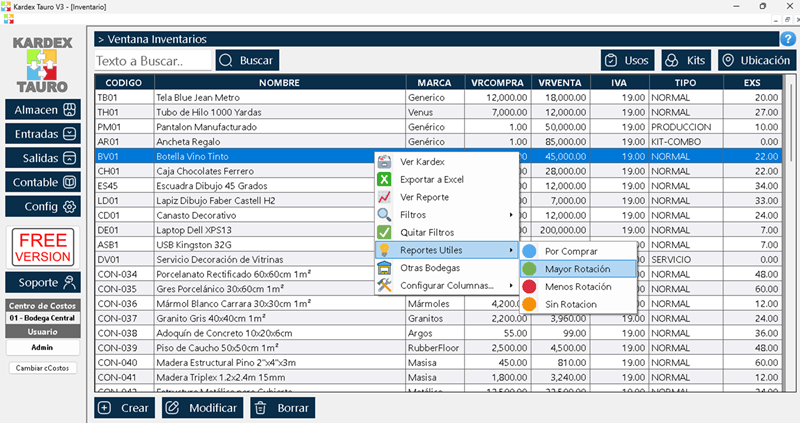
These benefits multiply when the inventory software records every movement by location. A system that handles addresses can, for example, generate a shipping order that already shows the aisle and rack of each item, and alert when a product has no assigned location. Tools such as Kardex Tauro are designed to operate with this scheme: they let you check in seconds which location holds each product and how many units remain there, and they record transfers between locations without losing track of the inventory.
The golden rule: every box has ONE address
A frequent mistake when implementing locations is thinking the system should guess where everything ended up. No: the inventory lives where the system says it lives, not where someone left it. If that premise is respected, the warehouse manages itself; if not, no label will be enough. The rule is simple:
- A product can occupy several locations (for instance, one lot in the hot zone and another in general storage), but each box or position has exactly one recorded address.
- Every movement — inbound, outbound, transfer between locations — must be recorded the moment it happens, not at the end of the shift or 'when there is time'.
- If a worker finds a box outside its location, the rule is not to leave it because it is already there: it is to relocate it and update the record, or correct the data if the system was wrong.
When this rule is respected, physical and logical inventory match and the system becomes trustworthy for planning purchases, shipments and counts. When it is not, the warehouse slowly drifts back to 'somewhere around there', and no software can stop a poorly recorded inventory from producing wrong decisions.
Conclusion: start today, even with one zone
Implementing locations does not require a remodel or stopping operations. You can start in the shipping zone: label its racks, record the addresses in your system and extend the scheme to the rest of the warehouse as inventories turn over. Every coded shelf is an order that will ship faster, a shorter count and one less argument about who moved that box.
Order in the warehouse is not a luxury: it is the foundation for reliable shipments, truthful inventories and a team that spends its time adding value instead of searching. If today you cannot say, without looking, which location holds each product, this is a good moment to start coding your warehouse.