Using vertical space: racks, shelving and warehouse heights
Using vertical space: racks, shelving and warehouse heights
When a warehouse fills up, the automatic answer is usually more square footage: renting another warehouse, moving to a bigger space or leaving boxes wherever they fit. But there is one area almost every business already pays for and never uses: the air between the floor and the ceiling. If your warehouse is 3 meters tall and you only store in the first meter, you are paying for three floors and using one. Before spending money on more meters, it pays to measure how much height you have and learn to turn it into capacity with racks and shelving. That is exactly what we are going to do in this article.
Let us be clear from the start: this is not about filling the warehouse to the ceiling just for the sake of it. Stacking without a method is dangerous, damages merchandise and produces the opposite effect: you lose product, you do not know what is on top, and every search turns into a moving job. Good vertical storage combines four steps: measuring the real usable height, choosing the right rack type for your merchandise, calculating with numbers how much fits, and applying clear safety and rotation rules. Let us go through them.
First step: measure the usable height of your warehouse
Everything starts with a laser measurer or a tape measure, not with your eyes. The number that matters is not the ceiling height but the usable height: the distance between the floor and the lowest obstacle above your head. That obstacle is almost never the ceiling. It is usually a hanging light, a beam, a duct, a pipe, some wiring or a fire extinguisher anchored to the wall. If you install a 2.8-meter shelving unit below a light that hangs at 2.5 meters, the light loses and so do you: the top boxes do not fit or keep hitting it.
To calculate usable height you have to walk the whole warehouse and write down, zone by zone, the height of the lowest protruding point. The usable height of each zone is the distance from the floor to that point, minus a safety margin of 10 to 15 centimeters: loads move, pallets get lifted, and hitting a light or a fire extinguisher costs dearly. Also measure the aisle width. A three-level rack is useless if there is no way to take out what you stored.
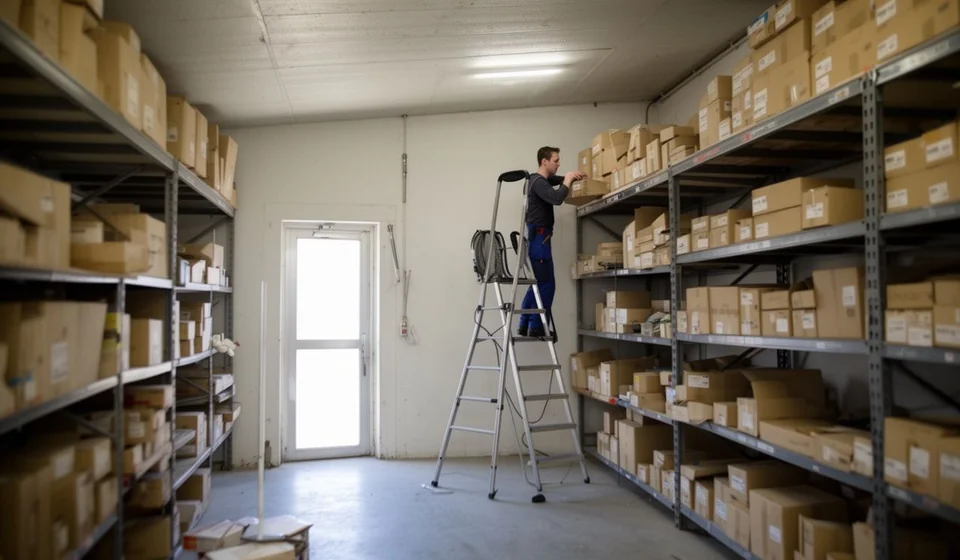
The second piece of data is human: how high can your people reach? Without a ladder, a person comfortably reaches about 1.8 meters. Above that, everything you store must be put up and brought down with a safe ladder, a fixed platform or mechanical equipment such as a pallet jack. If nobody in your warehouse can safely work above 2 meters, that extra shelf level is not capacity: it is a risk with boxes on top of it.
With that data you can answer the key question: how many levels fit in my warehouse? With 3 meters of usable height you can install two or three-level shelving operated by hand with a ladder. From 4.5 to 6 meters, pallet racks with a pallet jack or forklift are justified, or an intermediate platform that creates a second floor. Above 6 meters, the decision is industrial-scale. The height of your ceiling defines the technology that suits you, and only measuring tells you which one it is.
Types of racks and shelving: choosing by your merchandise
There is no such thing as "the rack". There are families of racks and shelving, and each one solves a different type of merchandise and a different height. The table summarizes the four most common options for small and medium warehouses; we explain each one in detail below.
| Type | Best use | Typical capacity | Relative cost |
|---|---|---|---|
| Light shelving (metal shelves) | Small boxes, spare parts, supplies and loose goods in small warehouses, shops and offices | 50 to 250 kg per level; up to 3 or 4 levels by hand | Low |
| Selective rack (2 or 3 pallet levels) | Medium warehouses with pallet jack or forklift; full pallets with medium or high turnover | 500 to 1,500 kg per pallet position | Medium |
| Cantilever rack | Long materials: pipes, profiles, lumber, sheets and rods | 300 to over 1,000 kg per arm | Medium-high |
| Platform or mezzanine | Warehouses with high ceilings: creates a second floor for boxes, shelving or dispatch | 300 to 500 kg per square meter of platform | High, but it returns the most space |
Light shelving is the doorway to vertical storage. These are metal shelves assembled by levels that support between 50 and 250 kilos per level depending on the model. They are ideal for small boxes, spare parts, supplies, stationery and loose goods in small warehouses, shops and offices. Their great advantage is that they need no equipment: one person with a ladder can operate three or four levels. Their limit is weight: they are not built for full pallets or very heavy loads.
Selective rack becomes the standard when the pallet appears. These are two or three-level structures where each pallet has its own position, hence the name: you can reach any pallet without moving the others. In medium warehouses they are operated with a pallet jack or forklift, with typical capacities of 500 to 1,500 kilos per position. It is the best balance of cost, access and order when you handle palletized goods with medium or high turnover.
Cantilever rack solves the problem of long items: pipes, profiles, lumber, sheets, rods, moldings and everything that does not fit in a box or a normal shelf. Instead of front columns it uses arms coming out of a central column, so long merchandise rests without obstacles. Each arm typically supports between 300 and more than 1,000 kilos. If you sell construction materials, hardware or metalworking products, this is probably your rack.
A platform or mezzanine is something different: it does not store upward, it turns height into a second floor. A steel structure is built at mid-height, with an anti-slip floor, guardrail and stairs, and on top you gain a complete surface for shelving, boxes or even a dispatch area. It is the biggest investment, but also the one that returns the most space when the ceiling is high and the land is expensive. In warehouses of 4.5 meters or more, a mezzanine can double the usable area without buying one more square meter of floor.
How do you choose? Simple rule: if you store boxes and packages that one person can lift, use light shelving. If you store pallets, use selective rack. If you store long items, use cantilever. If nothing fits on the floor anymore but the ceiling is empty above 4 meters, study the platform. And remember that solutions combine: many warehouses use selective racks at the back and light shelving in the dispatch area.
Calculate capacity: levels × shelves × boxes
The formula to know how much fits in an area is simple: capacity = height levels × shelves per level × boxes or packages per shelf. It sounds obvious, but almost nobody does it before buying the shelving, which is why most people underestimate how much they gain with the third level. Let us run the calculation with a complete example.
Imagine a warehouse with 3 meters of usable height and a light-shelving module 2.4 meters long by 0.6 deep, meant for boxes of 40 × 30 × 25 centimeters (length, width, height). On each shelf you fit 6 boxes along the length (240 ÷ 40) and 2 along the depth (60 ÷ 30): 12 boxes per level. With single-level shelving, that module holds 12 boxes. With three levels spaced one meter apart, it holds 36 boxes in the same floor footprint. If your warehouse has four identical modules, you go from 48 to 144 boxes without moving a wall.
And if today you stack those boxes directly on the floor, the jump is even bigger. By hand and without a ladder, stacking more than two boxes of 25 centimeters in height forces you to stretch, unbalances the pile and risks everything falling; for safety, most people stop at two. Three-level racking does more than multiply capacity: it gives you orderly access to every box without dismantling the tower to reach the one at the bottom.
Three warnings so the calculation is honest. First: the rack structure itself takes up space; deduct between 5 and 10 percent of the theoretical capacity for columns and beams. Second: not every level fills to 100 percent; leave a 10 percent buffer if your boxes are not all the same size. Third: if access is manual, the level above your head always performs worse than the one at waist height, because people avoid climbing, and that shows in practice. Calculate with those three deductions and the number you get will be real.
Safety first: anchoring, loads and aisles
Vertical storage concentrates weight and puts it above people. That is why safety rules are not optional: they are part of the design. The first one: every rack must be anchored to the floor and, when appropriate, tied to the wall, especially in seismic zones. An unanchored rack is a giant piece of furniture waiting for an excuse to tip over: a forklift bump, a badly placed load or a mild earthquake.
The second rule is maximum load. Every rack states how many kilos each level supports, and that rating must be respected and must stay visible. Overloading a level bows the beams, loosens the joints and turns the structure into an accident waiting to happen. Distribute the weight evenly: never load just one end of a shelf, and always put the heaviest items on the lower levels, never on top.
- Keep aisles clear: an aisle blocked with boxes is the number one cause of trips and of collisions with the racks. Reserve at least 1 meter for people to move, plus the width needed if a forklift passes through.
- Use ladders in good condition, fixed or certified, and never climb on the shelves to reach something: they tip over and fall. If you frequently reach a level, install a fixed ladder or a platform with a guardrail.
- Do not store heavy items above shoulder height when access is manual: what falls from a high level arrives with a lot of force.
- Inspect the structure regularly: bowed beams, loose bolts, dented legs or corrosion are signs that the rack needs repair or replacement.
- Keep fire extinguishers, exits and electrical panels clear and accessible: no shelving or boxes in front of them, because in an emergency every second counts.
What goes up top and what goes down below
Height has a hierarchy too. The golden rule combines weight and turnover: heavy items and fast movers go down below; light and slow items go up top. The reason is twofold. First, ergonomics: repeatedly lifting a heavy box from the top level tires people out, causes injuries and slows down dispatch. Second, risk: a heavy box falling from two meters can hurt someone or crush whatever is underneath.
Up top, on the high levels, goes the following:
- Low-turnover merchandise: what you sell once a month or less, last season's products, samples and surplus.
- Light items: small spare parts, accessories, empty packaging, promotional material, files and documents.
- Closed, well-labeled boxes that do not need frequent checking.
Down below, on the low levels and the floor, goes the following:
- Heavy items: packages over 10 kilos, liquids, tools and construction materials.
- Fast movers: what ships every day should sit between knee and shoulder height, with no bending or stretching.
- Items picked by the unit that need constant checking.
In practice, organize the warehouse in three bands: the picking band, between knee and shoulder, with your best sellers; the low band, for heavy and bulky goods; and the high band, for light and slow items. If you apply that logic, your people stop climbing ladders ten times a day and dispatch speeds up on its own.
When is it worth investing in racks?
The moment to invest arrives when two conditions are met at once: you ran out of floor and the ceiling is empty. Before renting another warehouse, check whether the problem is a lack of meters or a lack of levels. These signs point to the second one: boxes on the floor and blocked aisles; merchandise being returned because there is nowhere to put it; duplicate purchases because you cannot find what you already have; and hours of work lost searching and rearranging.
The economic comparison is straightforward. An additional warehouse means rent, moving costs, insurance and travel time, month after month. A rack, in contrast, is paid once and multiplies the use of the space you already pay for. If the value of the merchandise you cannot receive or ship because of lack of space exceeds the cost of the shelving, the decision is made. Most medium racks pay for themselves with what they save in a few months of normal operation.
Two warnings for investing well. First: buy extra structure. A rack that holds more than you need today is better than one at its limit that you will have to reinforce or replace when the merchandise changes. Second: think about the floor slab capacity. If your warehouse is on a second floor or is an old building, have a professional check how much weight the floor supports before filling it with racks: the rack carries the load, but the slab carries the rack.
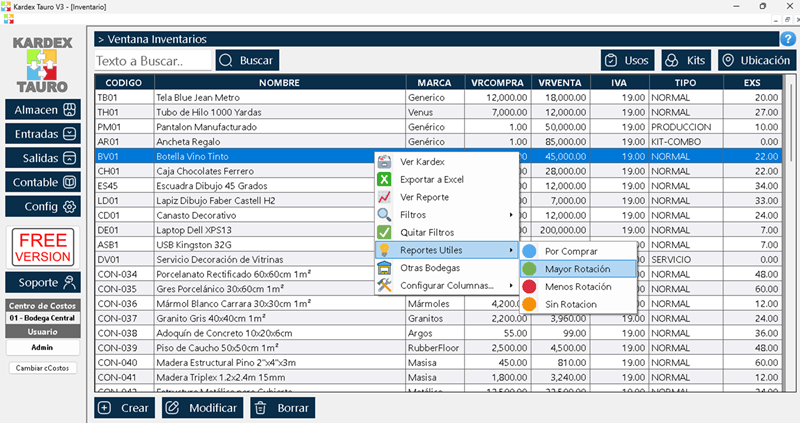
Well-used vertical space does more than store more: it organizes. When every box has a defined level, shelf and place, you know what you have, how much you have and where it is, and that shows up in counts, dispatch and purchasing. Height thus becomes part of your inventory control, and that control is completed by recording every receipt and issue in a reliable system such as Kardex Tauro, which tells you the quantities behind every location in your warehouse. Measure, choose the right rack, calculate and secure it: the next level of your warehouse is already up there, waiting for you to use it.