Product recall: how to know which customers bought a batch from you
Product recall: how to know which customers bought a batch from you
A recall notice almost never arrives with a week of advance warning. One ordinary day you receive a circular from the health authority or a call from the manufacturer: a batch of a product you sell has to be pulled from the market because a defect or a risk was found. From that moment, every hour counts. And the first question you will be asked — you, the distributor, the wholesaler or the pharmacy sitting in the middle of the chain — is very specific: which customers did you sell units of that batch to?
If you cannot answer right away, the problem stops being the manufacturer's and becomes yours. This article explains what a product recall is, why it affects you even when you only resell, and what records you need so you can act calmly and quickly when the notice arrives. You do not need a sophisticated system: you need order, and that order is built every day, long before the alarm goes off.
What a product recall is
A product recall is a formal request to remove merchandise from the market because it represents a defect or a risk. It can be issued by the manufacturer itself, when it detects a failure in its production or in its raw materials, or by the health authority, when it considers that the product may affect consumers' health. It is a routine procedure in medicines, food, beverages, supplements, cosmetics and hygiene products: all the categories where safety depends on knowing exactly what was made, when, and with what.
The first thing to understand is that a recall almost never covers the whole product. It covers a specific batch. A batch, or lot, is the set of units made in the same production run, with the same raw materials and under the same conditions. If the problem started in that run, the risk is concentrated in that batch: units made before or after are, in theory, not involved. That is why the entire recall operation revolves around a simple piece of data: the batch number.
That number organizes everything else: identifying which warehouses and which stores hold the merchandise, how many units are still in the hands of distributors, and how many reached the final consumer. And to answer those questions, the authority does not rely only on the manufacturer: it relies on the information that every link in the chain can provide.
Why it affects you even when you only resell
It is tempting to think that a recall is the manufacturer's problem. You did not make the product, you did not choose the raw materials, and you bear no responsibility for the original defect. But there is an uncomfortable detail: the merchandise from the affected batch is in your warehouse, on your shelves and, above all, in your customers' shops and pantries. Even if the fault belongs to the laboratory or the processing plant, the logistics of the recall pass through your hands.
When the notice arrives, the authority or the manufacturer expects the product to stop being sold immediately and the merchandise in circulation to come back. If you do not know who you sold that batch to, you cannot warn anyone in time, you cannot coordinate returns, and the product keeps moving while the risk remains. The consequences are concrete: administrative penalties, loss of your customers' trust, merchandise nobody is going to pay you for and, in the worst case, a consumer harmed by a product you could have contained in time.
The good news is that being prepared does not require a new department or cutting-edge technology. It requires a daily habit: record the batch on every inbound receipt and on every sale, and keep what remains in your warehouse identified by batch. That habit is what separates a business that lives through a recall as an annoying procedure from one that lives through it as an unmanageable emergency.
The key: batch traceability
Batch traceability can be summed up in a single capability: for every batch you received, know who you sold each unit to and how many you have left. That capability runs in two directions. Backward traceability answers where the merchandise came from: which supplier sold it to you, on which date and with which invoice. Forward traceability answers where it went: which customers bought it, when, and in what quantities.
When that two-way traceability exists, a recall notice becomes a lookup question: how many units of batch X did you sell, to whom, and how many do you still have? When it does not exist, it becomes an investigation that can take days, and every day that passes the merchandise keeps circulating. That is the whole difference between being prepared and improvising with scattered invoices and half-filled notebooks.
Three records that get you out of trouble
Traceability is not achieved with a single piece of paper: it is achieved with three records that are fed at three different moments of your operation. If all three are up to date, you have the complete answer when a recall hits. If one is missing, you have a gap through which information escapes.
- The batch on inbound receipts. When you receive merchandise from your supplier, the batch number must be recorded together with the quantity, the reception date and the purchase invoice reference. It is the starting point of everything: if the batch is not noted when it comes in, there is no way to track it later.
- The batch on every sale or dispatch. The invoice or delivery note of each shipment must state which batch or batches are being delivered and in what quantities. That way, when a customer asks or when a recall arrives, you know exactly what left your warehouse, where it went and when.
- Remaining stock identified by batch. What stays in your warehouse cannot be an undistinguished mass. Each batch must be identified with labels and, when the operation allows it, physically separated, so that at any moment you know how many units of each batch you have available and which ones are close to expiring.
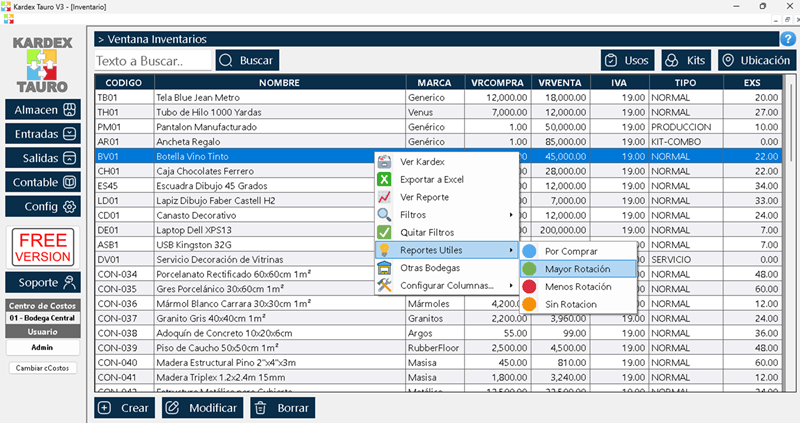
Recording the batch on every inbound receipt and on every sale is what makes tracing possible; the tool only helps make sure that record does not depend on memory. An inventory system like Kardex Tauro lets you carry the batch linked to inbound movements, outbound movements and the warehouse balance, so the information stays organized and searchable in seconds when you need it.
Worked example: one product, two batches
To make this concrete, take a product you sell — a syrup, a dairy drink, a supplement — and imagine that your warehouse has handled two different batches of it. Your sales record by batch would look like this:
| Batch | Units received | Units sold | Customers | Sale dates | Warehouse stock |
|---|---|---|---|---|---|
| Batch A | 100 | 95 | Centro Pharmacy (60), San Martin Drugstore (20), La Esperanza Store (15) | August 12 to 18 | 5 |
| Batch B | 50 | 10 | Centro Pharmacy (10) | August 20 | 40 |
Now imagine the recall notice arrives for Batch A. In ten minutes you know exactly where you stand: you sold 95 units to three customers and you have 5 units left in your warehouse. You have the names, you have the quantities and you have the dates, so you can notify the three customers and set aside the 5 remaining units. If the recall were for Batch B, the problem would be smaller: one customer and 10 units in their hands, while 40 units sit in your warehouse without ever having left it.
Notice what you do not need to do in either case: you do not need to go through stacks of invoices one by one, nor call every customer to ask what you sold them. The information is already organized around the batch — which is exactly the question you are being asked.
What to do when the recall notice arrives
When the notice arrives, the process has five steps. If your records are up to date, none of them is complicated; the only thing you cannot afford is improvising the information as you go.
- Identify the affected batch. Read the notice carefully: batch number, product presentation, implicated manufacturing and expiry dates, and the reason for the recall. Make sure the batch named matches the one you handle and not a similar one.
- Check your record. With the batch number in hand, review how many units you sold, to which customers, on which dates and how many you have left in the warehouse. That lookup should take minutes, not days.
- Set the stock aside in quarantine. The batch units in your warehouse must leave the sales and dispatch area immediately. Mark the quarantine zone and do not let anything from that batch leave, even if the product looks fine to you: deciding whether it is safe is not your call.
- Notify the affected customers and coordinate returns. Contact every customer who received the batch, tell them to stop selling the product, and arrange pickup or return. Keep the invoice or delivery note numbers at hand so the operation is fast and documented.
- Record the recall exit and the credit note. The return to the manufacturer and your customers' returns must be recorded as a special recall exit, with quantities and dates. When the manufacturer issues the credit note, compare it with what you actually returned and with what is still pending recovery.
The last step is the one almost nobody does and the one that prevents the most headaches: closing the loop. If the manufacturer asks for reports on how much you recalled and from whom, your records let you hand over the information without reconstructing the story from loose invoices. And if an audit or a claim comes months later, you have evidence that you acted on time.
Knowing who you bought it from matters too
So far we have talked about forward traceability, which is what lets you notify your customers. But a recall also demands backward traceability. When the manufacturer or the authority asks you how many units of the batch reached you, you must be able to answer with your purchase record: which supplier you bought it from, on which date and with which invoice.
That data point is not bureaucracy: it serves to delimit the scope of the recall. If the batch was distributed across several regions and channels, your purchase information lets the manufacturer confirm how much merchandise entered through your channel and compare it with what you report having sold. The differences between what came in, what was sold and what remains are exactly what a recall investigation pursues.
Extra benefit: handling quality complaints without recalling everything
Preparing for a recall has a benefit you notice long before one happens: it lets you respond precisely to quality complaints about a specific batch. A customer returns a product because it arrived damaged, or a consumer reports an inconsistency in a package. With batch traceability, that complaint stops being a suspicion over your whole inventory and becomes a bounded question: which batch did that unit come from?
If the answer points to a specific batch, you can inspect that batch, set it aside while you investigate, and keep the rest of the merchandise selling normally. You take care of the customer, you protect everyone else, and you do not paralyze your business over a problem that affects a limited part of your inventory. It is the same recall mechanism, applied at the scale of a single counter.
Preparing costs less than improvising
You may never receive a recall notice. Most distributors, pharmacies and food businesses go for years without seeing one. But the ones that do arrive never give much warning, and the difference between a business that settles them in days and one that drowns in weeks of paperwork is not luck: it is whether the batch number was recorded at the exact moment the merchandise came in, went out and stayed in the warehouse.
With an orderly stock ledger like the one Kardex Tauro makes possible, that record maintains itself: every inbound with its batch, every sale with its batch, every balance identified. When the notice comes — if it comes — instead of an investigation you will run a lookup. And that is the best possible position: being ready for a problem that may never happen.