What is an ERP and when does your business need one?

What is an ERP and when does your business need one?
If you own a shop, a warehouse or a small company, you have probably heard the word ERP more than once: in a call from a software salesperson, in an online article, or in a conversation with another business owner who moved to an ERP. You may also have wondered what it actually means, whether your business needs one, and why some people recommend it with such enthusiasm while others warn against it just as strongly. This article explains it in plain words: what an ERP is, where it comes from, what it solves, what it really costs, and above all when it makes sense and when it is better to leave it for later.
The real question is not what the most modern option is, but what your operation needs today to run without duplicated work and errors. As you will see, the answer is not the same for everyone: some businesses run very well with specialized software, and others are already losing money because their areas do not talk to each other.
What an ERP is (and what it is not)
ERP stands for Enterprise Resource Planning. Behind the name there is a very concrete idea: an ERP is a system that brings together in a single database all the information of the company, that is inventory, purchasing, sales, invoicing, accounting, accounts receivable, payroll and, in manufacturing companies, production, and lets every area work on the same data.
That is the difference from what most businesses use today. A point solution solves one area: there are programs to invoice, spreadsheets for inventory, a notebook for the day's sales, and accounting in the hands of an outside accountant. Each piece does its job, but none of them knows what the others are doing. Imagine that every employee kept their own sales notebook: the cashier writes down what was sold, the warehouse person writes down what went out, and the accountant writes down what he was told. When the notebooks do not match, nobody knows which one is right.
In an ERP, by contrast, the sale the cashier enters is the same record that reduces inventory, the same one the warehouse sees, the same one that feeds invoicing and the same one the accountant uses to close the day. It is entered once, and every area works from that single version of the truth. That, in essence, is the promise of an ERP: one database for the whole company.
Where ERPs come from: a short history
ERPs are neither a recent invention nor a cloud trend. Their history begins in the 1960s and 1970s, when large factories started using programs to calculate how much material they needed to produce: the MRP systems, short for Material Requirements Planning.
During the 1980s and 1990s, those inventory and production systems grew. First they added purchasing; then accounting, sales, payroll and receivables. That is how the ERP as we know it was born: a single system covering the whole operation of the company. The first versions were expensive, heavy and took months to install, which is why only large corporations could afford them.
Over time the software became more accessible: cloud versions, monthly plans and offers designed for medium and small companies appeared. But it is worth remembering that the essence is still the same as thirty years ago: integrating every area in a single database. When a salesperson offers you an ERP for small business, what he is really offering, in a lighter version, is that idea born in the factories of the 1980s.
What modules an ERP usually has
An ERP is organized in modules. Each module represents one area of the company and all of them share the same information: when one module records a movement, the others see it immediately. The following table summarizes the typical modules and what each one does.
| Module | What it does |
|---|---|
| Inventory | Records stock in and out, values the inventory and keeps the stock record of every product. |
| Purchasing | Creates purchase orders, receives goods and updates stock and costs in the same movement. |
| Sales and invoicing | Records orders, issues invoices and automatically deducts what was sold from inventory. |
| Accounting | Receives the movements of all the other areas and generates journal entries, ledgers and financial statements. |
| Accounts receivable | Tracks who owes you and whom you owe, with due dates and aging of balances. |
| Payroll | Calculates wages, benefits and contributions from each employee's data. |
| Production | Manages manufacturing orders, bills of materials and production costs. |
None of these modules is new on its own. What makes an ERP different is that the sales module talks to the inventory and accounting modules without anyone having to copy data from one place to another.
Who an ERP is for
The right question is not whether ERPs are good, but whether your company already has the problem an ERP solves. That problem is fragmented information: when a sale has to update accounting, inventory and receivables at the same time, and doing it by hand means typing the same record three times in three different places, with three chances of getting it wrong.
That pain appears when the operation grows in any of these dimensions:
- Several areas with a life of their own. Sales, purchasing, warehouse and accounting work separately, and each one keeps its own records.
- Several people touch the same information. When more than two or three employees need to check and update stock, prices or balances, shared spreadsheets stop being enough.
- More than one location or point of sale. With two or more stores, knowing the real total stock means consolidating data that lives in different places.
- There is manufacturing or assembly. When you turn materials into products, you need to control bills of materials, production orders and costs, not just buy and sell.
A common reference point is size: companies with ten employees or more start to feel the cost of fragmented information. But size is only a hint. What really matters is whether your operation already demands that the areas talk to each other: if the answer is yes, an ERP begins to make sense.
When you do NOT need an ERP
Here is the part few software salespeople will tell you: most shops and warehouses do not need an ERP. If your business has one, two or three locations, and the main pain is inventory and invoicing, meaning stock that does not match, you do not know what is really in the warehouse, or invoicing is slow, a large ERP does not solve that problem better: it makes it more complicated.
Why? Because an ERP brings modules you will never open, an integrated accounting that depends on how you configure it, and slower operations for simple tasks. Recording a cash sale at a fast checkout should not require navigating screens designed for the financial manager of a corporation.
For that kind of business, the right tool is software specialized in what you actually do every day: controlling inventory, keeping the record of each product and invoicing without double entries. It is cheaper, it is implemented in days, and it does not force you to reorganize the company around the system. Most shops and warehouses, even those with high invoicing volumes, run their operation with good inventory and invoicing software, not with an ERP. A large ERP, on the other hand, adds cost, complexity and slowness without a proportional benefit.
What an ERP really costs: money, time and effort
It is a mistake to compare only the license price. The real cost of an ERP has several layers:
- Licenses. Charged per module or per user, with monthly or yearly plans that grow with every area you add.
- Implementation. Someone has to configure the system for your operation: product catalog, chart of accounts, taxes and user profiles.
- Data migration. Moving inventory, customers, suppliers and balances from your current spreadsheets and programs without losing or duplicating anything.
- Training. Every area must learn to work inside the system, and that takes weeks, not afternoons.
- Process change. The ERP demands that everyone follows the same flow: if someone skips a step, the information goes wrong in every area at once.
In practice, a serious implementation takes months: configuration, testing, adjustments and a staged go-live. And after going live there is maintenance: updates, adjustments, and the cost of depending on a system that is now the heart of the operation.
Compare that with specialized inventory and invoicing software: it is set up with your products and your taxes, people learn it in days, and you do not need to restructure the company to use it. An ERP is not bad: it is a powerful tool for a problem of a certain size, and paying for it when your problem is smaller is simply overbuying.
Signs that your company does need an ERP
How do you know if your business has already crossed that line? These are the most common signs in companies that genuinely benefit from an ERP:
- Accounting and inventory do not talk to each other. The accountant receives the information at the end of the month and types it again into their program: the same sale is recorded twice, in two systems that are never compared.
- Areas show contradictory data. The warehouse says 40 units remain, the system says 35 and the accountant has another number. When you ask which one is correct, nobody can be sure.
- Production throws costs off. You manufacture or assemble with bills of materials, and the real cost of what you produce never matches what you paid for the components.
- Management reports require crossing areas. To know whether a customer is profitable you must combine sales, returns, costs and receivables, and building that report takes days of manual work in spreadsheets.
- Receivables and invoicing do not match. Paid invoices still show as pending and payments arrive that nobody knows how to apply.
- Month-end closing is an ordeal. Reconciling inventory, cash, bank and accounting takes several days, and there is always a floating balance nobody can explain.
If you recognize two or more of these signs, your operation has probably outgrown what single-area software can hold, and it is worth evaluating an ERP calmly, comparing vendors, modules and total cost. If you recognize only one, or none, strengthening what you already have is still the more profitable path.
Decision table: point software vs ERP
To close the practical part, this table summarizes when specialized software is enough and when it is worth considering an ERP.
| Your situation | What fits best | Why |
|---|---|---|
| Shop, warehouse or distributor with 1 to 3 locations; the pain is inventory, stock records and invoicing. | Specialized inventory and invoicing software | It solves the real problem at a lower cost and without restructuring the operation. |
| You invoice high volumes, but all areas fit in one location and few people. | Specialized inventory and invoicing software | The bottleneck is operational; an ERP does not make it faster. |
| Several areas force you to type the same data more than once: a sale feeds accounting, inventory and receivables by hand. | ERP | Integration in one database eliminates double entries and mismatches. |
| More than one location or several points of sale that you must consolidate daily. | ERP or multi-location software depending on scope | You need one version of the truth for the whole operation. |
| Manufacturing or assembly with bills of materials, production orders and costs. | ERP with a production module | Only an integrated system crosses materials, labor and costs. |
| A team of 10 employees or more sharing the same information across several areas. | ERP | The cost of fragmented information already exceeds the cost of the system. |
The table is not a straitjacket: some single-location businesses benefit from an ERP because of their model, for example credit sales with a large receivables balance, and large companies can operate for years with well-managed specialized tools. Use it as a starting point, not as a verdict.
Conclusion: the right software for your size
An ERP is not better or worse than specialized software: it is a tool for a problem of a certain size. Choosing well does not mean buying the most complete option, but the one that fits the operation you have today and the one you can sustain without breaking your routine.
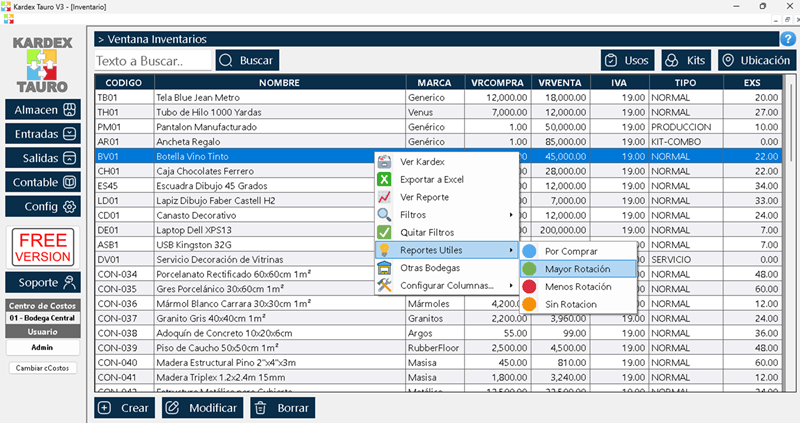
If your company already lives with fragmented information, with areas that do not talk to each other and with reports nobody dares to build, an ERP can be one of the best investments you make. If your daily life is selling, controlling inventory and invoicing, and that is what goes wrong, the most profitable answer is usually software built for that task, not a system that integrates twenty areas. Tools like Kardex Tauro exist for exactly that: covering inventory, stock records and invoicing with the depth a shop or warehouse really uses, without modules you will never open or processes you must learn just to invoice faster. The ERP will arrive if your operation grows until it needs it. In the meantime, do not let the software be bigger than the problem.