Inventory for dental practices: supplies that expire and are never invoiced

Inventory for dental practices: supplies that expire and are never invoiced
Dental care burns through supplies in silence. Before a single tooth is touched, the practice has already spent a pair of gloves, a needle and an anesthetic cartridge; if the procedure is a restoration, it also used composite resin, adhesive and polishing discs. The patient pays for the visit or the treatment and receives an invoice for the service. The materials consumed to provide it never appear on any invoice: they were not sold, they were used up.
That spending is the practice's invisible cost. The dentist who runs their own office almost always knows how much they buy, because the supplier's bill arrives, but rarely knows how much they consume. They buy gloves when the shelf looks empty, order composite when they find the box exhausted and discover the expired anesthetics when they are already useless. Between purchase and use there is no record; between use and reordering there is no criterion, only emergencies. This article explains how the supplies of a dental practice are classified, which rules prevent silent losses and how to calculate the real cost of each procedure to know whether the fee actually pays.
The supplies that disappear without leaving an invoice
In any business, inventory leaves through two doors: sales and shrinkage. In a dental practice there is a third one, and it is the most important: clinical consumption. A composite filling uses anesthetic, a needle, gloves, cotton, resin, adhesive and polishing material; a prophylaxis spends paste, a rubber cup, floss and gauze; a wisdom tooth surgery uses more anesthetic, suture, sterile gauze and maybe a hemostatic agent. None of that is invoiced to the patient, but all of it was paid to the supplier.
If nobody records those withdrawals, the practice runs on a dishonest inventory: the purchase record shows what came in, but nobody can say how much is left, how much was used in the month or how much it costs to produce one visit. At the end of the year, the accounting profit exists, but the money does not: it went into supplies that were never controlled. Gloves, anesthetics and composites are the classic example, but not the only one: implants, impression materials, sealants and even cleaning supplies share the same fate.
Five groups of supplies and the control each one needs
Not all practice supplies are controlled the same way. The most common mistake is treating everything with the same recipe: either everything is tracked in lavish detail, and the control ends up costing more than what it controls, or nothing is tracked at all. A practical classification separates five groups, each with its own consumption logic and its minimum control.
| Supply group | Examples | How it is consumed | Minimum control |
|---|---|---|---|
| Per-patient clinical consumption | Gloves, anesthetics, needles, composites, gauze, sealants | Used up in every visit, in quantities that vary with the procedure | Withdrawal recorded per procedure or per day, minimum stock and expiry dates |
| Laboratory materials | Impression materials, stone, ceramics, veneers, frameworks | Fabricated for a specific patient case and returned as a finished piece | Work order per patient and cost per case |
| Instruments and equipment | Handpieces, trays, mirrors, autoclave, curing lights | Not used up in one visit: reused, worn out and in need of maintenance | Asset inventory, sterilization cycles and scheduled replacement |
| Office and cleaning supplies | Forms, paper, soap, disinfectants, bags | Consumed continuously by the administrative and cleaning staff | Simple monthly record of purchases and usage |
| Retail products | Toothbrushes, toothpastes, hygiene kits | Sold with an invoice or given away as a courtesy | Inventory kept separate from clinical use; courtesy items tracked |
Read the table with one question in mind: which group does each item used in a visit come from today? Most practices answer well for office and cleaning supplies, because they are low-value and bought occasionally, and for retail products, because they are invoiced. The gap is in the first three groups: they concentrate the money and they are the least controlled.
Rule 1: manage expiry dates with FEFO
In dentistry, expiry dates are not an administrative detail: they are a clinical matter. An expired anesthetic is not used, it is discarded; an expired composite loses its properties and a hardened sealant does not seal. If the practice organizes its storage without looking at dates, it ends up using what is in front, which is what it bought yesterday, and leaving behind what expires soon, which is what it bought six months ago. The result is a box of expensive supplies thrown away whole.
The FEFO rule, first to expire, first out, solves that problem with five simple steps:
- Organize supplies by expiry date, with the earliest expiring at the front of the shelf.
- Review the storeroom once a month and set aside what expires within the next thirty or sixty days.
- Rotate the inventory: use what is close to expiry first in the procedures where it applies.
- Remove what has expired, record it as waste and take it out of the area where usable material is kept.
- Buy against real consumption, not against the supplier's offer: the extra box that takes advantage of the discount is usually the one thrown away expired.
The monthly review takes less than half an hour in a small practice and prevents the silliest loss in the business: money that leaves the cash register, enters the storeroom and comes out again straight into the trash. With anesthetics and composites, among the most expensive supplies per unit, that review pays for itself with a single box rescued in time.
Rule 2: record consumption, not just purchases
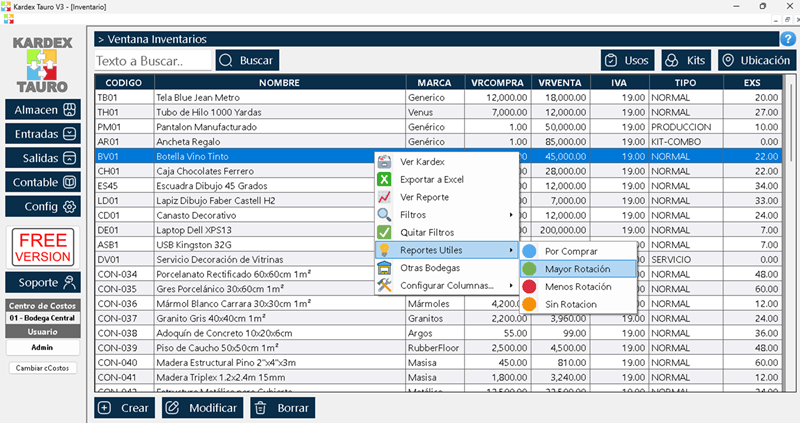
The practice's inventory record cannot register only incoming stock. If only purchases are recorded, the balance says one thing and reality another, because the gloves used in the morning never left the record. For the inventory to tell the truth, every withdrawal from the storeroom must be noted even when no invoice is involved. A system for internal consumption, such as the one offered by Kardex Tauro, records what leaves without an invoice and deducts it from stock on the spot, so the balance reflects what is really available.
The practical question is how much detail to record. There are two levels, and each practice chooses according to its size:
- Record by procedure: the assistant notes which supplies were used in each visit, whether a filling, a cleaning or an extraction. It is the only way to know the real cost of each procedure and it demands daily discipline.
- Record by day: at closing time, what was taken from the storeroom during the day is noted, grouped by supply type. It is lighter and enough to control stock and reorder in time.
Recording by procedure sounds like paperwork, but in practice it comes down to a short list per visit. Its reward is huge: with three months of data, the dentist knows how much it costs to produce each service and can compare it with the fee, instead of guessing.
Rule 3: minimum stock for what cannot run out
Some supplies cannot be missing: without gloves there is no care, without anesthetic no procedure starts and without gauze no surgery ends. When one of these runs out, the practice does not save money: it loses the appointment, the patient's trust and the profit of the day. The solution is not to stockpile more, but to set a minimum level and a reorder point for each critical supply.
The mechanism is simple. For example, the practice decides that gloves will not fall below two boxes in the storeroom and that, when that level is reached, the reorder is placed; the same goes for anesthetics, composites and gauze according to the practice's pace. A weekly storeroom review, five minutes with the list in hand, makes it possible to anticipate the order and buy calmly, instead of paying supplier emergencies or borrowing from the office next door.
The minimum stock also orders purchases: you buy what needs replacing, not what the salesperson offers. And it frees up cash: money sitting on shelves is working capital frozen and not working for the business.
Rule 4: implants and expensive materials, with batch and traceability
Implants, screws, grafts and biomaterials are not managed like gloves. They are expensive, they are placed in a specific patient and, in clinical practice, the practice must always be able to answer one question: which batch, which reference and which manufacturer were used in each case. If the manufacturer issues an alert or a problem appears with a lot, the affected patient must be identifiable. That ability is not an administrative luxury: it is part of responsible clinical practice.
This requires two records that touch each other: the storeroom record, with the batch entry and its expiry date, and the clinical record, with the withdrawal linked to the patient and the chart. Recording the purchase is not enough: the batch that stayed in the storeroom and the one that was placed must match on paper. That is why the withdrawal of an implant should require identifying the patient, and the inventory should make it possible to check how much of a batch remains without digging through old invoices.
Laboratory materials have their own rule: they are fabricated for a case. Every shipment to the laboratory must carry a work order with the patient and the agreed cost; when the finished piece returns, that cost is added to the case. Without that order, the laboratory becomes the same invisible cost, only invoiced from the outside.
Rule 5: the monthly count and the difference it reveals
No matter how good the record is, someone has to look at the storeroom from time to time. The monthly physical count, counting what is there and comparing it with what the record says, is the truth test of the inventory. The difference between what is counted and what is recorded reveals what no piece of paper says on its own: an expired item not removed, a supply taken by an employee, a box used up without being noted or a recording error.
When a difference appears, the rule is not to adjust the balance and move on: first look for the cause. Was it unrecorded consumption, waste or an entry error? Answering that question fixes the process; adjusting without answering it only hides the problem for another month. In a small practice, the monthly count of the valuable groups takes an afternoon, and it is better done by someone other than the person who records withdrawals, even if that means the dentist does it when the assistant manages the storeroom.
The cost per procedure: the fee works or it does not
All the control described here converges on one business question: how much does each visit cost to produce and does the fee cover it? The calculation is a sum: the clinical supplies used in the procedure plus the laboratory cost, if any. Think of two extremes. A composite filling uses materials whose value can represent between 10% and 20% of a typical restorative fee, and it generates no laboratory cost. A prosthetic case, on the other hand, can carry a laboratory cost well above the value of the supplies used in the cementation session; if the fee does not account for it, the case is done almost at a loss without anyone noticing.
With the record by procedure, that calculation comes out by itself: at the end of the month, the consumption of each type of visit is added up and compared with what was invoiced. If the materials of one service represent a very high share of the fee, the problem is waste, purchasing or the fee itself, and with data you decide which one to adjust. Without data, all that remains is the feeling that the practice works hard and earns little.
Control is not paperwork: it is margin
Controlling supplies in a practice is not office bureaucracy: it is the difference between a business that pays and one that works for the supplier. With five rules, expiry dates under FEFO, recorded consumption, minimum stock for critical items, traceability for expensive ones and a monthly count, the clinic stops guessing and starts measuring. The tool can be as simple as a well-kept sheet; when volume grows, a system for internal consumption that deducts from the storeroom, such as Kardex Tauro, does the work with fewer errors and less time.
What gets measured gets improved; what does not get measured gets lost. In a dental practice, that loss has a name and an expiry date: it is the supplies used in every visit that were never invoiced and never recorded.