Inventory for liquor stores and spirits distributors
Inventory for liquor stores and spirits distributors
A liquor store, an off-licence or a spirits distributor sells small, expensive products that turn over very quickly, and most sales are paid in cash. That combination turns inventory control into the difference between a business that grows and one that works all month only to find out it does not know where the profit went. Bottles that do not match the records, complimentary drinks nobody logs, poorly planned seasonal purchases and cash that does not match what was sold are silent losses that pile up one reference at a time.
The good news is that control does not require sophisticated tools: it requires simple rules applied every single day. This article explains how to manage inventory in a liquor store or spirits distribution business without drowning in the effort: what to count, how often, how to record what leaves the warehouse, how to reconcile the cash drawer and how to prepare for peak dates without discrepancies.
Why a liquor business is a different animal
In a clothing shop a garment can sit on the shelf for months. In a liquor store it cannot: premium whisky, tequila, aguardiente, wine and beer move fast, go up in price often and concentrate a lot of value in very little space. A case of wine can be worth more than the entire stock of a small grocery store, and it fits on one shelf. That means a counting error is not a minor error: one bottle that disappears unrecorded can represent the profit of several sales.
On top of that, the business faces three peaks that test it: the year-end holidays, national holidays and big events. In those periods volume multiplies, service speeds up, there is less time to write things down and discrepancies appear right when sales are highest. If control depends on the manager's memory, in December memory loses.
Finally, cash is the star of the show. When most sales come through the register, inventory and money are two sides of the same problem: if you do not know what was sold, you cannot know how much should be in the drawer.
The 20 percent that drives 80 percent: strict control of star references
In almost every liquor store a handful of references generate most of the sales: the most requested whisky, the local aguardiente, the mid-priced tequila, the fastest-moving beer. That is the 80/20 rule applied to spirits, and it defines how to divide your control effort. It makes no sense to count the expensive whisky bottle and the soft drink in the back corner with the same dedication, but it also makes no sense to neglect the cheap reference that sells by the case every week.
The practical rule is this: identify your star references, the ones that concentrate volume or value, and give them strict control with a daily or weekly count. The rest of the assortment needs only a more spaced periodic count and constant visual checks. The following table summarizes how to differentiate control between both groups.
| Criterion | Star references | Rest of the assortment |
|---|---|---|
| What they are | The 20 percent of references generating 80 percent of sales or value | The remaining 80 percent: side items, slow-moving wines, occasional spirits |
| Counting frequency | Daily or weekly, always on the same day and time | Monthly or biweekly, with a visual check every week |
| Who counts | The owner or the manager, never only the same person who serves | The floor or warehouse staff member in charge |
| Difference tolerance | Zero: any shortage is investigated the same day | Small defined margin, reviewed at the periodic count |
| Record | Documented and signed count on every round | Documented count on the monthly round |
Do not guess when defining your stars: review the last three months of sales and sort references by units sold and by value. You will see a handful of products at the top of both lists. Those are the ones you protect first.
Warehouse and sales floor: every transfer recorded, every sale invoiced
The most common control mistake in liquor stores with a warehouse is recording as a sale what is really an internal movement. When a case of whisky moves from the warehouse to the sales floor, there is still no sale: there is a transfer. If you log it as a sale, the system tells you that you sold twelve bottles that are still in the store, and at the end of the day the physical count does not match what the paperwork says.
The rule has two legs. First: everything that leaves the warehouse for the sales floor is recorded as a transfer, with date, reference and quantity, so you always know what is in each place. Second: only what is actually sold is deducted from inventory, and every sale leaves with its invoice or receipt, no exceptions, including a single beer. When the receipt is always generated, the physical count at closing can be compared against sales and any difference stands out immediately.
This separation between transfer and sale also organizes replenishment: when the sales floor runs low, the staff member knows exactly what to request from the warehouse, and the warehouse knows exactly what is available without relying on memory.
If you sell by the glass: the open bottle is inventory too
Anyone who sells by the glass faces an extra difficulty: an open bottle stops being a sealed unit and becomes a live reference that is consumed little by little. Without rules, the open bottle is the black hole of the inventory, because paid glasses, complimentary drinks and unrecorded pours all come out of it.
The first rule is knowing how many glasses each bottle yields. A standard 750 milliliter bottle serves about fifteen 50 milliliter glasses, fewer if it is poured over ice or if the pour is more generous. Define your pour size, calculate the theoretical yield of each reference and write it down: that number is your control benchmark. The second rule is that every open bottle has an owner for the shift: when it is opened, the date is noted, and every glass served, paid or complimentary, is recorded. If the glass count does not match the expected yield by the time the bottle is finished, you know something is escaping.
The third rule covers what is left over: an open bottle that is not finished during the shift does not vanish, it is closed with its shrinkage record. Shrinkage from an unsold open bottle is recorded and deducted, because it is a real cost: it oxidizes wine, dilutes spirits or simply represents product that left inventory without a sale. Recording shrinkage is not a punishment; it is the only way to know how much selling by the glass really costs. Complimentary drinks deserve a special mention: if you offer them, define them as policy, record them and budget their cost. A courtesy that is not recorded is not hospitality; it is shrinkage by your own hand.
Cash rules: daily drawer reconciliation
In a liquor store, drawer reconciliation is not an end-of-month chore: it is a daily routine that takes ten minutes and stops small discrepancies from becoming big losses. The idea is simple: at closing, the cash in the drawer must match what the day's recorded sales say, and that figure must match what the inventory says was sold.
Reconciliation happens on two levels. First you match cash against sales: count bills and coins, deduct any authorized petty expenses paid from the drawer and compare against the total of receipts issued. Then you match what was sold against inventory: the units that left according to the invoices must appear as shortages in the count of each reference. When both levels agree, the day closed clean.
| Step | What you do | What a discrepancy reveals |
|---|---|---|
| 1. Count the cash | Count bills and coins by denomination and add up the total | Shortages or surpluses from change errors or unrecorded sales |
| 2. Compare with sales | Add the receipts issued in the shift and subtract authorized drawer expenses | More cash than sales suggests unrecorded sales; less suggests bad change or theft |
| 3. Compare with inventory | Verify that units sold per invoices match the physical shortage of the day's references | Differences point to misrecorded transfers or bottles without an invoice |
| 4. Sign the report | Write down the day's total, the differences and who reconciled | Without a signed report there is no way to investigate old discrepancies |
If the daily reconciliation always happens, a discrepancy is detected the same day, when there are still witnesses, a shift and a memory of what occurred. If it happens weekly, today's discrepancy mixes with tomorrow's and no one ever knows the truth again.
Seasonal purchases: no shortage in December, no drowning in January
Peak dates punish the liquor store twice over: the store that runs out of whisky in December loses the biggest sale of the year, and the one that overstocks to be safe freezes its cash in boxes that will take months to sell. The seasonal purchase is planned, not improvised.
The foundation is history: review how much you sold of each star reference in the previous season, estimate expected growth and buy with a realistic margin, not out of panic. The second pillar is the agreement with the supplier: define volumes in writing, staggered delivery dates and the possibility of short replenishment orders. A good spirits supplier prefers a customer who buys in two or three batches over one who places a giant order and then does not come back for six months. The third pillar is cash: the seasonal purchase is paid with the season's own cash, so set a purchase cap per reference and respect it even when the salesperson offers volume discounts you do not need.
And remember the full cycle: what comes in in October for December should be almost sold by January. If you are still full of seasonal stock on January 31, the next big purchase will be financed with borrowed money.
Wine: position, temperature and light
Wine is the reference that gets damaged without anyone noticing. Poorly stored wine loses value silently: heat cooks it, light oxidizes it, an upright position dries out the cork and knocks disturb the sediment. Spoilage does not show up in any count as a shortage, but it is lost money all the same: a damaged bottle is discounted for whatever it can fetch, or it does not sell at all.
The storage rules are simple and cheap: wine is kept on its side or in a position that keeps the cork moist, in a cool, dark place, away from windows and heat sources, with a stable temperature. On the sales floor, no shelving in the sun: the window display that looks nice from the street is oxidizing the wine it shows. In addition, the wine inventory must record position and lot: if you know which case arrived first, you sell the oldest first and avoid a reference sitting still until it passes its drinking window. In practice, rotate wine with more discipline than any other reference, because its deterioration is invisible inside the sealed bottle.
Shrinkage and staff consumption
Two leaks follow every liquor business and neither shows up in the counts if it is not named. The first is shrinkage: the complimentary drink that is not recorded, the bottle that leaves inside a grocery bag, the extra pour served so the customer comes back. The second is staff consumption: the manager who tastes the inventory, the bottle opened at the store on a Friday after closing, the loan that nobody returns.
Neither leak is eliminated with mistrust: both are eliminated with rules and records. Define what internal consumption is allowed, if any, and document it for what it is: an inventory exit with its record. If there is no policy, everything is suspicious and nothing can be investigated; if there is a policy and records, whatever is not recorded is, by definition, an irregularity. The daily count of star references and the drawer reconciliation are exactly the two controls that make shrinkage visible: when the open bottle yields fewer glasses than expected or the drawer does not balance, the problem stops being invisible.
A control system that keeps up the pace
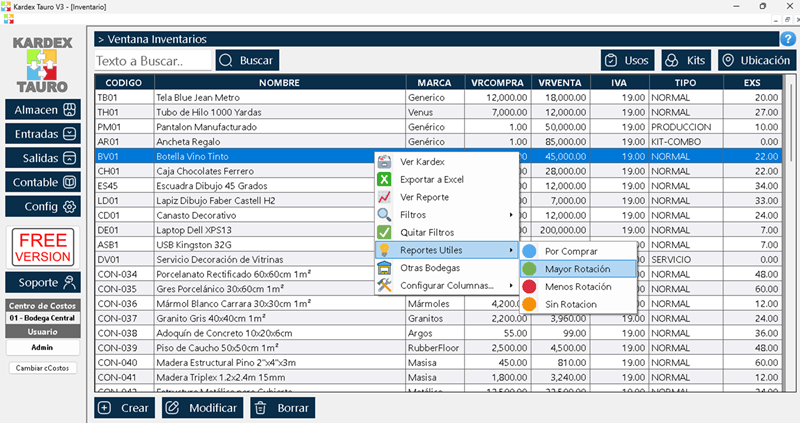
The rules in this article fit into a well-built spreadsheet, and many liquor stores start that way. But when the business grows, the spreadsheet fills with typing errors, the file gets duplicated and no one knows which version is the real one. That is where inventory software like Kardex Tauro comes in: it records transfers from the warehouse to the sales floor, deducts inventory with every invoice, keeps track of references and supports the daily cash reconciliation without you having to enter the same data twice.
The tool, however, does not replace discipline: counting, reconciling and recording are owner habits, not program features. Combine good control with good records and the liquor store will always know how much it has, how much it sold and how much should be in the drawer, even in the busiest week of December.