What is inventory visibility? (and why not having it costs you money)

What is inventory visibility? (and why not having it costs you money)
Try a quick test right now: how many units of your best-selling product are in the warehouse today? How many at the point of sale? How much money is sitting idle in merchandise that has not moved in months? If answering took more than a minute, or if the answer came with an "I think", a "more or less" or a "ask the warehouse manager", your business does not have inventory visibility. At best, it has a product list.
Inventory visibility is the ability to answer, at any moment and with reliable numbers, four questions: what you have, where it is, what it is worth and what is moving. It is not a decorative report printed for a meeting: it is operational information that purchasing, sales and cash flow all depend on. Without it, every decision is made blind, and the mistake is discovered weeks later, once the money has already left the account.
Let us be direct from the start: having a spreadsheet with references and quantities is not visibility. It is a starting point. The difference between a list and real visibility is the difference between an old photograph and an open window: the first shows how the business looked at some point; the second shows what is happening while you read this.
This article explains what inventory visibility is, what separates it from a simple stock list and why its absence shows up first in your pocket. It also looks at how a small business can build it with discipline, without needing an IT department.
What inventory visibility is not
To understand what it is, it helps to rule out what is often confused with it. Visibility does not appear on its own just because you buy software, or because you count the warehouse once a year, or because you keep a neat paper stock ledger ledger. These are useful pieces, but none of them answers the questions the operation asks every day.
These are the most common substitutes, and why each one falls short:
- A spreadsheet with last month's stock levels. It was updated once, when someone had the time, and reality kept moving after that. Every sale made it more outdated.
- The annual physical count. It is done for taxes or because it is required, everyone congratulates themselves on the result, and the paper goes into a drawer until the following year.
- The warehouse manager's memory. It is valuable, but one person cannot be in the warehouse, at the counter and with the supplier at the same time, and on the day that person is absent, nobody knows anything.
- The handwritten stock ledger ledger. Movements are recorded, but corrections, adjustments and internal loans pile up out of order, and nobody dares to reconcile it.
- The daily sales figure. It says how much went out, but it does not say how much is left, what is about to run out or what has been sitting still for months.
None of these tools is useless: they are raw material. The problem is mistaking raw material for the finished result. Visibility begins where those loose documents become one reliable figure, updated with every movement and available to whoever makes the decision.
The four questions that visibility answers
Stripped to its essence, inventory visibility means answering four questions well. Everything else, reports, alerts, indicators, is just a way of serving those four answers.
- What you have. The real references in the business, without duplicates. It is more common than it seems to have the same product under two names or two codes: one purchase is entered as "sugar 1 kg" and another as "sugar kilo", and the system, or the notebook, treats them as two different products. When that happens, no stock figure can be correct, no matter how well you count.
- Where it is. Each location with its own quantity: the central warehouse, the point of sale, merchandise in transit, what is reserved for a customer. Having forty units in the warehouse is not the same as having twenty in the warehouse, fifteen at the counter and five reserved: the first answer leads to overbuying, the second lets you sell knowing what is truly available.
- What it is worth. The total cost of the inventory and the cost per reference: how much money is tied up in merchandise. Many businesses know their stock in units but not in dollars, and that is why they do not feel the cost of idle product until they run short of cash to pay salaries.
- What is moving. What sold today and so far this week, and what has not moved in sixty days. Visibility is not a frozen inventory: it is inventory that tells its own story of movement, and that story is what justifies buying more of one reference and liquidating another.
Whoever answers those four questions with today's numbers makes purchasing decisions with information. Whoever cannot answer them decides by gut feel, and gut feel charges interest.
Basic stock list versus real visibility
The difference is easier to see by comparing, row by row, what a stock list can say and what real visibility adds about the same product:
| Question | Basic stock list | Real visibility |
|---|---|---|
| Stock levels | How many units the paper says there are | How many there really are, per reference, without duplicates or repeated codes |
| Value | Not shown, or calculated using sale price | Total cost and cost per reference: the money tied up in each product |
| Location | Everything adds up into one global figure | Warehouse, point of sale, in transit and reserved, each with its own quantity |
| Age | Not known | Days since the last receipt and since the last issue of each reference |
| Turnover | Guessed from overall sales volume | Issues per period and per reference: fast, normal and slow movers |
| Committed stock | The concept does not exist | Reserved items and promised orders, visible before you promise again |
The table can be read another way: every row on the right is a decision you can make better. The row on the left does not stop you from operating, but it forces you to operate on assumptions.
Why the lack of visibility costs money
Visibility is not an administrative whim. Its absence turns into money leaving, or money that never arrives, almost always through four paths:
- Overbuying. If the record says five units are left and the warehouse actually holds forty because a receipt was never entered, the reorder arrives duplicated. The result is extra product that takes up space, expires or sits still, with cash that could have stayed in the business.
- Stockouts and lost sales. The opposite case: the sheet says there are twenty, but twenty is what the sheet says, and the shelf is empty because a dispatch was never recorded. The customer asks, the salesperson confirms in the system, makes a promise, and the problem appears at delivery time. The customer does not come back.
- Discrepancies that only surface at the annual count. When the only comparison against reality happens once a year, the business spends twelve months buying, selling and deciding with wrong numbers. The discrepancy is not the problem: the problem is the eleven previous months in which nobody saw it.
- Cash frozen in slow movers. Without knowing what does not move, inventory fills up with references that have not sold in months. Each one is idle money that generates no sales, takes up shelving and, in many industries, expires. It is the most silent cost of all: it appears on no statement, yet it explains why there is too much product and too little cash.
These four effects are not rare events: they are the normal operation of a business without visibility. And the serious part is that none of them is visible at the moment it happens. They show up at the end of the month, when the result does not match the effort, and it is already too late to fix the purchase that went wrong three weeks ago.
How visibility is built
The good news is that visibility does not require expensive software or a team of specialists. It is built with four habits, in this order, and each one reinforces the previous one:
- Record every movement on the same day. Every supplier receipt, every sale issue, every adjustment for shrinkage, every return, is entered when it happens. Delayed recording is enemy number one: if today's movement is entered on Friday, by Thursday the business is already deciding with a lie.
- Keep a single product master. One reference, one code, one name and one unit of measure per product. Cleaning up existing duplicates is a tedious one-time job, and it is what guarantees that every later figure means something.
- Run periodic counts that correct the system. Instead of waiting for the annual count, count by sections every so often: dairy this week, grains next week. The count is not paperwork to balance: it is the mechanism that gives the record back the truth that human errors have been taking away.
- Review one simple report every week. A single page showing the essentials: top sellers, slow movers, items about to run out, reserved items and the total value of the inventory. If the report cannot be understood in five minutes, it is not working.
None of these habits is new or brilliant. They are pure routine. The difference lies in doing them systematically, with a single record that everyone feeds, instead of depending on notebooks, memories and loose sheets that never agree with each other.
Visibility is the foundation of almost everything else
Almost every inventory management tool loses its meaning if the base figure is not reliable. The reorder point, for example, is a simple calculation: how many units remain before you restock. But if the recorded stock is not the real stock, the alert arrives late or never. Inventory turnover, another example, is calculated from issues and costs; if those records are incomplete, the indicator lies gracefully. And purchasing decisions, where the most money is at stake, end up resting on the last conversation with the supplier's salesperson.
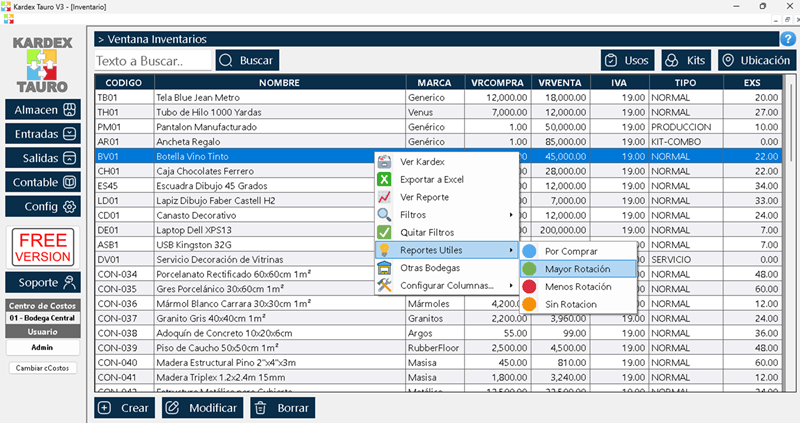
That is why it makes sense to rely on a tool that takes care of the mechanics while the business focuses on selling. A stock ledger system such as Kardex Tauro centralizes the product master, movements, counts and reports in one place, so the figure you check today is the same one that recorded this morning's sale.
In the end, inventory visibility is not a luxury for large companies: it is a discipline within reach of any business that wants to stop guessing. It starts by recording movements, it is sustained with honest counts and it pays off every week with a report you can read in five minutes. The next time someone asks how much stock there is of a product, the answer should be a number. With visibility in place, that number comes out of the system instantly, and with a record like the one Kardex Tauro provides, it comes out without depending on anyone's memory.
