What is product traceability and why does it matter?
What is product traceability and why does it matter?
Imagine a customer returning a damaged unit and insisting it came from your warehouse three weeks ago. Or a supplier calling to say that a batch they shipped you has a problem, and you need to know whether you have already sold it, to whom and how much of it. At that moment only two scenarios exist: you have the product's history and answer within minutes, or you do not and start guessing. The difference between the two is called traceability.
Traceability is the ability to reconstruct the path of a product from the moment it enters your business until it leaves, and also in the opposite direction: from a unit sitting in a customer's hands back to the batch, the purchase and the supplier it came from. It is not a nice label or a code printed on the box: it is a continuous record that links every movement to the next one. This article explains what it is, the two directions in which it is read, the minimum data you need to record and what you gain, or lose, with it.
What it means for a product to be traceable
For a product to be traceable means you can answer specific questions about it at any time: when it came in, which batch it belongs to, who you bought it from, which customer you sold it to and how long it sat in your inventory. Every one of those questions is answered with a record: the goods receipt, the dispatch, the invoice, the delivery note. If those records exist and are connected to one another, the product is traceable. If they exist but live on loose papers, in an employee's memory or in a spreadsheet nobody updates, it is not traceable in practice.
It helps to separate two ideas that are often confused. The first is identification: putting a batch number or a serial number on the goods. The second is movement recording: leaving evidence of when that identified merchandise came in, moved around the warehouse and went out. Traceability is built with both. You can have the best labeling in the world, but if you do not record which customer received each batch, you will not be able to track it down on the day you need it.
Backward and forward: the two directions
Traceability is read in two directions, and each one answers different questions. Neither is optional if you want real control.
Backward, from the sale toward the origin: you take a unit or a batch and reconstruct where it came from. Who did I buy this batch from? When did it come in? Which batch did this unit on my counter come from? Which supplier and which receiving conditions apply to it? This direction is what you use to claim against a supplier, verify the origin of merchandise and know exactly what you purchased.
Forward, from the origin toward the customers: you take a batch or a purchase and reconstruct where it ended up. Which customers did I sell this batch to? How many units are still sitting in my warehouse? Who did I sell this serial number to? This is the direction you need in a product recall, for a warranty claim, or when a batch turns out to be defective and every recipient must be located.
A business without records can only look forward with luck and backward with memory, and neither is reliable when money is at stake.
Two levels: batch traceability and serial traceability
Not all products are tracked the same way. There are two levels, and the difference lies in how fine you need the identification to be.
By batch. A batch is a group of units that were produced or purchased together and therefore share the same conditions: same production run, same origin, same probable expiry date. If one unit in the batch is defective, it is reasonable to suspect every unit in that same batch. This level is the standard in food, medicine, cosmetics, beverages, chemicals and anything with an expiry date or a health risk attached.
By serial number. A serial number identifies a single unit, different from every other one: no two phones, engines or machines share a serial. This level is used for equipment, machinery, appliances, tools, vehicles and expensive spare parts, where you need each unit's history: when it was sold, to whom, whether it went into warranty or came back for repair.
The two levels work together without conflict. A business can receive a shipment of machines by batch and still sell each machine by serial number. The batch serves supplier and expiry control; the serial serves warranty and after-sales service.
The minimum data you need to record
Traceability does not demand an expensive system: it demands that certain data exist and be recorded at the right moment. These are the minimums for each level and what each one lets you answer.
| Level | Minimum data | What you can answer with it |
|---|---|---|
| By batch | Batch number, expiry date (if applicable), supplier and receipt date; outbound movements with customer and date, on the invoice or delivery note | Who did I buy this batch from and when did it arrive? Which customers did I sell it to? How many units are still in stock? Which ones are expired or about to expire? |
| By serial | Unique serial number, model or reference, supplier or purchase date and warranty; movement history: receipt, sale, return, repair | Where is this exact unit? Who did I sell it to and when? Is it still under warranty? Has it ever been returned or serviced? |
Notice that both levels repeat the same rule: on every inbound movement you record the identification data and its origin, and on every outbound movement you record that same data and its destination. That match between what comes in and what goes out is what turns a list of data into real traceability.
Why traceability matters
So far this may sound like administrative busywork. These are the real situations where it decides between losing money and not:
- Recalls and withdrawals. When a product must leave the market, the authority or the manufacturer asks which customers received the affected batch. If you can narrow the answer to a few customers and to the units you still hold, the recall is manageable. If not, the problem spreads across your entire inventory and your whole customer list.
- Warranties. A warranty is managed with data: what you sold, to whom and when. With the serial recorded at the point of sale, handling a claim takes minutes. Without it, you argue with the customer over whether the machine came from your business, how old it is and whether coverage still applies.
- Quality control. If a batch turns out defective, traceability lets you isolate only that batch, return it to the supplier or pull it from sale without freezing or recalling the rest of your inventory. The problem stays exactly as big as it should be, and no bigger.
- Institutional customers. Distributors, retail chains, pharmacies and hospitals increasingly require the batch number on the invoice or the delivery note. If you cannot issue it, they simply will not buy from you.
- End-customer trust. Being able to tell a customer where their product came from and show that the purchase was recorded is a sign of order. Order is noticed, and customers pay for it.
How it is achieved in practice
Traceability is not bought: it is built in four moments of the daily flow, and each one depends on the previous one.
- At the receipt. When goods arrive, record the batch number or the serial number of each unit together with the supplier and the date. If the product has an expiry date, record that too: it is part of the batch's identity.
- While it sits in inventory. The data cannot get lost along the way. Internal movements, transfers between locations and adjustments must keep the batch or serial identification. A unit without a batch in the middle of your inventory is a black hole for traceability.
- At the dispatch. When you sell or ship, record which batch or which serial goes out and to which customer. The invoice or the delivery note is the natural place to do it: if the batch does not appear there, for all practical purposes it does not exist.
- Keep the history. Even after the stock runs out, the record of who bought it must remain. History is the one piece of data you cannot rebuild afterwards.
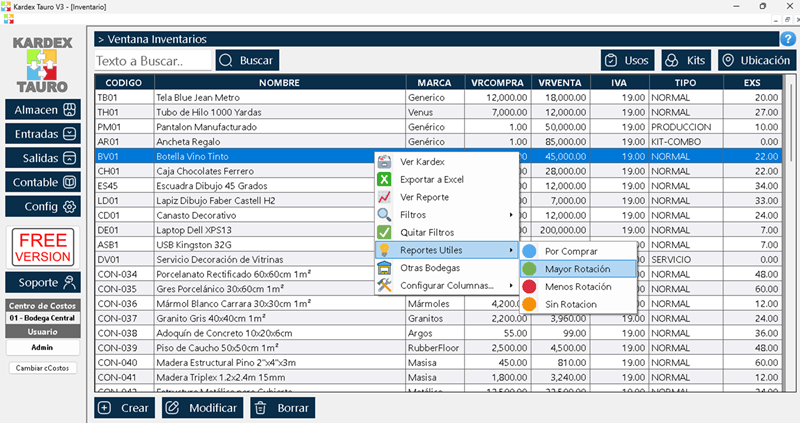
In practice, recording the batch or the serial on inbound and outbound movements is what builds traceability; no label or code replaces it. A stock card system that keeps that history per product, like Kardex Tauro, leaves the information ready for the day the difficult question shows up.
What happens when there is no traceability
To make the cost clear, it is worth looking at the scenario without it. A recall notice arrives for a batch you sold two months ago. You did not record which customers received it, so you cannot narrow anything down: either you withdraw the equivalent of everything you sold in that period, with its cost and its errors, or you withdraw nothing and take the risk. A customer files a warranty claim for a machine and you do not have the serial from the sale: the warranty is lost for lack of a record, and so is the customer. A supplier shipped you a defective batch and you cannot prove that it was that batch, and not another one, that you received: the return turns into a dead-end argument. In all three cases the product was not the problem: the missing history was.
Traceability also has a quiet effect: it orders your decisions. Knowing what you have, where it came from and where it went allows you to buy better, handle claims with evidence and stay calm when someone asks about a batch.
Traceability is built one movement at a time
You do not need a sophisticated system or a full warehouse reorganization to start. You need one simple rule and the discipline to follow it every day: every inbound movement with its batch or serial, every outbound movement with its batch or serial and its customer. With that, a product stops being an anonymous box and becomes a complete story you can read backward and forward.
Once that rule is followed systematically, the day of the claim, the recall or the audit stops being a crisis and becomes a query against your records. Recording the batch and the serial on every inbound and outbound movement in Kardex Tauro keeps that history automatically, and traceability stops depending on someone's memory and starts depending on a record.