Front of store vs back room inventory: two locations, one control

Front of store vs back room inventory: two locations, one control
In almost any store two spaces coexist that look like the same thing and are not. The front of the store — the counter, the display, the gondola — is what the customer sees, touches and decides to buy. The back room — the stockroom, the storage area or the warehouse — is what refills that display when it runs low. Day-to-day operations depend on understanding both as two locations of the same inventory: not two separate inventories, and not one vague global number.
This article explains why it pays to control the front separately from the back room, the practical rules that make that separation work without complicating the operation, and when it makes sense to record it that way in your system. It is written for store owners, retail managers and shop floor staff who want to stop guessing how much they actually have.
The front and the back room: two spaces doing different jobs
The front has a commercial job: to show the product, trigger the sale and give an image of a full assortment. That is why it is stocked with the fastest-moving references and kept presentable. The back room has a reserve job: to hold merchandise that is not needed on the floor yet, protect it from dust, sun and customer traffic, and allow volume buying without crowding the sales area.
The risk profile is different in each space too. The front is where retail loses the most: shoplifting and small theft, broken packaging, samples handed out and never recorded, returns left in the wrong place, customers moving products from one shelf to another. The back room sees fewer people and less movement, so differences there usually come from poor receiving, expirations or recording errors, not from constant handling.
When you do not distinguish one space from the other, you cannot tell where the losses come from. And without knowing where you lose, any count you run is of little use.
The classic mistake: a single global number
The most common mistake in small and mid-size retail is keeping one single balance per product. The system says there are 48 units of the reference, and the whole operation runs on that number. But that figure does not answer the questions that matter: how many of those 48 are in front of the customer? How many remain in reserve to refill the display when it runs out? Is the shelf full because the stock is there, or because of overbuying?
Worse is what happens when merchandise moves from the back room to the front. Because the front got fuller and the back room went down, some businesses record that movement as a sale or an issue. The damage is double: inventory that was never sold gets deducted, and you lose track of the product, which only changed location. Days later nobody can explain why the system shows fewer units than physically exist.
The answer is not to eliminate the front or to stop buying in volume. It is to record both spaces correctly and to record the movement that connects them.
Rule 1: moving stock is not selling it
When you take boxes out of the back room to fill the front, you are not selling: you are transferring. It is an internal movement that changes the balance of two locations at the same time: the back room gives units and the front receives them. The total of that product in the store does not change by a single unit.
An example is worth the explanation. Suppose you have 40 units of product A in the back room and 8 on the front counter. The display is running low, so you decide to transfer 12 units. The correct record looks like this:
| Product | Quantity transferred | Back room before | Back room after | Front before | Front after |
|---|---|---|---|---|---|
| Product A | 12 | 40 | 28 | 8 | 20 |
Notice what happened to the total: 48 units before the transfer (40 plus 8) and 48 after (28 plus 20). Total inventory did not change; only the location of 12 units changed. If you record a sale instead of a transfer, the system will claim you only have 36 units left and you will start chasing a difference that never existed.
The discipline is simple: it is a sale only when the customer pays and the product leaves the store. Everything else that moves between the back room and the front is an internal movement.
Rule 2: set a minimum display level for each product
So that restocking does not depend on whoever is on shift or on the when it looks empty habit, set a minimum display level for each product: the quantity that must always be in front so the display looks full and the customer finds the item. When the front drops below that minimum, you refill it from the back room.
An example with two products shows the logic:
| Product | Display minimum | Current display | Action |
|---|---|---|---|
| Product A | 10 | 8 | Refill from back room |
| Product B | 15 | 22 | No refill needed |
Set the minimum by looking at rotation: a product that sells fast needs generous display and frequent refills; a slow seller does not need fifteen units sitting idle on the shelf. With clear minimums, restocking becomes a mechanical task any staff member can execute, and the front never looks empty or clogged with merchandise.
There is an extra signal in this rule: when the display minimum is higher than what is left in the back room, that is your early warning to buy. Do not wait until you run out of stock in both spaces.
Rule 3: count the front separately and more often
The front is where you lose the most, so its count cannot wait for the month-end general inventory. The practical approach is to count the front frequently, in short cycles by zone or by category, and leave the general back room count for longer intervals.
A well-run front count catches problems fast: the small theft of one unit every couple of days with no invoice behind it, the broken package damaged on the shelf, the return a customer left in another aisle, the sample given away and never recorded. If those shortages are found after three days, they can still be investigated. If they surface after thirty, there is no way to know what happened.
Separate counts are also faster counts: the front takes minutes because the volume is small and everything is in sight; the back room is slower, but it does not need to happen as often. At the end of the period, both results are added and compared against the system total.
Rule 4: what sells from the front is invoiced and deducted
The real sale happens at the front: the customer pays, the product leaves the store and that is invoiced. How it is recorded depends on the model you use, and it is worth knowing which one is yours.
If your system separates locations, the sale deducts from the front balance: sell 3 units of product A and the front balance drops from 20 to 17, while the back room stays untouched at 28. At any moment you know how much is left to refill with and how much is on display. If your system does not separate locations, the sale deducts from the total balance: 48 minus 3, and the system shows 45. That model works as long as the physical count confirms the total; what you cannot do is mix the two models, because that is where unexplainable differences begin.
The underlying rule is the same in both cases: every sale-out starts from an invoice, and every movement from the back room to the front starts from a transfer. Never the other way around.
Two record-keeping models: separate locations or a single balance
It is worth summarizing both models so you choose with full information. In the separate-locations model, each product has a balance per location and transfers move units between them; the sale deducts from the location where it happened. In the single-balance model, each product has one existence and the detail of what is in the front and what is in the back room comes from the physical count, not from the system.
Neither model is the right one in the abstract: each responds to a business size and a way of operating. What matters is that the model you choose is applied consistently and that the whole team understands the difference between selling and transferring.
When separating locations in the system pays off
- When the store has a large back room or an external storage area that holds a good part of the purchase, and the sales floor only shows a fraction of the inventory.
- When there are several counters, gondolas or display points inside the same store and you need to know which one holds each thing.
- When you operate in a market, in a stall with a storage area, or in a business where restocking happens several times a day and movement between spaces is constant.
- When more than one person handles the merchandise and anyone should be able to know, without asking, how much is available to refill with.
- When front losses are significant and you want to measure them separately so you can attack them.
When a single balance is enough
- When the business is small and almost all the inventory is in sight of the customer, with no relevant reserve behind it.
- When the back room is a shelf or a couple of boxes behind the counter, and separating it adds no useful information.
- When the team is minimal and the person serving is the same person who refills, counts and buys.
- When the volume of products does not justify the time spent recording every transfer.
In those cases, a single balance backed by frequent counts is more practical than a location structure that nobody will keep up to date.
Benefits of running two locations under one control
When the front and the back room are controlled as two locations of the same inventory, operations improve on several fronts:
- You know at all times what is available to refill with and what is on display, without having to go and look.
- Purchases are decided with data: if the back room is low and so is the front, you buy; if merchandise sits in the back room without moving, you investigate why it is not rotating.
- Counts are faster and more accurate, because each space is counted separately and differences are located in minutes.
- Front losses come to light and stop hiding inside a global number.
- Restocking becomes predictable and the customer always finds the product presented and available.
Internal transfers in practice
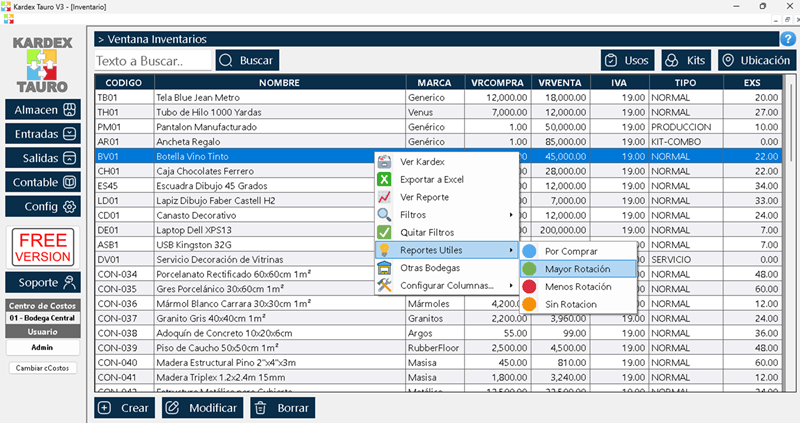
For this discipline to stick, recording a transfer must be as simple as the physical movement. Kardex Tauro allows internal transfers between warehouses or cost centers and lets you check the stock of each one at any time, so moving boxes from the back room to the front is recorded in seconds and both balances update instantly, without touching invoicing or losing traceability.
If you also use minimum stock alerts and location reports, the front and the back room stop being a source of daily argument and become two numbers that always add up.
Conclusion
The front and the back room are not enemies, and they are not the same thing: they are two locations of the same inventory, each with its own job and its own risk. Sales happen at the front and deduct stock; transfers happen between the back room and the front and only move units from one balance to another. Setting display minimums, counting the front often and recording every movement with its correct type leaves you with a control that answers the two questions that matter every day: how much do you have to sell, and how much do you have to refill with.
Start simple: separate the two spaces in your records, set minimums for your ten fastest-moving products, and record the next box you take from the back room to the front as a transfer, not as a sale. On that foundation, inventory stops being a decorative number and becomes the most reliable management tool in your store.