Roles in inventory control: who should do what in your business

Roles in inventory control: who should do what in your business
In a business with two, five or ten employees, almost everyone ends up touching inventory at some point: the person who receives the goods from the supplier, the one at the counter, the one who asks for replenishment, the one who counts the stockroom at the end of the month. Everyone taking part is not the problem. The problem appears when anyone can do everything and afterwards nobody can tell who did what.
Separating duties is not a requirement of large companies with internal audit departments. It is a practical move for a small business: spread the inventory tasks across several people, even if the team is only three, so that mistakes become visible and internal theft is much harder to sustain over time. In this article you will see which roles are worth defining, which permissions to give each one, which functions are the most sensitive and where to start without creating conflict with your team.
Why separate roles even when you only have three employees
Internal control rests on a simple idea: no single person should control every stage of an operation alone. In inventory, the full cycle is ordering, receiving, storing, recording, selling and reconciling. When the same employee receives the goods, records the receipt in the system, dispatches orders and also runs the count that confirms the stock, that person controls the whole cycle from start to finish. If something goes off track, a box that arrives incomplete, a withdrawal without an invoice, a count that does not match, that person can fix the records, hide the difference and nobody else ever finds out.
This is not about distrusting anyone in particular. It is about designing the business so that an honest person is not tempted and a dishonest one cannot operate without leaving a trace. Experience in any business with more than one employee confirms it: most inventory losses do not come from spectacular external theft, but from the combination of carelessness, poorly made records and opportunities that repeat every single day.
The golden rule: custody, records and reconciliation should not rest on one person
To keep it practical, separate three basic responsibilities:
- Custody: keeping the goods locked up or on the shelf, receiving them from the supplier and dispatching them.
- Records: entering receipts, withdrawals and sales in the system, with date and responsible user.
- Reconciliation: physically counting the stockroom and comparing the result with what the system says, to find differences.
If the same person handles custody and records, then at least the count should be done by someone else, or always with two people present. In a three-person company this works by combining responsibilities: the owner reconciles and reviews, the warehouse worker keeps custody and records, the salesperson invoices. You do not need to hire anyone new; you only need to decide who reviews whose work.
Typical roles in a small business
You do not need a formal organization chart, but you should have five functions clear, even if several of them fall on the same person:
- Owner or administrator: the owner of the information. Approves adjustments, write-offs and price changes, and sees every report.
- Warehouse worker: receives the goods, puts them away, dispatches them and records receipts and withdrawals.
- Salesperson or cashier: sells, invoices and checks stock. Does not create products or adjust anything.
- Buyer: creates the purchase orders and checks stock reports to replenish on time.
- Accountant: sees the valued reports and reconciles inventory with the accounting books.
Function matrix: who can do what
This matrix summarizes the day-to-day functions and which role can perform them. It is the basis for setting the permissions in your inventory system:
| Function | Owner or administrator | Warehouse worker | Salesperson or cashier | Buyer | Accountant |
|---|---|---|---|---|---|
| Receive goods and check against invoice | Yes | Main | No | Can support | No |
| Record receipts in the system | Yes | Main | No | No | No |
| Dispatch and record withdrawals | Yes | Main | No | No | No |
| Sell and invoice | Yes | No | Main | No | No |
| Check stock levels | Yes | Yes | Yes | Yes | Yes |
| Create products and set prices | Yes | No | No | No | No |
| Create purchase orders | Yes | No | No | Main | No |
| Adjust stock levels | Owner only | No | No | No | No |
| Write off products | Owner only | No | No | No | No |
| See costs and margins | Yes | No | No | Per policy | Yes |
| Take part in counts | Supervises | Accompanied | Can support | No | Witness |
| Authorize returns | Yes | No | Up to a limit | No | No |
Read it this way: each row is a function and each column is a role. A No does not mean the person is incapable of doing the task; it means the system should not allow it, so that every movement leaves a trace and nobody runs the whole cycle alone.
Which permissions to give each role, and why
This second table turns the matrix above into concrete permissions for the software, with the reason behind each decision:
| Permission | Who holds it | Why |
|---|---|---|
| Adjust stock levels | The owner and at most one delegate | It is the one function that can erase the truth of the inventory; if everyone can adjust, differences get corrected in silence and the business never learns what really happened. |
| Create products and change prices | Owner or administrator | A salesperson with that permission could create discounts, phantom products or special prices with no oversight. |
| See the product cost and margin | Owner and accountant | Cost is sensitive information: whoever sees the margin can give it away in a negotiation or leak it to a customer. |
| Record receipts and withdrawals | Warehouse worker | Keeps the daily flow up to date and leaves a trail: you always know who received or dispatched what. |
| Sell and invoice | Salesperson or cashier | It is their natural function; the system must always record who made each sale. |
| Create purchase orders | Buyer and owner | Centralizes purchasing so nobody orders goods without control. |
| Write off products | Owner | A badly done write-off removes inventory from the system without anyone noticing. |
| See valued reports | Owner and accountant | Reports that show money are not for the whole operation; give them only to those who need them. |
Inventory adjustments: the most sensitive point
Of all the functions, adjustments are the ones that can do the most damage. An adjustment changes the stock level shown by the system so that it matches reality, or what someone says is reality. When a count does not add up and goods are missing, the easiest path is to adjust the number and move on. If every employee can do that, the inventory never shows the truth: each difference is corrected in silence and the business loses the ability to find out what is really happening.
That is why the rule must be strict: adjustments stay reserved for one or two people, usually the owner and, at most, one trusted delegate. Every adjustment must require a mandatory cause: shrinkage, damage, expiry, counting error, theft. And it must stay in the history with the name of the person who authorized it, the date and the reason. Once a month, review the adjustment report: if you see many adjustments on the same product, from the same employee or always in the same shift, there is a problem worth addressing before it grows.
When an employee reports a difference, the right answer is not to fix the number on the spot. The right answer is to count again, look for the misplaced goods, review the day sales and dispatches, and only then, with evidence, authorize the adjustment. That small ritual separates businesses that know what they have from businesses that only believe they know.
Write-offs, costs and returns: three decisions that are not for everyone
Besides adjustments, there are three decisions worth keeping under control:
Writing off products. A write-off removes goods from the inventory. If any employee can write products off, an item that was lost or given away can disappear from the system without an explanation. Write-offs should stay in the hands of the owner and always carry a visible justification: damage, expiry or obsolescence.
Seeing the cost. The purchase cost is sensitive information because it reveals the margin of every product. If a salesperson sees the margin, they may end up giving it away in a discount or leaking it in a conversation. Define who sees costs: usually the owner, the accountant and, maybe, the buyer, who needs them to negotiate with suppliers. Reports that show the profit per product should not be opened at the point of sale.
Handling returns. Returns give back money or goods, and that invites abuse: a cashier could accept the return of a product that was never sold and keep the cash. Define a simple rule: returns up to a certain amount are authorized by the salesperson, and above that amount they are authorized by the owner or the administrator. The system must always record the reason and who authorized each return.
How to implement this without drama in your business
Changing the way people work can feel like a judgment against the team if it is announced badly. The key is to present it for what it is: a way for the inventory to tell the truth and a way to protect everyone. Nobody should be left in the position of being the only one responsible for a shortage they did not cause.
Start with three rules, without needing to reorganize the whole company:
- Adjustments only for the owner. Nobody else modifies stock levels; if someone finds a difference, they report it and the owner decides after verifying it.
- Counts always with two people. Every count is done with a witness and both people confirm the result before it is loaded into the system.
- Limited access to the stockroom. Only two people have physical access to the warehouse, keys are not lent and every entry is recorded with a movement in the system.
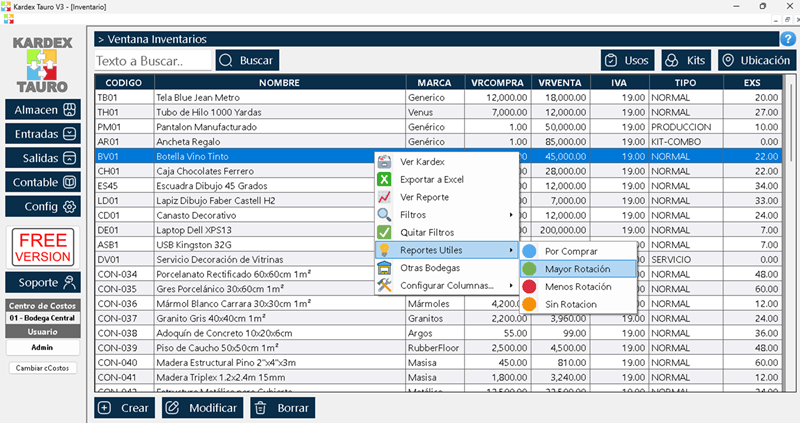
The next step is to reflect those rules in the software: each employee logs in with their own user and sees only what their role needs. An inventory system like Kardex Tauro must allow giving different permissions to each employee, so that a salesperson can check stock and invoice, but cannot adjust, write off or see costs. If the software does not distinguish users, the business depends on everyone's word, and that is exactly what we want to avoid.
Announce the changes calmly, explain the reason behind each rule and leave a channel for the team to report differences without fear. Within a few weeks, the new rules stop feeling like control and become the normal way of working.
Benefits of separating roles: less shrinkage and trustworthy numbers
When roles are defined and permissions work, the results show up in the day-to-day:
- Less shrinkage from internal theft. Someone who knows another person will count and review thinks twice before taking advantage of an opportunity.
- Errors traceable to a person. When every movement is linked to a user, finding an error is a matter of checking the history, not of asking everyone.
- Knowing who to train. If errors concentrate on one employee or one shift, you know exactly where to invest training.
- Reliable inventory for buying. With numbers that tell the truth, you stop overbuying out of fear of running out of stock and underbuying because you believe you have more than you do.
- A calmer team. Clear rules protect honest people: nobody stays under permanent suspicion and nobody carries alone the responsibility for what others touch.
Separating roles does not solve every problem in the business, but it removes the most common cause of silent losses: one single person controlling the whole inventory cycle. If you define roles, assign permissions and protect the adjustments, inventory starts working in your favor. And if you are looking for software that supports that scheme, demand that it respects roles: with a system like Kardex Tauro, everyone does their part and you keep the full picture of what you have, what is missing and what is being lost.