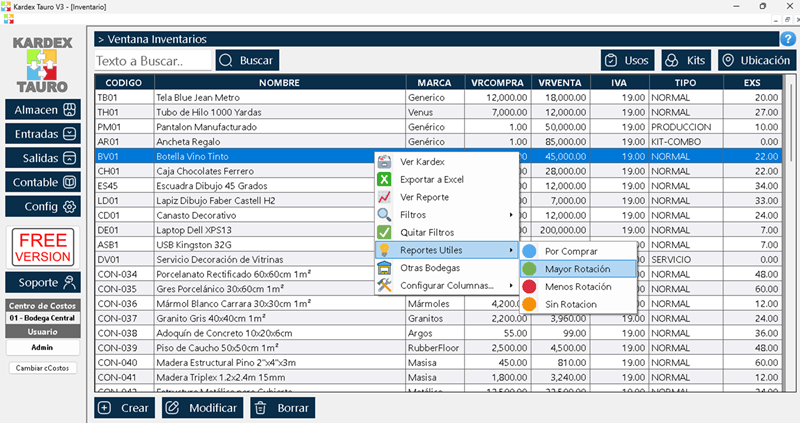
The product record: what data it needs from day one

The product record: what data it needs from day one
Setting up a product looks like a one-minute task: open the form, type a name, save. In practice, that record becomes the identity of the item for purchasing, sales, the warehouse, accounting and auditing. If it is born wrong, every process that uses it carries the error for years; if it is born right, most of the operation runs on its own. This article walks through the fields no product record should leave empty, with concrete examples, the most common mistakes in item setup, and the rules that keep the item master data healthy.
Why the record decides the rest of your operation
The item master is the base everyone looks at: the purchase order copies the name and the code, the goods receipt copies the unit of measure, the invoice copies the price, the stock card copies the cost and the physical count copies the location. If the record has a wrong or empty field, the error does not show up on the day of setup. It shows up weeks later, at the worst possible moment: in an order that cannot find the product, on an invoice with no cost, in an inventory count that does not balance.
The uncomfortable part is that the cause is usually a tiny detail: a wrong unit of measure, a name that does not say what the product is, a code that only its creator understands. That is why it pays to treat the record as infrastructure rather than paperwork. A good record prevents questions, corrections and reconciliations that today are paid for with hours of work.
The essential fields, one by one
Not every business needs the same fields, but there is a common core that works for any catalog. The table below summarizes what to ask for when creating a product, with a realistic example and the reason each field matters.
| Field | Example | Why it matters |
|---|---|---|
| Internal code | LUB-0012 | It is the unique reference that purchasing, sales and the warehouse use to talk about the same item. Without a clear rule, each area invents its own. |
| Product name | Motor oil 10W-40, gallon | It is the first thing read when searching or picking. A complete name avoids opening the record to guess what the product is. |
| Category | Lubricants | It groups the catalog, organizes reports and lets you apply policies by product family. |
| Unit of measure and pack | Unit; case of 12; kilo | It defines how the item is counted and sold. If it is missing, the same product is handled in different ways without anyone noticing. |
| Purchase cost | 12.500 per unit | It is the base of the margin and of inventory valuation. An empty cost produces profit reports that mean nothing. |
| Sale price | 18.900, counter price list | It is what the point of sale charges. It should be tied to a price list so it does not depend on the cashier's memory. |
| Main supplier | Andina Distributors Inc. | It speeds up replenishment and returns, and concentrates negotiation power on the items you buy most. |
| Barcode | EAN 7701234567890 | It lets you scan the product at checkout and during counts without typing, and avoids keying errors. |
| Warehouse location | A-03-02 | It points to aisle, shelf and position. It speeds up receiving, picking and physical counts. |
| Applicable taxes | VAT included; exempt; excluded | It avoids invoices with the wrong tax treatment and customer claims for incorrectly calculated charges. |
| Status | Active / Inactive | It retires an item from sale without erasing its history or breaking previous reports. |
With these fields complete, the record already answers the questions every process asks: what the product is, what code it goes by, how it is counted, what it costs, what it sells for, where it is and who it is bought from. The rest depends on the type of business.
Fields that depend on the type of business
Each line of business adds data that would be noise for others. The rule is simple: if a field will filter, sort or decide something, it deserves a place in the record; if it will only decorate, leave it out.
| Additional field | Example | When it applies |
|---|---|---|
| Expiry date and batch | Batch L2407, expires 2026-11-15 | Food, beverages, pharmacy and chemicals. Without this data you cannot pull expiring items in time or handle a claim about a specific batch. |
| Serial number | Unique serial per unit | Electronics, appliances and machinery, where each unit has a warranty and needs individual traceability. |
| Size and color | Size M, black | Apparel and footwear. If they are missing, the inventory mixes references that are not the same, and the warehouse never has what the invoice says. |
| Photo | Picture of the packaging | Warehouse and point of sale. An image prevents confusing two similar presentations and speeds up visual recognition. |
The internal code: unique, ruled, and forever
The internal code, or SKU, is the most mistreated field in the catalog. Some people build codes with dates, initials, colors and even the price of the day. Those codes make sense to their creator for one afternoon, and to nobody else ever. A code does not need to be pretty: it needs to be unique, stable and assigned under a written rule. A practical format is a short category prefix plus a sequential number, like LUB-0012 or FER-0087.
- Be unique: no other item can hold it, not even one that was already retired.
- Have a written rule: whoever assigns it must be able to explain how it is generated without hesitating.
- Be stable: it does not change when the price, the supplier or the warehouse changes.
- Be short: just enough to identify, not to tell the product's life story.
Beware of the code with too much meaning. When the code tries to summarize category, brand, color and date, the rule becomes fragile and someone always ends up creating variants that do not follow the format. Category, brand and color already live in their own fields; the code only needs to tell one item from another.
The name: a convention everyone understands
The name is the most visible field and the most neglected one. Without a convention, the same product shows up as Motor oil 10W-40, Engine oil gallon and Lubricant for engines: three records that search shows separately and nobody recognizes as one. A formula that works is: brand, description and presentation or size, in that order and with no ornaments.
- Case of 12 does not say what it contains; Saltine crackers, case of 12 packs does.
- Special rice does not describe anything; White rice, 1 kg bag does.
- Shirt without a size forces you to open the record; Long-sleeve shirt, size M is understood in the list.
Selling adjectives have no place in the item master. Delicious, economical and best quality are marketing words; inventory does not sell, it counts. If the adjective does not help tell one product from another, it does not belong in the name.
Cost and price: what gets updated, and when
Two fields of the record live in motion: the purchase cost and the sale price. The typical mistake is treating them as data entered once. Cost changes with every negotiation with the supplier and should be updated at the moment goods are received, not when someone remembers to do it.
What works is defining who does it and when: purchasing updates the cost upon receipt, with the supplier invoice in hand, and nobody else edits it. Sales or management defines the price and the list it belongs to. If anyone can touch those two fields, no margin report will ever be trustworthy again.
Anyone who keeps a real stock card knows that the cost shown on the record must be the same one that values the inventory. Tools like Kardex Tauro exist so that this data travels with every movement and nobody has to fix it by hand afterwards.
Mistakes that cost you dearly later
Most catalog pain is not born in the software but in the setup. These are the most repeated mistakes:
- Codes that mean different things to different people. Purchasing uses the supplier's code, the warehouse uses its own sequence and sales searches by name: the same product ends up with three identities. A single internal code, under a rule, solves it.
- Incomplete names. Case of 12, Spare part or Screw 5 are useless for anyone who was not at the setup. If the name cannot be understood on its own, it is badly done.
- Mixing units. Creating the same product by unit and by case as two separate records breaks the inventory: stock piles up in one and is missing in the other. The base unit is defined once and the presentations are derived from it.
- Ignoring the factory barcode. If the product already carries a printed EAN, that is the best identifier for scanning; inventing your own only adds an unnecessary translation between the box and the system.
- Duplicate records. Setting up the same item twice with minor spelling differences splits the stock and forces a catalog cleanup that always costs more than preventing it.
And a silent rule: if a field can stay empty for now, it will stay empty forever. The incomplete record is a problem you pay for every time someone looks it up.
The golden rules of item master data
More than tools, what keeps a catalog clean are four operating agreements:
- One single person, or one single format, creates the products. Everyone else requests the setup and nobody does it on their own. With a clear owner, format errors are corrected once and stop repeating.
- The code is never reused, not even after retirement. A recycled code erases the previous item's identity from history: old reports, purchases and invoices end up pointing at the wrong product. Once retired, the code rests forever.
- Master data is reviewed when buying and when selling. When goods arrive, check cost, supplier and pack; when selling, check price and list. Those two control moments keep the record alive without massive cleanup campaigns.
- The name and the unit do not change after the first movement. If the presentation changes, evaluate whether it is a new product; renaming an item with history breaks the continuity of its reports.
If those agreements are respected, the record stops being a form and becomes the control point of the whole inventory.
A record done well works every day
Setting up a product is the only moment when the data is captured calmly; after that, everything is urgent. That is why it is worth doing it right from day one: define the fields, write the rules and name the person responsible before the catalog grows.
The difference between an inventory that defends itself and one that demands endless reconciliations is, almost always, the quality of its records. Inventory and stock-card software like Kardex Tauro organizes the daily work, but the starting point, the record created properly, is still your decision.