Held or reserved merchandise: how to control it without losing the sale
Held or reserved merchandise: how to control it without losing the sale
"Hold that blouse for me, I will come back Saturday to pay for it." The salesperson nods, the customer leaves, and the blouse stays on the same hanger, with no tag and no note. On Saturday the customer comes back and the blouse was sold on Thursday. Or the silent version: nobody sold it, the customer never came back, and the blouse has been hanging for two months with an invisible "on hold" sign. Both scenes are the same mistake: a hold was accepted by word of mouth and nobody controlled it.
A hold — also called a layaway, a reserved item or held merchandise — is a promise of sale: the customer commits to buying a product within a short period, often leaving a deposit, and the business commits to not offering that piece to anyone else while the period lasts. Handled well, it is a real selling tool: it keeps an undecided customer engaged, secures the transaction and builds trust. Handled badly, it is a source of complaints, refunds and frozen merchandise that nobody dares to sell. The difference between one outcome and the other is not goodwill: it is the record.
The word-of-mouth hold: a promise with no memory
When a hold exists only in the salesperson's head, the store depends on someone else's memory and on the shift schedule. The person who accepted the promise goes off duty at noon; the afternoon-shift colleague sees the blouse, does not know it is committed and sells it. The promise never traveled from the counter to the inventory: it stayed a conversation. And a conversation does not stop another customer from paying and walking out with the item.
Recording the hold the moment it is accepted is not mistrust toward the customer: it protects the customer and protects the business. The customer needs to know that his word was written down, that the item is safe and that there is a date to come back. The business needs to be able to prove it when the item is at stake. That is why the first step of control is not technological or complicated: it is writing it down.
The problem of selling the same item twice
The word-of-mouth hold produces the most expensive mistake at the counter: selling the same merchandise to two people. Customer A asked to have the item set aside; customer B arrives, likes it, pays and takes it. When A comes back for it, every way out is bad: telling him it is gone (he loses trust and the deposit must be returned), asking him to accept another piece (he feels at a disadvantage) or handling a complaint that ends up with the manager.
The scene repeats in any store that sells physical products:
- The one-of-a-kind or display piece that two customers want at the same time.
- The last unit of a size, color or model that was on hold for someone.
- The product a salesperson set aside for an acquaintance and forgot to tell coworkers about.
In all three cases the mistake was not selling: it was holding without a record. If the reserved merchandise were marked as unavailable for sale, customer B would have picked another option and customer A would have found his item waiting for him.
The other failure: merchandise held in limbo
The second failure is silent: the customer never comes back and the merchandise stays "on hold" forever. Nobody sells it because, in theory, it is committed; nobody releases it because nobody remembers since when. The piece takes up its space on the shelf or in the stockroom and the money invested in it sits still. For a small business, a blouse or a power tool frozen for months is working capital tied up.
The curious part is that frozen merchandise feels like a safe sale: "it is already on hold, it already has an owner." But it was never invoiced, never collected and nobody knows if it ever will be: it is a sale that exists only in intention. The deadline passes, nobody calls the customer and the piece moves from "on hold" to "forgotten". Releasing expired holds and offering the merchandise again is also part of hold management.
A hold is not a sale, and it is not a credit sale
It is worth being clear about the practical and accounting difference. In a credit sale, the merchandise is delivered, an invoice is issued and an account receivable is born: the customer owes the money and that is part of your receivables. In a hold, the merchandise remains in your possession, there is no invoice and there are no receivables: there is a promise and, sometimes, a deposit. The risk of a hold is not collection risk, it is inventory risk: the item being sold twice or never being sold at all.
That distinction changes how you see the deposit. The deposit on a hold is not payment for a sale: it is the customer's sign of commitment and compensation for the time the business keeps the merchandise reserved. That is why a hold is not recorded as a sale or as a payment on account; it is recorded for what it is: reserved merchandise with a purchase promise and a deadline.
What every hold must record
A well-taken hold captures, on the spot, enough information for anyone in the store to understand it without asking:
- Customer: full name and a phone number or way to reach them.
- Product: exact description, size, color or reference, and the quantity.
- Agreed price: the value guaranteed to the customer, written down.
- Deposit received: how much was paid and how, cash or transfer.
- Deadline: the date until which the reservation is kept.
- Conditions: what happens if the customer does not come back before the date.
The agreed price deserves its own line: if the product goes up during the hold period, the customer pays the price he was promised; if it goes down, the fair thing is to charge the lower one. Writing the price down avoids the most common counter argument: "you told me it cost less."
Mark the merchandise as reserved
Once the hold is recorded, the item must leave the available stock for other customers. If your point of sale or inventory system can separate reserved quantity from available quantity, use it: that is the difference between a real reservation and a piece of paper in the cash drawer. In the inventory, the product is still yours and still counts in the physical stock, but it stops counting as available to sell.
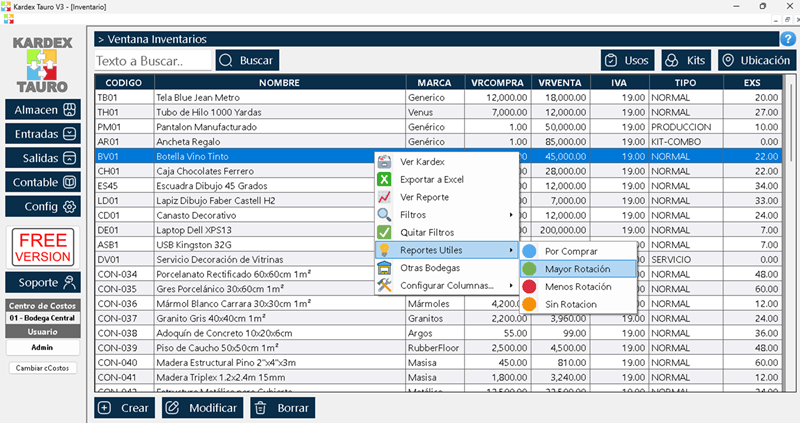
The logic is simple: available for sale = physical stock − reserved merchandise. If you have five drills and one is on hold, four are available: the system should offer four for sale and keep the fifth for the customer who reserved it. Doing that same operation from memory is exactly what causes double sales. An inventory system with a reserved status, like Kardex Tauro, makes that separation automatic and keeps the item ready to become a sale when the customer returns.
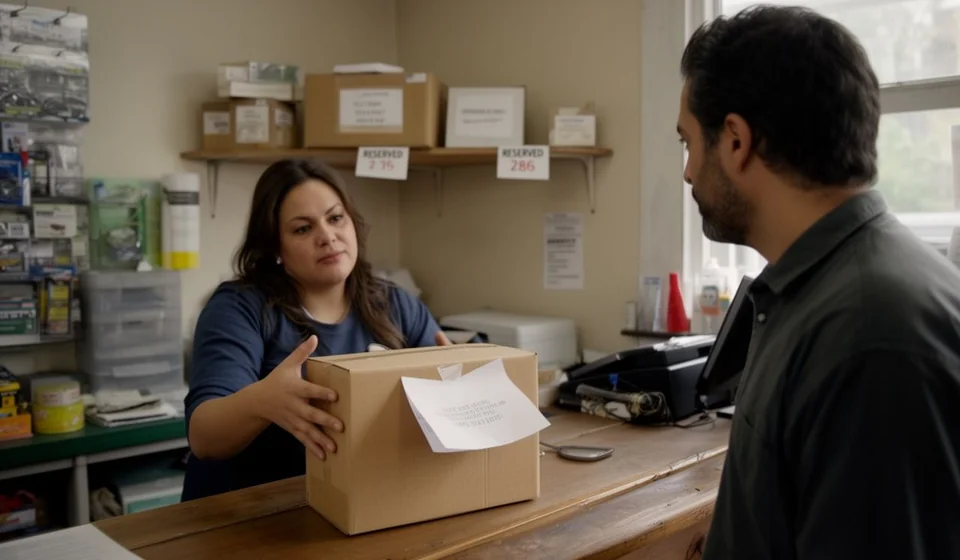
The reservation must also be visible in the physical store: a note on the box or package with the customer's name and the deadline stops another salesperson from offering it. The sign does not have to be pretty, it has to be clear: "On hold for Laura until the 12th."
A sample hold log
A simple table with statuses solves the day-to-day follow-up. Each row is one hold and each status says what to do with it:
| Customer | Product | Quantity | Deadline | Deposit | Status |
|---|---|---|---|---|---|
| Laura Méndez | Display blouse, size M | 1 | Until September 12 | 20% of the price | Active |
| Carlos Rueda | 26-inch bicycle | 1 | Expires tomorrow | 10% of the price | Expiring: call today |
| Ana Torres | 18 kg washing machine | 1 | Until September 19 | 30% of the price | Active |
| María Gil | Cookware set | 1 | Expired September 8 | No deposit | Released and back on sale |
| Diego Salazar | Hammer drill | 1 | Until September 15 | 15% of the price | Converted to a sale on September 10 |
Four statuses are enough to run the list: active, while the deadline is still running; expiring, when one or two days remain; converted to a sale, when it was paid and invoiced; and released, when it expired and the merchandise went back to the available stock. If your list has no status, it has no control: it is a drawer full of promises.
The deadline: three to eight days, depending on your business
The hold period must be short and explicit. In practice, most retailers work with three to eight days: long enough for the customer to gather the money or check with whoever decides, and short enough that the merchandise does not freeze. A seasonal or fast-moving product calls for shorter periods; an expensive item or a considered purchase can tolerate a few more days.
What matters is not the exact number, but that it exists and is said out loud when the hold is accepted: "I will keep it for you until Thursday; if you do not come back, the item goes back on sale." A customer who hears the date from the start is not surprised later, and the salesperson has a clear reason to call before it expires.
Define what happens if the customer does not come back
The release policy is decided beforehand, not after the deadline has already passed. The options most used in retail are:
- Release the merchandise automatically when the period ends and offer it again.
- Keep the deposit as compensation for the reserved time, if that was the agreement.
- Apply the deposit to another purchase by the same customer, if he prefers and the store accepts.
Any of the three is valid if it was agreed with the customer and stated in writing or on the hold receipt. The policy must respect the local consumer protection rules in force: it is wise to check with an advisor what your country's regulations say about deposits and cancellations before setting the fine print. What must not happen is improvising the answer when the customer is already at the counter asking for his deposit back.
Follow-up: review the list of holds about to expire
A hold is not controlled on the day it expires: it is controlled before. A daily or every-other-day review of the list of expiring holds is enough for most businesses. The goal is to call or message the customer who is one or two days away from losing his reservation, not to pressure him, but to remind him that the item is waiting.
A polite, concrete message works better than a claim: "Hi Carlos, this is the store: the bicycle you reserved is ready until tomorrow. If you cannot make it, let us know so we can figure out how to help." That call turns doubtful holds into sales and abandoned holds into clean releases, with no hard feelings. Whoever calls on time wins customers back; whoever waits until the deadline passes loses the sale, and sometimes the customer.
When the customer returns: the hold becomes a sale
The moment of truth is payment. When the customer comes back within the period, the hold becomes a normal sale, with the same merchandise that was reserved:
- Check the hold record and the identity of whoever claims the item.
- Take the reserved merchandise out of the physical hold area.
- Apply the deposit to the agreed price and collect the balance.
- Invoice the sale and hand over the item, with its warranty if applicable.
- Change the hold status to converted to a sale.
At that moment, and not before, the merchandise leaves the inventory: the sale deducts from stock the exact item that was reserved. If the hold record and the sale live in the same system, the operation is one click: the reservation closes and the stock record registers the exit. If they live on separate papers, someone has to remember to cross both, and that is where inventory differences reappear.
If the customer changes the product or asks for more time
Changes are handled without drama, but always with a record. If the customer comes back and prefers another item, the original hold is released, the merchandise goes back to the available stock, and a new hold is recorded for the chosen product, keeping the deposit already received. If he asks for more time, the reasonable move is to grant it once and for a few days, updating the deadline and leaving a note of the new expiration date.
The limit on changes is the same as on the deadline: merchandise must not stay frozen out of politeness. A hold that is renewed three times while the customer pays nothing more is not a purchase promise: it is an occupied shelf. Friendliness is shown with clear rules, not with open-ended promises.
The deposit: a commitment, not income
The deposit deserves separate treatment at the register. It is not profit, it is not a sale and it is not a payment against receivables: it is the customer's money backing a promise. Until the sale is completed, that money is an obligation of the business, to return or to apply as agreed, and it must be recorded as such, with its receipt and a reference to the related hold.
When the sale happens, the deposit is deducted from the total and the hold receipt is attached to the invoice. When the hold is released, the deposit follows the agreed path: it is returned, kept or applied to another purchase. On any of those paths, the record lets you answer without hesitation how much the store received, for which product and under what conditions.
A well-managed hold turns a fragile promise into a scheduled sale: the customer knows his item is waiting, the store knows who to call and the merchandise is never sold twice or left frozen. A point of sale that can separate reserved merchandise from available stock, like Kardex Tauro, lets the system remember what the counter's memory forgets, and the salesperson only has to do what he does best: serve the customer and close the sale when he comes back.
