Inventory by project: how to assign materials without mixing warehouses

Inventory by project: how to assign materials without mixing warehouses
If your company runs more than one project at a time — two construction fronts, installation contracts for different clients, scheduled maintenance jobs, or several events in the same month — you probably recognize this scene: the supplier delivers the order, someone writes "received" in the notebook, and the material sits in the warehouse with everything else. Weeks later, when it is time to bill project A, nobody can say how much cement, pipe or cable went from that warehouse to project A and how much went to project B. Material cost is one blurred number and each project's profit becomes a guessing game.
The problem is not a lack of control; it is that control is being done backwards. You buy "for the company" and later try to guess which project consumed what. What actually works is to reverse the order: open an independent inventory for each project from day one, point every purchase and every consumption at that project, and treat transfers between projects as explicit, recorded movements. This article explains how to do it, with a numeric example you can replicate in your own operation.
Why mixing materials gets expensive
When materials for two or more projects share a warehouse and a record, the same symptoms appear over and over. First, real cost per project disappears: if you buy 100 bags of cement for three work fronts, the invoice stays "in the company" and at the end of the month you cannot tell how much belongs to each contract. Second, client invoices are built on estimates: you charge roughly what you spent, and when the client asks for detail there is no clear support of quantities per item. Third, losses and leftovers get mixed up: leftover material from project A is used on project B without being recorded, nobody deducts it from inventory, and at the closing count of project A the numbers simply do not add up.
The most common pattern in small and mid-sized construction firms is centralized purchasing paid from the general cashbox. It is convenient and often necessary — the supplier dispatches one order and freight is used more efficiently — but if the material received is not assigned to a project right away, the record gets contaminated. The same happens in installation companies that buy pipe and fittings "for the month" and then split them among several contracts without leaving a trace, and in event companies that receive pallets, tents and décor for several dates at once.
The worst part is that the cost of this disorder is not visible in the warehouse: it shows up in profitability. A project that on paper left a 12 percent margin may have consumed materials from the other one, and the project that was actually profitable ends up charged with someone else's expenses. Billing wrong, quoting wrong and making decisions with those numbers is the inevitable result.
The solution: a virtual warehouse for each project
The idea is simple: each job, contract or project has its own inventory, as if it were a separate warehouse, even when the materials are physically in the same place or spread across several sites. In inventory terms, this is called working with cost centers: each center represents a project and accumulates its own receipts, issues and balances. The central warehouse, if you have one, is just another center: the transit point for purchases, not the drawer where everything gets mixed.
Under this scheme every movement has a clear origin and destination. A purchase is recorded as directed to the project that requested it, or it is received at the central warehouse and transferred to the project immediately. A consumption is recorded against the project: the crew withdraws material and that material leaves that project's inventory. A leftover is transferred back to the central warehouse or to another project that needs it. Nothing floats around "with no owner".
This does not require extra physical warehouses or more store staff. It does require discipline in recording and a tool where each project keeps its own balance, viewable at any time.
A worked example: 1/2-inch pipe
Let's look at a concrete case, the kind that happens every day. The company buys 100 PVC pipes of 1/2 inch centrally, for two active projects: project A, a home extension, and project B, a commercial unit. The material arrives at the central warehouse; from there 60 pipes are transferred to project A and 40 to project B. During the month, project A consumes 40 pipes and project B consumes 25. This is how the inventory looks:
| Movement | Central warehouse | Project A | Project B |
|---|---|---|---|
| Central purchase: 100 pipes of 1/2 | +100 | 0 | 0 |
| Transfer to project A: 60 pipes | −60 | +60 | 0 |
| Transfer to project B: 40 pipes | −40 | 0 | +40 |
| Consumption of project A: 40 pipes | 0 | −40 | 0 |
| Consumption of project B: 25 pipes | 0 | 0 | −25 |
| Final balance | 0 | 20 | 15 |
At the end of the month you know three things that were impossible to know for sure before: project A has 20 pipes left, project B has 15 pipes left, and each project's material cost matches exactly its recorded consumption — 40 and 25 pipes times their unit cost. If project B finishes and those 15 pipes remain, they are transferred to the central warehouse or to project A: they do not sit piled in a corner, they are not charged to the next contract without a record, and they are certainly not written off as lost.
The same exercise applies to bags of cement, cable reels, paint, fasteners or event supplies. The product does not matter: what matters is that every movement has a project as origin or destination.
How each movement is recorded in practice
Directed purchasing is the first step. When the site supervisor requests material, the purchase order is issued in the project's name and the receipt is recorded directly into that project's inventory. When the purchase is central, the receipt goes into the central warehouse and the transfer to the project is recorded the same day, with the exact quantity dispatched. A single unassigned movement, and next month the "nobody's material" is back.
Consumptions are recorded against the project. On site this relies on a withdrawal slip: the crew from project A takes 10 pipes and signs; the storekeeper deducts those 10 pipes from project A's inventory. No long forms are needed: the exit just has to be linked to the right project and the real date, because both the cost and the progress of the project come from that record.
Transfers between projects are also recorded as transfers, with their own date and quantity. If project A needs 5 pipes that are sitting in project B, you do not book a consumption in B and a phantom receipt in A: you record a transfer from B to A and both balances stay correct. Returns to suppliers and site leftovers work the same way — always with a project as origin or destination.
The rules that make the scheme work
- Create the project before the first purchase. If the cost center does not exist, the inventory does not exist: nothing is recorded "for now, we will decide later".
- Point every purchase at a project. If the purchase is central, transfer the material the same day it is received; if you do not know which project it is for, that purchase should not have been made.
- Forbid "nobody's material". Every balance must belong to a project, to the central warehouse or to a specific job. Unassigned material is what later shows up as shortages or as invisible cost.
- Record consumptions against the project that uses them, with a withdrawal slip, the same day or no later than the next day.
- Run a physical count per project at closing. When the job ends, count what is left, compare it with the system balance and transfer the surplus: to the central warehouse, to another project or, if you decide so, return or sell it.
Discipline is the weak link in most companies, and it is not solved with more forms: it is solved with a short daily routine, five minutes, in which the storekeeper or the site supervisor confirms the day's movements.
What you gain with per-project inventory
The most direct benefit is knowing the real material cost of each project, and with that, billing and quoting better. The client invoice stops being an estimate: it is backed by the issues recorded against that project. The next quotation is based on what similar projects actually consumed, not on the estimator's hunch.
The second benefit is profitability per project. With receipts, issues and balances separated, the margin of each contract is calculated without mixing figures: project A's materials against project A's income. That is where the projects that looked good but were not show up, along with the consumption excesses nobody noticed and the oversized orders from supervisors who buy "just in case".
The third benefit is that surplus material is not lost. The 15 pipes left when project B closes are reused on the next job, and their cost was already charged to the right project. Project closing becomes clean: counted inventory, transferred leftovers, invoices with proper support and a free warehouse for the next job.
The role of stock ledger software with cost centers
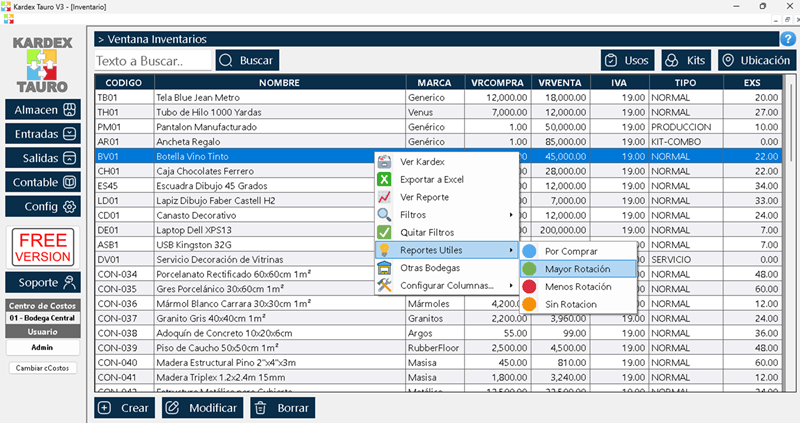
Doing this in a notebook or spreadsheet becomes unsustainable as soon as more than two projects are active, because every product needs its own per-project tracking and transfers double the work. That is why the scheme relies on an inventory system. Kardex Tauro supports several cost centers — for example, one per project: each center keeps its own stock, transfers between centers are recorded as movements, and the stock of each project can be checked separately at any time.
In day-to-day work this means the storekeeper stops asking "how much pipe do we have left?" and asks "how much pipe does project A have left and how much does project B have?", which are two different answers and both correct. With that information, deciding a transfer, approving a purchase or closing a contract stops being a leap into the dark.
Start with the next project
You do not need to reorganize the whole warehouse at once. The practical change is this: when the next project opens, create its cost center on the same day, register every incoming purchase in that project's name and issue consumptions from its inventory. Handling just one project this way already shows the difference; with two or three, mixed materials stop being a monthly problem. Per-project inventory is not one more report: it is the way to make every project pay exactly what it consumed and show the profitability it really has.