Packing and shipping supplies: the invisible inventory you should also control
Packing and shipping supplies: the invisible inventory you should also control
When an order leaves the warehouse, almost nobody thinks about the cardboard box protecting it, the roll of tape sealing it, or the bag it is handed over in. These are materials that travel with every sale but are never sold themselves: they carry no price tag, produce no invoice, and rarely show up in cost reports. That is why they make up the invisible inventory of a business, the one nobody controls, the one that gets used up every day without any report recording it, and the one that only becomes visible when it runs out, almost always at the worst possible moment, like a Monday in peak season, or at year end, when someone reviews how much went into packaging over the last twelve months and finds out the number was not small.
What packing and shipping supplies are
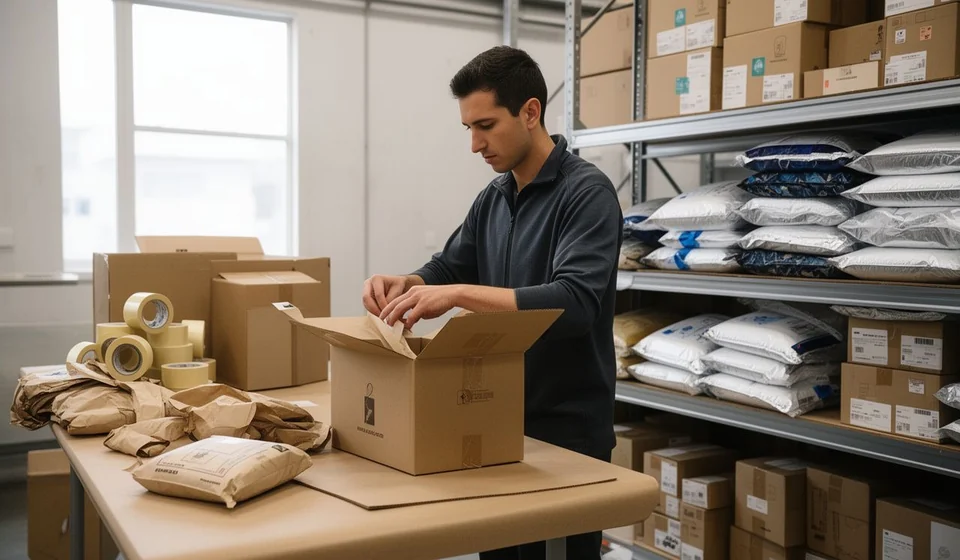
Packing and shipping supplies are all the materials consumed to prepare and deliver an order: cardboard boxes in several sizes, plastic or paper bags, packing tape, shipping envelopes and padded mailers, kraft paper for filling, shipping and address labels, stretch film, bubble wrap, corner protectors, dividers and seals. What all of them share is that they are never sold. They support the sale: without a decent box the product does not arrive in one piece, but the box itself generates no revenue and no invoice of its own. That quirk makes them invisible to billing and invoicing, and if the warehouse does not track them on its own, they turn into an expense that happens every day and leaves no trace.
Why they matter: a real cost on every single sale
Packaging is not an occasional stationery expense; it is a direct cost of the sale. Run the numbers in round figures: each online order consumes between $0.50 and $2.00 in materials, counting box, tape, filler and label. If the business ships 1,000 orders a month, that is $500 to $2,000 a month, or $6,000 to $24,000 a year, coming straight out of the margin. It is the same kind of cost as freight, with one key difference: freight arrives with a carrier invoice and gets recorded, while tape and boxes are taken from a shelf and nobody writes down the withdrawal. Nobody argues that they are necessary; the problem is that without a record, the business does not know how much it spends on them, or whether that spending is growing for no reason.
In an e-commerce, wholesale distribution or catalog operation, where shipments are counted in the thousands, packaging stops being a detail. An extra $0.20 in average packaging cost, multiplied by 40,000 shipments a year, is $8,000 less margin with not a single selling price changed. That is why high-volume shippers watch packaging cost per order with the same care they give to product cost or freight: it is the only way to know whether the dispatch operation is eating the profit.
How the money leaks out without anyone noticing
When there is no control, packaging money escapes through several channels at once:
- Excessive use: boxes bigger than needed, extra tape, double bags out of habit, overfilling. It does not look serious per order, but it adds up across thousands of shipments.
- Petty theft: these are small, light items that are easy to hide. A roll of tape or a bundle of bags every now and then is not noticed at the moment.
- Shrinkage and waste: boxes crushed by bad storage, rolls that get damaged, misprinted labels thrown away, film cut wrong and discarded.
- Purchasing with no reference: because nobody measures consumption, you buy too much and tie up cash in idle stock, or you buy too little and the dispatch area runs out at the worst time.
The pattern is always the same: the shortage is discovered late, and when it is, the urgent fix is usually buying at a premium with express freight, right in the season when the material costs the most. Urgency also pushes you to accept any supplier and any quality, so the problem repeats the next cycle.
The golden rule: treat them as inventory, not as loose expense
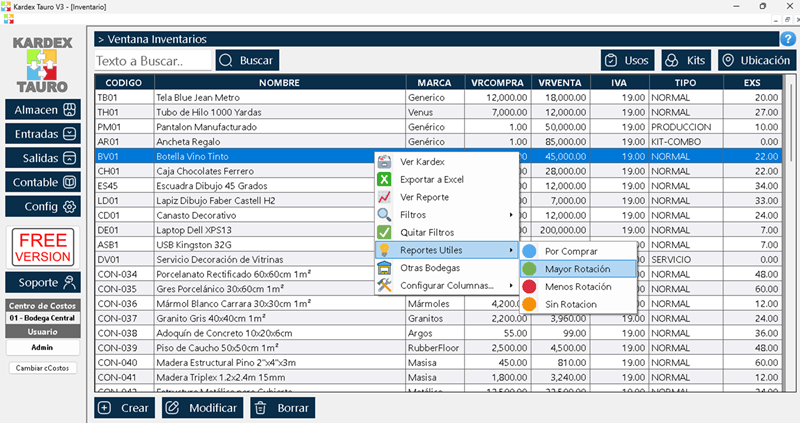
Shipping supplies deserve the same treatment as the merchandise you sell: they are purchased, received, stored, consumed and depleted, and all of that movement should be recorded. The only operational difference is that they leave without a sales invoice: they leave as consumption. Recording those withdrawals as internal consumption, as Kardex Tauro allows, closes the hole that forms when material leaves the warehouse without a trace: the cost stays visible, the stock stays up to date, and the monthly report says exactly how much was really spent on packaging.
Five steps to take control
- Set them up as products in the system, with their unit and their cost: boxes by unit, tape by roll, kraft paper by kilo or sheet. Without a cost loaded, there is no way to measure the expense.
- Record the withdrawal as internal consumption when they are used, meaning an uninvoiced issue for packaging consumption, or assign it to the sale when the system allows it, so you know the packaging cost of each order.
- Set minimum stock for the critical items: the box size you sell the most, the standard mailer, the tape. With lead time included, the purchase order is triggered before the item runs out, never in the middle of peak season.
- Restrict access: only the dispatcher takes from the packaging stock. When material is within everyone's reach, nobody answers for it; when one person is responsible, usage becomes measured.
- Measure packaging cost per sale: total consumed in the month divided by orders shipped. If the indicator goes up with the same number of orders, there is a variance to investigate.
What the monthly consumption table shows
Once consumption is recorded, the information fits in a simple table. Here is an example of a business shipping about 2,000 orders a month, with a mix of large and small products:
| Supply | Units consumed | Unit cost | Monthly total |
|---|---|---|---|
| Cardboard boxes (17 x 12 x 9 in) | 1,850 | $0.45 | $832.50 |
| Plastic shipping bags | 2,300 | $0.08 | $184.00 |
| Packing tape (roll) | 95 | $0.90 | $85.50 |
| Padded shipping mailers | 640 | $0.32 | $204.80 |
| Month total | $1,306.80 |
The right way to read the table is not how much was purchased, but how much was consumed during the month. Compare the total with the orders shipped: $1,306.80 divided by 2,000 orders gives a packaging cost close to $0.65 per order, a reasonable figure for an operation this size. If the total rises to $1,800 the following month with the same number of orders, something changed: the supplier's price, the product mix, sloppier use, or material leaving through another door. Without the monthly record, that signal simply does not exist.
Fine control or simple control: it depends on the business
Not every business needs the same level of detail, and the decision should be made on economic grounds.
Fine control, recording every issue: it pays off in e-commerce with many daily shipments, in distribution, and in stores with a wide catalog where each order is packed differently. There, packaging is part of the cost of every sale and helps set prices, evaluate channels and catch variances early; recording consumption per order or daily internal consumption pays for itself.
Simple control, average consumption and monthly review: it fits a physical store or a business that hands out a standard bag, where packaging does not vary. Just set an average consumption, for example one bag per sale and one tape roll per hundred sales, multiply it by the month's sales and compare it against what left the stock. If the average jumps without explanation, investigate; if it stays stable, the control is doing its job.
The practical rule is this: the cost of control should never exceed the cost of the waste it prevents. To decide, look at what you spend on packaging today and what you believe is being lost. If the answer is that you do not know, start with simple control and move up a level when the numbers justify it.
Before peak season: minimum stock for the critical items
Critical supplies are the ones that cannot be easily substituted: the box size that sells the most, the standard mailer, the tape the whole team uses. For those, set a minimum stock with its lead time and review it before the season, when the supplier is also working at full capacity. The goal is not to hoard; it is to never buy out of urgency at the moment of highest demand. The premium of an emergency purchase in December can cost more than all the savings achieved during the year.
Conclusion: take the invisibility out of packaging
The box, the tape and the bag are part of the cost of every sale, even though they are never invoiced. As long as nobody records them, they remain the invisible inventory: used without control, lost to excessive use, petty theft or shrinkage, and always found missing at the worst moment. Controlling them does not require a new billing system, but an inventory record that knows the difference between a sale and an internal consumption: setting supplies up with their cost, recording the issue when they are used, and reviewing the packaging cost per order every month. That habit, supported by a stock ledger that keeps consumption issues recorded and stock up to date like Kardex Tauro, turns a silent expense into a controlled figure, and that figure is what protects the margin of the business.