Warehouse handover report: how to transfer responsibility when the storekeeper changes
Warehouse handover report: how to transfer responsibility when the storekeeper changes
“The storekeeper resigned, and Friday is his last day.” If the owner's answer is “just hand him the keys over to the new person and that's it,” the business has just planted the most expensive problem in inventory management: a handover with no report. The scene repeats in warehouses of every size. The person leaving says everything is in order, the person taking over assumes that is true, nothing gets signed, and three weeks later a shortage of two cases of cooking oil shows up that nobody can explain. The previous storekeeper is no longer there to answer, and the new one swears he never touched them. The money vanished from the records, and responsibility was left floating in the air.
The warehouse handover report —also called a handover certificate, a handover-and-receipt record or a storekeeper change document— is the paper that closes that gap. It is, in essence, a dated snapshot: what merchandise was there, in what quantities, which keys, documents and equipment were handed over, who received them, and from what moment the receiver answers for them. It is signed whenever the person in charge of the warehouse changes: resignation, dismissal, a long vacation, illness or simple internal rotation. Its value is not bureaucratic but practical and legal: it protects both people and it protects the business.
This article explains the whole handover process: how to give notice and prepare, how to pull the stock list from the system, how to run the joint physical count, how to handle differences without dressing them up, and what the report must say so that, once signed, there is no doubt about who answers for what.
The word-of-mouth handover: differences show up later
When a storekeeper change is settled with a conversation, the inventory is left with no cut-off point. No document says how much stock existed on the exact day the keys moved from one hand to the other. Everything that happens afterwards —a sale recorded wrongly, internal theft, a receiving error, expired product that was never written off— gets blamed on whoever holds the position when it is discovered, whether or not they had anything to do with it.
That is the classic “inherited shortage” pattern: the new storekeeper arrives, works in good faith, and at the first monthly count a large difference appears. The guessing game begins: the owner looks at the new employee, the new employee blames the previous one, the previous one is gone and cannot defend himself. Nobody has provable blame, yet somebody ends up paying: the business loses the money, the new storekeeper loses the boss's trust, and the one who left loses his good name. A well-made handover report would have avoided all three losses.
What the report protects: the one leaving and the one taking over
For the person handing over, the report is a letter of backing. If the warehouse was up to date, the document certifies that he delivered everything complete and in good condition: he leaves clean, without being charged later for shortages he did not cause. This matters both in a friendly resignation and in a dismissal, where the employer often needs a record stating that he received everything that was under the worker's custody.
For the person receiving, the report is entry protection. He does not inherit someone else's differences: if the joint count already detected a shortage, that shortage is recorded with its date and its responsible party; it is not charged to him. He also starts his job on a real basis and can detect past problems without being accused of creating them. For the business, the benefit is simple: responsibility never floats “in the air” and lost money leaves a written trail.
Step 1: give notice early and pick the right moment
When the departure is known in advance —a resignation with notice, planned vacations— the ideal is to set the handover date several days ahead and tell the areas that depend on the warehouse: purchasing, sales and accounting. That way nobody asks for merchandise in the middle of the count, and the storekeeper who is leaving can leave the post in order: paperwork up to date, products in place, pending items written down.
The best time to count is when the warehouse is quiet: end of month, weekend, or a slow day with the day's dispatches already recorded. If the departure is sudden —a dismissal or an immediate resignation— the handover still happens, but zone by zone and starting with the highest-value products; the count can be completed over the following days with a witness helping, and the report is signed once the reconciliation is closed. Long vacations deserve the same procedure as a resignation, because during the absence the replacement answers for the warehouse and needs to know exactly what he received.
Step 2: pull the stock list from the system
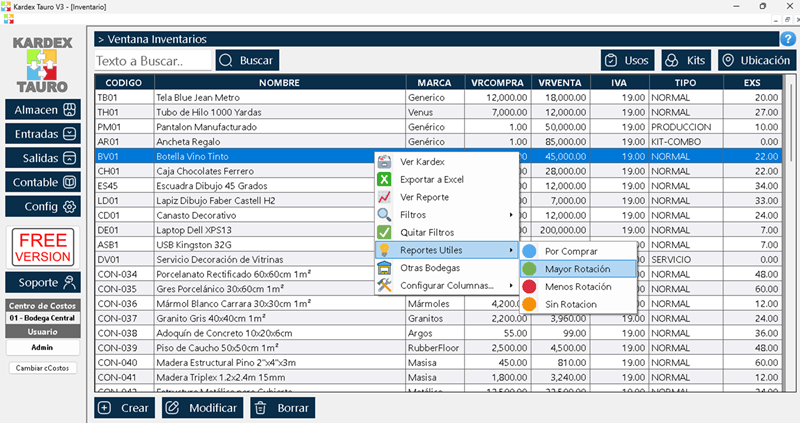
On count day, the system's theoretical stock is printed or exported: product, code, unit of measure, location and recorded quantity. That list is the reference to count against. Without it, everyone counts “from memory” or according to what they believe exists, and the handover turns into an argument about recollections instead of a comparison against data.
A count supported by an inventory system, such as Kardex Tauro, has an extra advantage: the theoretical list comes out in minutes, authorized adjustments are recorded with their date, and each product's movement history is available to investigate any difference. The printed list also becomes an attachment to the report, with the counted quantities written by hand next to the system quantities.
If the warehouse allows it, it is worth tidying up before counting: products grouped by reference, closed and labelled boxes, identified zones. Counting by zone —racking one, two, three— prevents jumps and makes the work verifiable: at the end, the sum of the zones must match the total on the list.
Step 3: the joint physical count
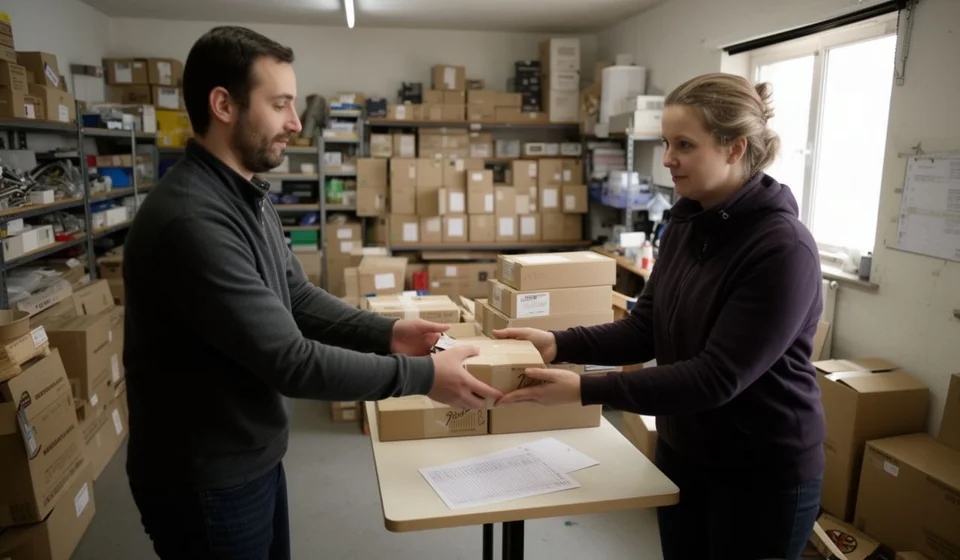
Three roles take part in the count: the person handing over, the person receiving, and a witness who is neither of them —the owner, the accountant or the purchasing manager. The witness is the one who prevents the “you said, I said” dispute: he watches the count, signs it, and can testify years later if someone asks how the handover was done.
There are two counting methods. The first is the full count: every reference is counted, item by item; it is the natural option in small and medium warehouses. The second is sampling: the highest-value and highest-turnover products are counted, since they concentrate the warehouse's money; it is used when the warehouse is very large or time is short, and it should always be completed with a full count if there is any suspicion. The practical rule: if the sample comes out clean, the rest of the warehouse usually is too; if the sample shows differences, move on to counting everything.
The mechanics of the count are simple and worth repeating identically for every reference: one person reads the system quantity, another counts physically and the third writes it on the list. What has been counted is marked with chalk or a tag so it is not counted twice. When a figure does not match on the first try, the count is repeated before recording it as a difference: many “differences” turn out to be counting errors by the team itself.
Step 4: differences: record them, investigate, adjust with authorization
It is normal for a handover to show small differences: units miscounted during a rushed receiving process, a dispatch that was never recorded, damaged product that was never written off. The golden rule is not to dress anything up: if something is short, it is short, and if something is over, it is over. Dressing up means silently adjusting the figures so everything “matches”, leaving no trace and no responsible party; that turns a small shortage into a problem with no origin, which will reappear at the next count bigger and more expensive.
Each difference is written in its column with the corresponding observation. If it is small and reasonable —shrinkage, packaging error, rounding— it is documented and adjusted with the owner's or accountant's authorization. If it is large, it is not adjusted yet: first it is investigated, reviewing the movements of the last few weeks, as explained below. The handover report is not the place to forgive differences, but to record them with a date.
The inventory section of the report carries at least these columns:
| Product | Stock in system | Physical count | Difference | Observation |
|---|---|---|---|---|
| Wheat flour 50 kg | 38 bags | 36 bags | −2 | Investigate dispatches from the 2nd to the 6th before adjusting |
| Cooking oil 1 L | 120 units | 120 units | 0 | Matches |
| Rice 25 kg | 25 bags | 27 bags | +2 | Surplus: check the purchase receipt from the 3rd |
| Eggs, tray of 30 | 60 trays | 58 trays | −2 | 2 broken trays pending write-off |
Notice that the difference column is never left blank “to keep the peace”. A zero is written as a zero, and a shortage or surplus is written with its number and its observation. The accounting adjustment is made afterwards, with authorization and supporting documents, but the report has already recorded the real situation on the exact date of the handover.
Keys, documents and equipment are handed over too
A warehouse is not only merchandise. When the storekeeper changes, other items change hands as well: the keys and the record of who else received copies; documents —open purchase orders, un-invoiced delivery notes, the last few days of invoices, equipment warranties—; and working equipment such as the scale, the barcode reader, the fire extinguishers or the ladder. Every one of those items must appear in the report, because the omission of an asset is what later creates the claim.
| Item handed over | Quantity | Condition | Responsible person receiving |
|---|---|---|---|
| Set of warehouse keys | 3 copies | Complete | New storekeeper |
| Floor scale | 1 | Working | New storekeeper |
| Barcode reader | 1 | Working | New storekeeper |
| Un-invoiced delivery notes | 6 | Pending collection | Accountant, as witness |
| Open purchase orders | 4 | In transit from supplier | New storekeeper |
If something is missing —a lost key, a reader sent in for warranty— it is recorded all the same, with its condition, and the commitment to regularize it is noted. Each block of the table is signed as received by the responsible person, so nobody can later say they did not know those items were under their care.
Step 5: the signature: responsibility starts with the new storekeeper
The report is signed at the end of the handover and must carry: date and cut-off time, name and ID of the person handing over, of the person receiving and of the witnesses, the list of attachments —the counted inventory pages, the copy of the system stock list, the difference detail if any— and everyone's signatures. A simple one-page format that summarizes the result and refers to the attachments works better than a huge document nobody ever reads again.
From the moment of the signature, the receiver is responsible for the warehouse. If something is missing tomorrow, the question stops being “what could have happened with the previous storekeeper?” and becomes “what happened to the inventory under my custody?”. The person handing over, for his part, is released from whatever happens after the cut-off date, unless the report itself records a shortage he must answer for before his final settlement. Copies are distributed: one for the business archive and one for each signatory, and the approved adjustments are entered into the system the same day.
And if the differences are large, what do you do?
When a considerable shortage or surplus appears, the rule is simple: do not sign yet. First run a full count of the affected zone —or of the whole warehouse, if suspicion warrants it— because a sample no longer provides peace of mind. Then review recent movements: purchases that arrived and were never entered, sales or dispatches that were never recorded, customer returns that never went back into stock, expired or damaged product that was never written off, receiving errors checked against the supplier's invoice.
Once the analysis is done, the adjustment is made with support and authorization: an adjustment record signed by management or accounting, backed by the document that explains the difference. If the investigation points to a shortage attributable to the person leaving —merchandise dispatched without being recorded, for example— responsibility is settled before his final payment or his definitive departure. What should never be done is to sign a report “to square things up later”, because later nobody squares anything and the problem ends up with no owner.
A well-done handover is also an opportunity
A storekeeper change is one of the riskiest moments for inventory, but it is also a cleaning opportunity: damaged products that were being carried along surface, badly used locations, late paperwork that nobody filed. An orderly handover lets the new storekeeper start with reliable data and the peace of mind of knowing that what he received is verified, and it leaves the business with an exact picture of its warehouse on a specific date.
When the count is supported by an inventory system such as Kardex Tauro, the whole process stays documented: the theoretical stock list of the day, the authorized adjustments with their dates, and the movement traceability that lets you answer any handover question with data instead of memories. Before closing, go through this checklist:
- Give notice of the change early and set the handover cut-off date.
- Print or export the stock list from the system.
- Count with the person handing over, the person receiving and a witness.
- Record every difference and adjust only with authorization and support.
- List keys, documents and equipment in the report, with their condition.
- Sign with date, names and attachments, and keep a copy in the archive.
The handover report is not an act of mistrust towards the storekeeper who leaves or the one who arrives: it is the written memory of the business. Sign the handover the way you sign a cheque: with the certainty that, if something goes wrong later, everyone will know exactly what was counted on that day and who answered for it.