The 5S method in your warehouse: order that speeds up inventory
The 5S method in your warehouse: order that speeds up inventory
There is a scene that repeats itself in thousands of small warehouses. The warehouse keeper needs to dispatch twelve units of a product, but he does not know whether any are left, he does not remember which shelf he put them on, and he ends up moving boxes for ten minutes while the customer waits. The product finally appears, but the search already cost time, and time is the most expensive resource in a business: you pay for it with wages, with overtime and with customers who get tired of waiting.
The good news is that the remedy for that disorder does not cost money. It is called the 5S method. It was born in Japan inside the manufacturing industry and is now applied in hospitals, offices and warehouses all over the world, because it works in any place where things are stored and searched for. It does not require buying new racks or hiring consultants: it requires judgment, method and, above all, consistency.
The 5S are five Japanese words that start with the letter S: seiri, seiton, seiso, seiketsu and shitsuke. In English they are usually translated as sort, set in order, shine, standardize and sustain. They sound simple, and they are. The hard part is not understanding them, but applying them to a real warehouse that keeps operating while you organize it. That is exactly what we will cover here: what each S means inside a small warehouse, what you gain from each one, how to implement them without stopping operations, and what to measure to know they actually work.
Where the 5S comes from and why it fits a warehouse
The 5S method was born in Japan after the war, when Japanese manufacturing had to rebuild itself with scarce resources. Companies like Toyota discovered that order was not a cosmetic matter: it was a production tool. In a messy factory nobody finds the tools, materials get damaged, workers waste time and mistakes multiply. Keeping the workplace organized, clean and governed by written rules produced productivity gains that surprised the world.
A warehouse is, in essence, a workplace whose main task is to store and to find. That is why the 5S fit it so well. Let us look at the typical problems of a disorganized warehouse:
- Time is wasted looking for products that should be at hand, and that time is paid for in every single dispatch.
- Physical counts fail because the product is not where the record says it is, or because there are mixed boxes that nobody knows what they contain.
- Products get damaged: crushed boxes, torn packaging, expired goods hidden behind others.
- There are avoidable accidents: blocked aisles, heavy items up high, spills that nobody cleans.
- The warehouse looks bad: when a customer or an auditor visits, the disorder speaks badly of the whole business.
The 5S attack all those problems at once, and they do it in stages so small that any warehouse, no matter how small, can advance one per day. Let us go through each one.
Seiri: sort, separate what is used from what is not
The first S means asking every single thing in the warehouse: does this help you operate, or does it only take up space? Almost every store has obsolete product that nobody dares to remove, empty packaging saved just in case, broken boxes, returns that were never processed, damaged tools and spare parts that do not match any equipment still in use. All of that is dead weight: it occupies rack space, complicates searches and dirties the counts, because it appears in the inventory as if it were available merchandise.
Sorting does not mean throwing everything away on the first day. It means making a decision about each item with a clear criterion. A practical criterion: if a product has had no movement in recent months and there is no plan to sell or use it, it leaves the active area. For doubtful items, use a quarantine or "to decide" area: a marked corner where things wait for a decision within a fixed period, say two weeks. If nobody claims them in that time, they are liquidated, donated, returned to the supplier or discarded.
This is where you should listen to the warehouse keeper. He knows which box has gone untouched for months and which product is ordered every week. His opinion prevents two classic mistakes: throwing away something that was actually used, and keeping something whose cycle is over. The golden rule of Seiri is that only what is used with real frequency stays in the work area.
Seiton: set in order, a place for everything and everything in its place
Once the warehouse is left with only what is essential, the second S arrives: give every product a fixed place and make sure it always returns to that place. The principle is summed up in a phrase we already know: a place for everything and everything in its place.
In practice, organizing a warehouse means assigning locations. You divide the warehouse into zones (dispatch, storage, returns, supplies), you identify the racks and their levels, and each product family receives its place. Fast-moving products go near the dispatch area and at hand height; heavy ones, at the bottom; light and fragile ones, at the top. Products that look alike or have almost identical names are separated, because they are the classic source of dispatch errors.
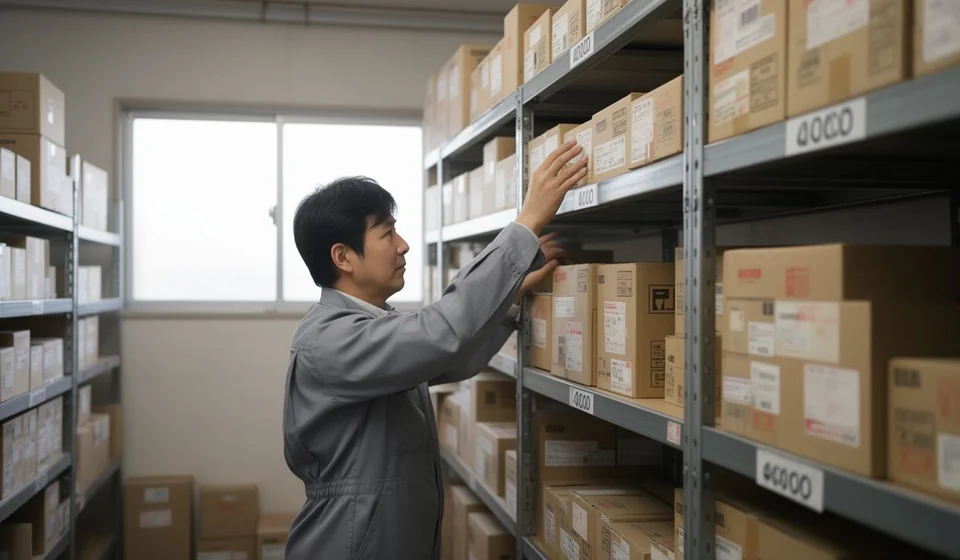
Every place must be labeled: the rack, the level and, if necessary, the exact slot. The label says what goes there, not what you hope to find. That way anyone, not just the usual warehouse keeper, can locate a product in seconds and put it back where it belongs. Once that is achieved, search time drops from minutes to seconds and dispatch stops being a hunt.
Seiso: shine, because cleaning is inspection
The third S is often misunderstood as a simple order to sweep. In the 5S, cleaning is much more: it is inspecting. Whoever sweeps and cleans a warehouse with open eyes detects what no record will ever say: a torn sack losing product, a leaking container, dampness in a corner, signs of pests, boxes damaged by water, a blocked aisle.
In a small warehouse, daily cleaning needs no more than ten or fifteen minutes at the end of the shift: sweep the dispatch area, pick up what was spilled, put back what is out of place and visually check the critical zones. The important thing is that cleaning is part of the closing routine of every day, not a campaign you run when someone complains.
The benefits of Seiso are direct and measurable: less damaged merchandise, because problems are detected while they still have a solution; fewer accidents, because the floor is clear and dry; less shrinkage, because spills and pests are dealt with in time; and a presentable warehouse, which is the first impression a customer or auditor gets when visiting.
Seiketsu: standardize, written and visible rules
The first three S are achieved in days, but without the fourth they are lost in weeks. Seiketsu means writing the rules so that order does not depend on anyone's memory or mood. It is the difference between "we organized the warehouse last week" and "the warehouse stays organized because this is how we work here".
Standardizing in a small warehouse is simpler than it sounds. One-page documents are enough, visible and written in plain language, that answer four questions: where each product family goes, how locations are labeled, who cleans and when, and how merchandise is received and dispatched. That standard is taught to everyone: new staff, temporary replacements, the owner. If a rule cannot be followed or gets in the way, the rule is changed, but in writing and with everyone's agreement.
Standardization turns order into part of the system instead of part of the people. When the warehouse keeper is sick or on vacation, the warehouse does not fall into disorder, because the rules are written and anyone can follow them. That is also what makes locations and inventory records survive staff changes.
Shitsuke: sustain, turning the 4S into a habit
The fifth S is the one that holds up the other four. Shitsuke means discipline, and in a warehouse it translates into short, steady routines: five minutes at the end of every shift to leave the work area ready for the next day, and a fifteen-minute weekly review, with a simple checklist, to confirm that sorting, setting in order and shining are still being done.
Discipline is not imposed with scolding; it spreads by example. When the owner or manager picks up a box that is out of place, he sends a message clearer than any sign. And when the warehouse keeper feels the warehouse is his, that his judgment was respected when organizing it, he defends the order as his own. That is why successful 5S is never done against the warehouse keeper: it is done with him.
A common mistake is treating the 5S as a one-time event and slipping back into disorder the following month. The 5S is not a project with a delivery date: it is a way of working. The good news is that maintaining it costs less time than it saves, because every minute of routine avoids ten minutes of searching.
| S | What to do in your warehouse | What you gain |
|---|---|---|
| Seiri: sort | Separate what is used from what is not; remove obsolete product, empty packaging and broken boxes; decide what is liquidated, donated or discarded | Freed space, faster searches and cleaner counts, with no ghost items in the inventory |
| Seiton: set in order | Give every product family a fixed, labeled location; keep fast movers near dispatch and at hand height | Less time to find and dispatch; fewer mistakes with similar products |
| Seiso: shine | Clean as daily inspection: spot spills, damage, dampness and pests before they grow | Less shrinkage and damage, fewer accidents, early detection of problems, a presentable warehouse |
| Seiketsu: standardize | Write visible rules: where each product goes, how it is labeled, who cleans and when | Order does not depend on a single person; any employee operates the same way |
| Shitsuke: sustain | Keep short daily routines and a 15-minute weekly review with a checklist | Lasting results: the organized warehouse stays organized and does not return to chaos |
How to implement it without stopping operations
The most common objection is: "I cannot close the warehouse to organize it." And it is true: you do not need to. The 5S are implemented zone by zone, without stopping operations, moving forward one day at a time. This is the plan that works in small warehouses:
- Start with the dispatch area. That is where order pays off most visibly: if everything there is at hand, daily operations improve from day one and the team sees immediate results.
- Spend one day per zone. In the morning you sort and set in order; at closing time you clean and label. One zone per day avoids exhaustion and does not interrupt the workflow.
- Take before and after photos. Photos serve as evidence and motivation: when enthusiasm drops, seeing the starting point reminds everyone why the effort is being made.
- Involve the warehouse keeper in every decision. He defines where each thing goes and is the one who sustains the habit afterwards; if the order is decided without consulting him, it will not last a week.
- Write the rules of the zone on the same day. As soon as the zone is organized, fix the standard: what goes in each place, who cleans and when.
- Close with the 15-minute weekly review. A walkthrough with a checklist through all the zones, every week at the same time, catches relapses before they turn into disorder.
The complete plan for a medium warehouse takes between one and two weeks, working one zone per day. You hire nobody and buy almost nothing: the materials are labels, tape and the will to make decisions. The biggest investment is consistency.
Measurable results: what to track before and after
The 5S is not faith: it is method, and method is measured. Before starting, record three numbers; afterwards, compare them. They are three simple indicators that any warehouse can measure without special tools:
- Time to find a product. Pick a product at random and time how long the warehouse keeper takes to find it. In disorganized warehouses it commonly takes ten to fifteen minutes; with fixed locations it drops to two or three.
- Count accuracy. In the physical count or in cycle counts, compare what the record says with what is actually on the shelf. An organized warehouse goes from an 80 or 90 percent hit rate to 98 or 99 percent, because the product is where the record says it is.
- Freed space. After sorting, many warehouses recover between fifteen and thirty percent of their useful space, which can be used for products that actually move or simply to operate more comfortably.
| Indicator | Disorganized warehouse | Warehouse with 5S |
|---|---|---|
| Time to find a product | 10 to 15 minutes | 2 to 3 minutes |
| Physical count accuracy | 80 to 90 % | 98 to 99 % |
| Useful space recovered | — | 15 to 30 % |
| Emergency purchases because "we could not find it" | Frequent | Almost none |
On top of those three numbers come effects you notice without a stopwatch: fewer emergencies over lost products, fewer overtime hours to balance counts, fewer customer complaints about wrong dispatches, and a warehouse you are no longer ashamed to show.
Physical order rests on the record: locations and counts
The 5S organizes what you see: boxes, shelves, aisles. But the warehouse also has an invisible layer, information, and there order is called locations, catalog and counts. The two layers need each other: a perfect rack is useless if the record says a product is somewhere it is not, and a perfect record is useless if nobody can find anything in the warehouse.
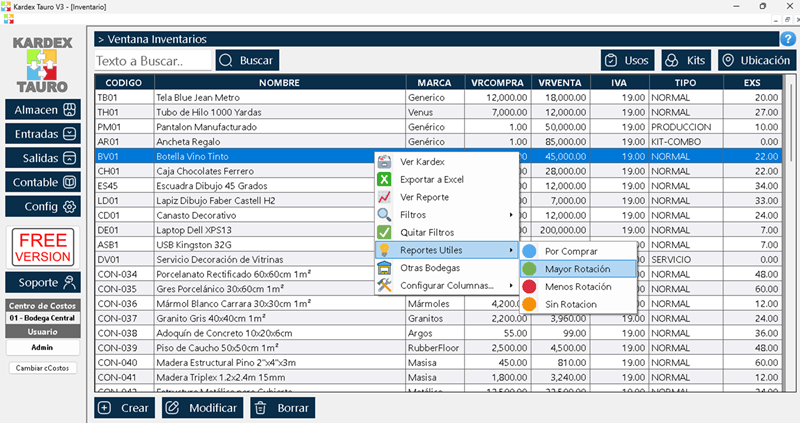
Once the 5S leave every product in a fixed, labeled place, that location can be recorded in the system, and every time merchandise is dispatched or received, the record is updated with the correct place. That makes the next physical or cycle count fast: you walk straight to the location, count and compare. Inventory software such as Kardex Tauro stores the location of every product and supports the count, but the physical order built by the 5S is what makes that record tell the truth. Without an organized warehouse, no inventory system delivers what it promises.
We have discussed in other articles how to design a location system and how to run reliable physical counts. The 5S is the previous, necessary step: it is what guarantees that the product is where the system says it is.
Order is not a project: it is a habit
The difference between a warehouse that was organized and an organized warehouse is time. The first returns to chaos within a month; the second stays that way because order became part of the daily routine, with the same automatic quality as locking the door at the end of the day.
You do not need to transform the whole warehouse in a week or reach perfection. It is enough to start today with one shelf or with the dispatch area, apply the five S there and spread the method zone by zone. Every organized corner is time recovered for what really matters: dispatching well, counting well and selling. And when physical order is combined with a reliable record, the kind a system like Kardex Tauro helps keep up to date, the warehouse stops being a headache and becomes a competitive advantage that the customer notices in every delivery.