Top 10 best inventory programs for small businesses
Top 10 best inventory programs for small businesses
Keeping inventory up to date is one of those tasks that quietly decides whether a small business makes or loses money: stock that cannot be found, duplicated purchases, shortages discovered too late, and invoices that do not match what is actually in the warehouse. A good inventory program puts all of that in order, but choosing one among so many options is not easy. In this article we have gathered ten programs that small businesses use today across Spanish-speaking markets, some installed on the desktop, some in the cloud, some hybrid, and we present them in a clear comparison built from public information and without made-up rankings.
One necessary disclosure up front, for honesty: this list includes Kardex Tauro, the software we develop, and we include it because it fits the profile of this comparison and because we want readers to be able to weigh it against the alternatives under the same conditions. The list was assembled from public information available as of September 2026, for strictly comparative purposes, and it declares no winner: the best program does not exist in the abstract; what exists is the one that best matches how each business works.
How this list was put together
To build this comparison we reviewed public sources: each product's official website, its pricing pages, app stores, documentation, and support material published by each provider. The cutoff date is September 2026 and prices are approximate, because providers adjust them often and run promotions that are not reflected here.
The ten programs appear in alphabetical order by name, not by quality or popularity. There are no scores, no positions, and no phrases like number one, because every small business has a different situation: what suits a corner store with a single computer can feel awkward for a warehouse with ten users and two point-of-sale terminals. Our only bias, declared, is that Kardex Tauro is the software we develop; that is why it appears here with the same public data as the rest and with the same level of detail we were able to verify.
The programs included, in alphabetical order, are:
- Alegra: cloud suite with accounting, inventory, point of sale, and electronic invoicing, monthly subscription, for small businesses and accountants in Latin America.
- Aspel SAE: desktop system for purchase and sale management with inventory stock ledger, one-time license plus maintenance, for small businesses in Mexico.
- Bind ERP: cloud ERP with inventory, purchasing, sales, and invoicing, monthly subscription of approximately MXN 949 to MXN 1,999, for small businesses in Mexico.
- CONTPAQi Comercial: desktop ecosystem with cloud options, with inventory (stock ledger), sales, and invoicing modules, per-product subscription, for small businesses in Mexico.
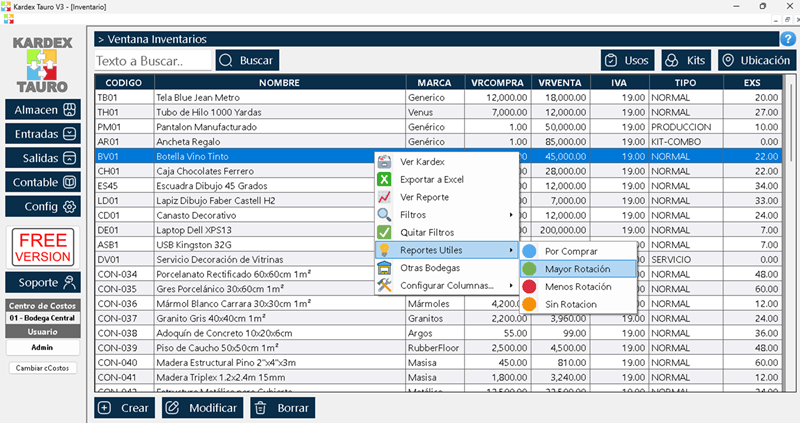
- Kardex Tauro: inventory and invoicing program for retail, warehousing, and light manufacturing small businesses in Latin America; it installs on Windows desktops with a local SQLite database and offers a server mode for networks.
- stock ledger.lat: desktop tool with cloud sync, one-time payment close to USD 49.99-99.99, focused on simplicity for Spanish-speaking micro businesses; its public information is limited.
- Nubox: cloud platform with monthly subscription for small businesses in Chile, Peru, Mexico, and Colombia, focused on electronic invoicing and administration.
- Scrampi: cloud point of sale with offline mode for shops, pharmacies, and restaurants in Colombia, with invoicing, a monthly subscription close to COP 46,000, and a 30-day trial.
- Siigo: cloud system with a desktop version, strong in accounting, payroll, and electronic invoicing, monthly subscription, for small businesses and accountants in Colombia.
- Zoho Inventory: cloud inventory software with ecommerce integrations, monthly subscription in USD, for businesses with online or multichannel sales.
Inventory programs compared
The table below condenses the essential data for each program: where it runs, how it is billed, what kind of business it is designed for, and notes worth knowing. It is a snapshot taken in September 2026 from public sources; check current figures before you decide.
| Program | Deployment | Pricing model (approx. Sep 2026) | Best for | Notes |
|---|---|---|---|---|
| Kardex Tauro | Windows desktop (local SQLite database, with server mode for networks) | Free plan and yearly payment per device | Retail, warehousing, and light manufacturing SMBs in Latin America | Integrated invoicing, unlimited users and warehouses, available on Microsoft Store |
| Alegra | Cloud | Monthly subscription | SMBs and accountants in Latin America | Suite with accounting, inventory, point of sale, and electronic invoicing |
| Aspel SAE | Desktop | One-time license plus maintenance | SMBs in Mexico | Purchase and sale management with inventory stock ledger |
| Bind ERP | Cloud | Monthly subscription (approx. MXN 949-1,999) | SMBs in Mexico | ERP with inventory, purchasing, sales, and invoicing |
| CONTPAQi Comercial | Desktop and cloud options | Per-product subscription | SMBs in Mexico | Ecosystem with inventory (stock ledger), sales, and invoicing modules |
| stock ledger.lat | Desktop with cloud sync | One-time payment (approx. USD 49.99-99.99) | Spanish-speaking micro businesses | Limited public information; focused on simplicity |
| Nubox | Cloud | Monthly subscription | SMBs in Chile, Peru, Mexico, and Colombia | Focus on electronic invoicing and administration |
| Scrampi | Cloud (point of sale with offline mode) | Monthly subscription (approx. COP 46,000) | Shops, pharmacies, and restaurants in Colombia | Point of sale with invoicing; 30-day trial |
| Siigo | Cloud (and desktop version) | Monthly subscription | SMBs and accountants in Colombia | Strong in accounting, payroll, and electronic invoicing |
| Zoho Inventory | Cloud | Monthly subscription in USD | Businesses with online or multichannel sales | Inventory with ecommerce integrations |
What to consider when choosing
Before comparing features one by one, it is worth agreeing on the criteria. These are the questions that matter most in practice when choosing an inventory program for a small business:
- Where does the program run? Desktop software is installed on the business's own computers and works with or without internet, but it demands its own backups. The cloud opens from anywhere and the provider maintains the data, but it depends on the connection. There are also hybrid formulas and point-of-sale systems with offline mode: first define how your team works.
- What does it really cost over three years? A one-time license is paid once; a monthly subscription multiplies month after month and often adds per-user or per-module costs. Calculate the total three-year cost, licenses, maintenance, support, and additional users, not just the first month's price or a launch promotion.
- Does it invoice and meet local requirements? In many countries electronic invoicing is mandatory. If the program does not invoice, you will type everything twice: once in inventory and once in the invoicing system. Also check that the provider updates the product when regulations change.
- Is there support and documentation in Spanish? For a Spanish-speaking small business, being able to resolve questions in the team's own language, with clear manuals and real support, is worth as much as any feature.
- Who controls the data? In the cloud, the provider stores your information; on the desktop, you do. Ask how backups are made, who can access the data, and what happens to your information if you stop paying the subscription or close the account.
- Users, warehouses, and growth? Count how many people will use the system today and how many warehouses, point-of-sale terminals, or branches you need to manage. A program that fits perfectly today may feel small in two years, and migrating systems while inventory is live is always expensive.
- Did you test it with your own operation? No table replaces a trial: use free plans, demos, or trial periods with your real products, your invoicing routine, and your people, before paying for the first year.
Kardex Tauro in this list
To be fair to the reader, we repeat it without beating around the bush: Kardex Tauro is the software we develop and maintain. It is an inventory and invoicing program for Windows that works with a local SQLite database and that, as the business grows, can run in server mode so several computers share the same information over a network. It offers a free plan and a yearly payment per device, includes integrated invoicing, does not limit users or warehouses, and is available on the Microsoft Store. It fits especially retail, warehousing, and light manufacturing SMBs in Latin America that prefer to keep their data on their own machines and pay a predictable yearly cost. If your case is different, multichannel online sales, full cloud accounting, or very specific tax needs in your country, the other programs in this list also deserve a careful look.
Final note: the prices and data in this comparison are approximate, come from public information, and correspond to September 2026; providers may change them at any time. Before deciding, verify the current information on each program's official sources and try it with your own business. The best inventory program, in the end, is the one your team uses every day.
