Top 10 best inventory programs with invoicing for your store
Top 10 best inventory programs with invoicing for your store
The problem a store faces is not selling: it is knowing, at the end of the day, what was sold and how much is left on the shelf. For a counter business, a hardware store, a pharmacy or a warehouse, the ideal program does two jobs in a single step: it issues the invoice or the sales receipt and, at that same moment, deducts the merchandise from inventory. When those two tasks live in separate programs, someone ends up reconciling by hand: receipts get added up at closing time, units get crossed off with a pencil, and the shortage only shows up weeks later, when it is already too late to reorder. This guide gathers ten programs that combine inventory with invoicing, used by store owners across Latin America, and presents their main features and pricing models so you can compare real options before making a decision. The selection includes cloud and desktop programs, free and paid, local and multinational, because each kind of business runs on a different logic.
Before we begin, the transparency note this list deserves: Kardex Tauro is the inventory software we develop, and it appears here as one more option, with the same kind of information and at the same level as every other program. This comparison was built from public information available in September 2026, strictly for comparative purposes. There is no winner, no ranking and no scores: the right choice depends on the country where you invoice, the type of store you run and the budget you can sustain month after month.
How this list was built
Three criteria guided the selection of these ten programs: they must offer inventory management connected to invoicing or to a point of sale; they must be accessible options that stores in the region actually use; and enough public information must exist, such as official websites, data sheets and pricing documents, to compare them without relying on marketing campaigns. The deployment, price and feature data reflect what each vendor published around September 2026. The goal was not to decide which program is the best in the abstract, but to lay out on the table what each one offers.
The programs included, in alphabetical order, are Alegra, Aspel SAE, CONTPAQi Comercial, Kardex Tauro, Nubox, Odoo, Scrampi, Siigo, Softland and World Office. No positions and no star ratings were assigned, because a system that works well for a pharmacy in Chile can feel clumsy to a hardware store in Mexico: the table below sticks to verifiable facts so that the decision stays yours. Accounting, payroll and banking modules fall outside the scope of this comparison, since each vendor handles them differently, and so do fully custom developments, which are beyond what a small business can sustain.
Comparison of programs with invoicing
The table below summarizes, for each program, the type of deployment, the approximate pricing model, the kind of business it usually targets and how it handles invoicing. Use it as a starting point and confirm each detail with the vendor before signing up, because conditions change over time and from one country to another.
| Program | Deployment | Pricing model (approx. Sep 2026) | Best for | Invoicing |
|---|---|---|---|---|
| Kardex Tauro | Windows desktop (local SQLite base, with server mode) | Free plan and annual payment per workstation | Stores, hardware stores, pharmacies and warehouses in Latin America | Integrated invoicing that deducts stock and generates the stock ledger record |
| Alegra | Cloud | Monthly subscription | SMBs in Latin America | Electronic invoicing (Colombia) and point of sale |
| Aspel SAE | Desktop | One-time license cost plus maintenance | SMBs in Mexico | CFDI invoicing |
| CONTPAQi Comercial | Desktop and cloud options | Subscription per product | SMBs in Mexico | CFDI invoicing |
| Nubox | Cloud | Monthly subscription | SMBs in Chile, Peru, Mexico and Colombia | Electronic invoicing |
| Odoo | Cloud and on-premises | Open source; optional SaaS subscription | Global SMBs | Integrated invoicing and point of sale |
| Scrampi | Cloud (point of sale with offline mode) | Monthly subscription (approx. COP 46,000) | Stores, pharmacies and restaurants in Colombia | Invoicing from the point of sale |
| Siigo | Cloud (and desktop version) | Monthly subscription | SMBs and accountants in Colombia | Electronic invoicing (DIAN) |
| Softland | Desktop and cloud | License or subscription | Mid-size companies in Colombia and Chile | Invoicing integrated with the ERP |
| World Office | Desktop | License | Companies and accountants in Colombia | Electronic invoicing (DIAN), multi-company |
What to consider when choosing
Comparing prices is the easy part. The hard part is telling apart a program that actually solves your operation from one that adds one more manual chore to your day. Before watching demos, get these criteria straight, because they are the ones store owners come back to again and again when making this decision.
- The invoicing your country requires. Not every program can invoice in every country. In Colombia, electronic invoicing must be validated with the DIAN, and options such as Siigo, World Office or Alegra are built for that scheme; in Mexico the mandatory document is the CFDI, which Aspel SAE and CONTPAQi Comercial handle; in Chile, Peru and other countries the scheme changes once more. Before looking at features, define which document you must issue by law and confirm that the program issues it and, when required, reports it to the tax authority. An excellent program in another country is of little use if it cannot invoice the way your legislation demands.
- The sale must deduct stock at that very moment. If the program issues the receipt but does not deduct inventory, it has not solved the core problem: you will have well-recorded income and outdated stock. Ask exactly that in the demo: when a sale is completed, does the system deduct the merchandise and record the movement on the product card? That single function, keeping the stock record up to date with no manual work, is what saves you from end-of-month reconciliation.
- What happens if the internet goes down. A cloud subscription looks great until the connection fails mid-afternoon and the point of sale freezes just when there is a line at the counter. Some options offer an offline mode, like the Scrampi point of sale; others, being desktop programs that work with local data, such as Aspel SAE, CONTPAQi Comercial, World Office and Kardex Tauro, do not depend on a connection to invoice. Judge by the reality of your store, not by the advertisement.
- The total cost, not just the sticker price. A monthly subscription looks affordable until you multiply it by twelve months and by every user; a one-time license can add annual maintenance or extra module fees. Compare the three-year cost: subscriptions such as Alegra, Nubox, Siigo or Scrampi; licenses with maintenance such as Aspel SAE or World Office; mixed models such as CONTPAQi Comercial and Softland; and options with a free plan, like Kardex Tauro, that let you start without spending.
- Where your data lives and who backs it up. In the cloud, the vendor handles backups; with a local program, backing up is your responsibility: if the hard drive fails and there is no copy, your sales and inventory history is gone. Ask how often you can back up, whether automatic backups exist, and whether the data can be exported to standard formats such as Excel or CSV in case you ever switch programs.
If your budget allows, ask for a trial with your own products: load ten real references, record one sale, check the stock record and see whether the inventory balances itself. That fifteen-minute test tells you more than any brochure.
Kardex Tauro in this list
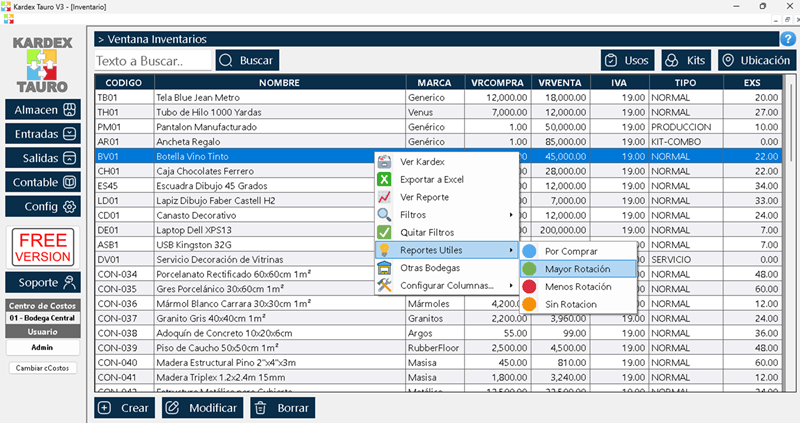
Kardex Tauro is desktop inventory software for Windows, built on a local SQLite database, with a server mode that lets several computers work against the same data. Invoicing is integrated with inventory: when a sale is completed, the system deducts the stock and generates the stock ledger movement automatically, so balances, valuations and the history of entries and exits stay up to date with no manual reconciliation. It targets stores, hardware stores, pharmacies and warehouses in Latin America that control their merchandise from the counter or the back room, and it offers a free plan to get started plus an annual payment per workstation for the full plan.
To be fair within this comparison: since it is a desktop program, it is not the right choice if you need to operate from anywhere without installing anything, and it does not try to replace a full accounting system, for which you will combine its reports with your accountant. If your priority is having invoicing and inventory live in one reliable program, it is worth trying with real data from your business.
Prices shown are approximate, based on public information from September 2026, and may change without notice; check current conditions with each vendor before subscribing. The best tool is not the most advertised one, but the one you end up using every day to invoice and keep your inventory up to date.