Top 10 inventory programs: local vs cloud software
Top 10 inventory programs: local vs cloud software
Choosing a program to control a business's inventory usually turns into a contest between two philosophies: installing the software on your own computers or using one that runs in the cloud. There is no single right answer, and this article does not pretend to offer one. Here you will find ten programs used by businesses across Latin America, listed in alphabetical order and compared with clear criteria: where the data lives, how each option is paid for, and what kind of business each one is designed for. A transparency note before we continue: Kardex Tauro is the software we develop, and it appears on this list as one of the options that bet on the local model, keeping the database on your own machine with an optional server mode to connect several computers. The remaining programs were included based on public information available in September 2026.
Why a comparison instead of a ranking of the 'best program'? Because the 'best program' does not exist in the abstract: it depends on your situation. A shop with an unreliable connection and a multichannel online business have opposite needs: the first must keep recording movements and invoicing without depending on the internet, and the second needs its information synced in the cloud. What does work is comparing honestly and without decoration, and letting each business decide with its own criteria. That is what this article proposes.
How this list was put together
The list was built from public information: each program's official website, its product pages and help documentation, the Microsoft Store, and public pricing materials, all consulted in September 2026. Nobody paid to appear here and we receive no commissions for recommending anything: if a product does not convince you, it is simply not the right fit for your case. The alphabetical order is deliberate: a program appearing earlier or later says nothing about quality or preference.
We aimed to cover the models that coexist in the market today: pure desktop, pure cloud, and hybrid options that combine local data with sync or a server mode. When a product publishes little information (such as stock ledger.lat, about which public data is very limited), we say so in the table instead of inventing features. Prices are approximate, reflect September 2026, and can change; treat them as a starting point, not as a quote.
Comparison: local vs cloud
Before reading the table, it helps to tell apart the three deployment models you will find. None of them is 'better' by itself: each one solves a different kind of need.
- Local desktop. The program is installed on your computers and the data is stored on your machines or your network. It works without the internet and you keep control of the information; in exchange, backups, maintenance and updates are also your responsibility.
- Cloud. The program runs on the provider's servers and is used from a browser or an app. You do not install anything, and the provider handles backups and updates; in exchange, you depend on your connection and on the continuity of the service.
- Hybrid. A combination of both worlds: a desktop program with a server mode to share the database across computers, or a local program that syncs part of the information to the cloud so it can be consulted from anywhere.
In alphabetical order, the ten programs in this comparison are:
- Alegra
- Aspel SAE
- Bind ERP
- CONTPAQi Comercial
- Kardex Tauro
- stock ledger.lat
- Nubox
- Softland
- World Office
- Zoho Inventory
The table summarizes the essentials of each one: deployment type, approximate price model, the kind of business it is usually recommended for, and a short note. The rows do not indicate a position or a preference: they are fact sheets meant for comparison.
| Program | Deployment | Price model (approx. Sep 2026) | Best for | Notes |
|---|---|---|---|---|
| Kardex Tauro | Local desktop (SQLite database) with optional server mode | Free plan and yearly payment per workstation | Those who want their data in their own hands and to work without the internet | Available on the Microsoft Store; built-in invoicing |
| Alegra | Cloud | Monthly subscription | SMEs and accountants in Latin America | Suite with inventory, POS and electronic invoicing |
| Aspel SAE | Desktop | License with one-time cost and maintenance | SMEs in Mexico | Purchase and sale administration with stock ledger |
| Bind ERP | Cloud | Monthly subscription (approx. MXN 949-1.999) | SMEs in Mexico | ERP with inventory, purchases, sales and invoicing |
| CONTPAQi Comercial | Desktop and cloud options | Subscription per product | SMEs in Mexico | Ecosystem with inventory and invoicing modules |
| stock ledger.lat | Desktop with cloud sync | One-time payment (approx. USD 49,99-99,99) | Spanish-speaking micro businesses | Focused on simplicity; limited public information |
| Nubox | Cloud | Monthly subscription | SMEs in Chile, Peru, Mexico and Colombia | Focus on electronic invoicing and administration |
| Softland | Desktop and cloud | License or subscription | Mid-sized companies in Colombia and Chile | ERP with inventory, purchasing and projects |
| World Office | Desktop | License | Companies and accountants in Colombia | Electronic invoicing, multi-company, 100% own infrastructure |
| Zoho Inventory | Cloud | Monthly subscription in USD | Businesses with online or multichannel sales | Ecommerce integrations |
Pay close attention to the deployment column: it says the most about how the program will work in your day-to-day. Local software requires you to take care of your backups, but it lets you operate offline. Cloud software lifts that burden, but ties your operation to the quality of your internet and to the provider's policies. Neither is more 'professional' or more 'secure' by definition: security depends on how you use each tool and how you take care of your data.
Local or cloud: questions to ask yourself
Before looking at prices and features, answer these five questions. The answers usually settle the debate for you.
- How reliable is your internet? If your connection drops often or gets slow at peak hours, a desktop program lets you keep working in the meantime. If your connection is stable and fast, the cloud stops being a risk and becomes an advantage.
- Do you want to own your data, or are you comfortable with it living on someone else's servers? With local software the data sits on your machines: you decide who sees it, how it is backed up and what happens to it. With cloud software the data sits on the provider's servers, subject to its terms, its policies and its continuity as a company.
- How much will you pay over three to five years? A monthly subscription looks cheap until you multiply it by months and years, and by every user or location. A one-time payment or a yearly license per workstation can be more predictable in the long run. Compare the total cost, not just the first month.
- Do you need to work offline? If you record movements in a warehouse, a workshop, a construction site or an area with poor signal, the program must not depend on the internet for the essentials. If your operation runs at a counter with a stable connection, the cloud does not pose that problem.
- Do you have several locations or computers that must see each other? The cloud syncs information across locations almost effortlessly. With local software you have to arrange the connection: a server mode on the local network, a VPN or scheduled sync. First define how many points of work you need to connect.
Kardex Tauro on this list
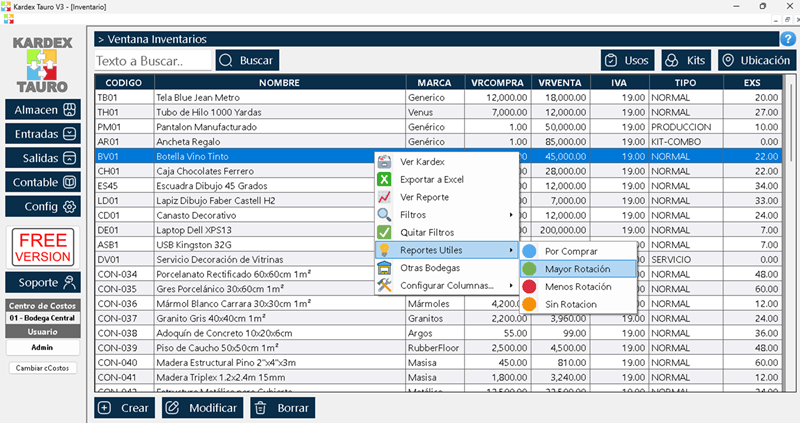
Since we are talking about transparency, it is only fair that you see Kardex Tauro's proposal with the same clarity we ask you to use when looking at the others. It is a desktop inventory program: the data is stored in a local SQLite database on your own computer. You can record products, incoming and outgoing movements, purchases and sales even if the internet goes down, and the information stays under your control.
It includes an optional server mode so several computers in the same business can share the database, built-in invoicing, and it is available on the Microsoft Store with a free plan and a yearly payment per workstation. It is designed for people who value keeping their data in their own hands, working without depending on the connection, and paying a predictable cost every year. If your business instead needs fully synced multichannel online sales or access from anywhere, a cloud program on this list may fit better. That diversity is exactly what this comparison wants to help you see.
Final note: the prices and payment models in this table are approximate, come from public information and reflect September 2026; they may vary by plan, region and purchase date. Always confirm the current terms with each provider before deciding. And remember what matters most: the best program is not the most popular one, but the one that best fits how your business works, where it keeps its data, and what it pays for its software.