Top 10 best inventory programs for pharmacies

Top 10 best inventory programs for pharmacies
For a pharmacy, controlling inventory is not just about knowing how many boxes are on the shelf. Medicines expire, are identified by lot, some sell out within days and others may sit for months without moving, and the health authority in each country requires records of incoming and outgoing stock and of purchase documentation. A suitable program has to help with all of that: flag which lot expires first, show which product is running out, support daily invoicing and keep the history available when it is needed.
This guide brings together ten programs that are offered or promoted for pharmacies and retail businesses in Latin America, based on the information their own developers publish. One transparency note before we continue: Kardex Tauro is our software, and it appears in this list because it works with stock ledger and inventory control and because its documentation declares features a pharmacy needs, such as lot and expiry date management. The data in this article come from public sources and reflect September 2026; prices are approximate and may change.
How this list was put together
The entry criteria were practical: the program must be marketed to retail SMBs or specifically to pharmacies in the region, and there must be enough public information about how it is installed or subscribed to, what it costs and what kind of business it targets. With that information on the table, the ten programs are presented in alphabetical order.
This is not a ranking and it declares no winner. There is no single best program for pharmacies: the right choice depends on the country where the business operates, its size, whether desktop or cloud software is preferred and, above all, how much lot and expiry control the operation needs. What can be done is compare the data calmly, and that is what the descriptions and the table in this article are for.
The ten programs, in alphabetical order
- Alegra: cloud suite for SMBs and accountants in Latin America combining accounting, inventory, point of sale and electronic invoicing, sold as a monthly subscription.
- Aspel SAE: purchase-sale administration with stock ledger for SMBs in Mexico; it runs on the desktop and is sold with a one-time license fee plus maintenance.
- Bind ERP: cloud ERP with inventory, purchasing, sales and invoicing modules for SMBs in Mexico, with a monthly subscription in the approximate range of MXN 949-1.999.
- CONTPAQi Comercial: ecosystem with inventory (stock ledger), sales and invoicing modules for SMBs in Mexico; available on the desktop and with cloud options, under a subscription per product.
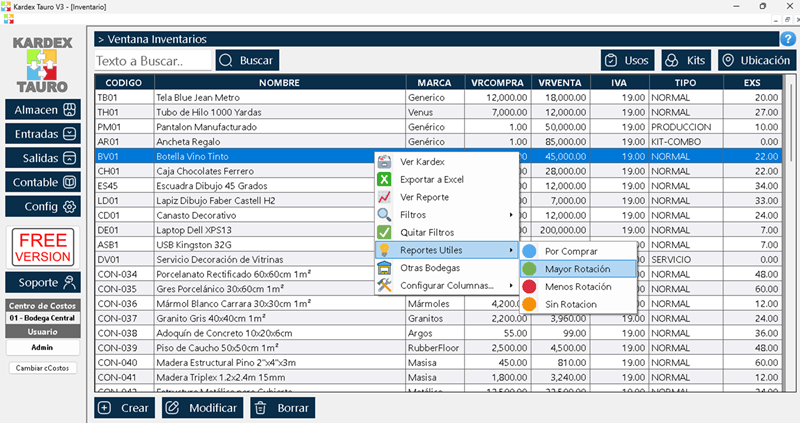
- Kardex Tauro: stock ledger and inventory software with invoicing for retail SMBs in Latin America; it installs on Windows desktops over a local SQLite database, includes a server mode for working on a network, is offered in a free plan and an annual paid plan per workstation, and its documentation declares lot and expiry date management.
- Nubox: electronic invoicing and administration in the cloud for SMBs in Chile, Peru, Mexico and Colombia, with a monthly subscription.
- Scrampi: cloud point of sale with an offline mode, marketed for shops, pharmacies and restaurants in Colombia, with a monthly subscription of approximately COP 46.000.
- Siigo: accounting, payroll, inventory and electronic invoicing for SMBs and accountants in Colombia; available in the cloud and in a desktop version, with a monthly subscription.
- Softland: ERP with inventory, purchasing and projects for mid-size companies in Colombia and Chile; available on the desktop and in the cloud, under a license or a subscription.
- World Office: electronic invoicing and multi-company support for businesses and accountants in Colombia; it runs on the desktop and is sold under a license.
Comparison of programs for pharmacies
The following table summarizes, for each of the ten programs, four pieces of data that matter to a pharmacy: the deployment model, the approximate price model as of September 2026, the profile declared by the developer and whether lot and expiry date management is declared. The information comes from public sources, not from tests run by us.
| Program | Deployment | Price model (approx. Sep 2026) | Profile | Lots and expiry dates |
|---|---|---|---|---|
| Kardex Tauro | Windows desktop (local SQLite database, with server mode) | Free plan and annual payment per workstation | Stock ledger and inventory software with invoicing for retail SMBs in Latin America; its developer declares lot and expiry date management | Yes (lot and expiry date management, according to its documentation) |
| Alegra | Cloud | Monthly subscription | Suite for SMBs and accountants in Latin America (accounting, inventory, point of sale, electronic invoicing) | Not declared in public sources |
| Aspel SAE | Desktop | License with one-time fee and maintenance | Purchase-sale administration with stock ledger, SMBs in Mexico | Not declared in public sources |
| Bind ERP | Cloud | Monthly subscription (approx. MXN 949-1.999) | ERP with inventory, purchasing, sales and invoicing, SMBs in Mexico | Not declared in public sources |
| CONTPAQi Comercial | Desktop and cloud options | Subscription per product | Ecosystem with inventory (stock ledger), sales and invoicing modules, SMBs in Mexico | Not declared in public sources |
| Nubox | Cloud | Monthly subscription | Electronic invoicing and administration, SMBs in Chile, Peru, Mexico and Colombia | Not declared in public sources |
| Scrampi | Cloud (point of sale with offline mode) | Monthly subscription (approx. COP 46.000) | Point of sale marketed to shops, pharmacies and restaurants in Colombia | Not declared in public sources |
| Siigo | Cloud (and desktop version) | Monthly subscription | Accounting, payroll, inventory and electronic invoicing, SMBs and accountants in Colombia | Not declared in public sources |
| Softland | Desktop and cloud | License or subscription | ERP with inventory, purchasing and projects, mid-size companies in Colombia and Chile | Not declared in public sources |
| World Office | Desktop | License | Electronic invoicing and multi-company, businesses and accountants in Colombia | Not declared in public sources |
The last column is the most important one for a pharmacy and also the hardest to confirm: lot and expiry date management is not always detailed on the developers' public websites. Looking at the sources available as of September 2026, among these ten programs the only one that declares this feature is Kardex Tauro. The fact that the others do not declare it publicly does not mean they cannot handle it: it means that, when a pharmacy needs it, that should be the first question to the vendor before making a decision.
What to consider in a pharmacy
Beyond the table, there are business criteria worth reviewing before choosing an inventory program for a pharmacy.
Expiry dates and lots. In this business, the most important piece of data about a product is not only how many units are on hand, but which lot expires first and where it is. The program should let the user record the expiry date attached to each lot, identify the product about to expire and help remove it from sale in time. A system that only counts stock falls short for a pharmacy.
The FEFO method. The recommended practice for medicines is to dispatch under FEFO logic, first expired, first out: the lot with the closest date should leave before the one with more shelf life. That prevents product close to expiry from piling up at the back of the shelf while newer stock is dispatched.
Turnover and restocking. Some medicines have high turnover, such as painkillers, cold remedies and other over-the-counter products, and require frequent restocking, while others move slowly. The program should help detect minimums, review how old the stock is and plan purchasing without ending up with excess inventory.
Invoicing and local requirements. Electronic invoicing is mandatory or widely used in several countries in the region, each with its own format. The inventory program must work alongside the invoicing the pharmacy already uses, or include it, and should make it possible to move away from informal operation without duplicating the work of entering sales.
Information backup. The history of purchases, lots and expiry dates cannot be rebuilt once it is lost. If the system lives in the cloud, it is worth knowing what happens when the connection fails; if it lives on the desktop, periodic backups and someone responsible for them need to be arranged.
Total cost, not just the monthly price. Comparing only the monthly fee is misleading: there are one-time licenses plus maintenance, subscriptions per product or per workstation, and free plans. Support, updates and the time needed to migrate data from the current system must be added to the cost.
Kardex Tauro in this list
Kardex Tauro is the software we develop, so this section cannot be neutral and we say so plainly. It is a stock ledger and inventory program with invoicing, designed for retail SMBs in Latin America. It installs on Windows desktops over a local SQLite database and offers a server mode for sharing information across several computers on the same network. Its commercial model combines a free plan and an annual paid plan per workstation, and its documentation declares lot and expiry date management, which is precisely the feature that is hardest to find in the public sources of other programs.
It is also fair to say what it is not. Kardex Tauro is not a full ERP: it does not include formal accounting or payroll, and its natural deployment is the desktop. A pharmacy that needs those pieces, or a cloud point of sale that can be consulted from anywhere, may find a better fit in other programs on this list. As always, the recommendation is to try it with real data before buying.
The prices shown are approximate and reflect September 2026; vendors update them frequently and often have special conditions. Each program's capabilities should be confirmed directly with its developer, as should the health and tax requirements of the country where the pharmacy operates. This guide was written from public information and is not a substitute for a real test with the business's own data.