The history of inventory records in ancient civilizations
The history of inventory records in ancient civilizations
Inventory existed long before coined money, and even before writing. As soon as a community learned to harvest more than it could consume, it faced a new problem: what to do with the surplus. The answer was to store it. And storing without recording is a recipe for chaos: nobody knows how much there is, how much is missing, who received what, or when to restock. That is why the history of stock control begins much earlier than the history of money or banking: it begins with the first granary that someone decided to count.
This article follows that story from its origins in Mesopotamia to the Roman Empire: how the receipts and issues of grain, livestock, oil and other goods were recorded, who kept those records, and which control mechanisms were invented to make the written account match what was actually stored. The companion pieces in this history section cover Egypt, Greece and Rome in depth from the viewpoint of accounting in general; here the focus is narrower: the stock, the stored good, and its record. The full arc of these methods up to the barcode and today's software deserves its own article and will be told in a later post.
Inventory was born before money
About ten thousand years ago, when the first farmers of the Near East began to domesticate cereals, they discovered that a well-kept harvest could feed the community all year round. That discovery changed the history of record-keeping: surplus grain was stored in silos and depots, and suddenly someone needed to remember how much there was, how much had been shared out, and how much remained for the next sowing. Coined money, by contrast, did not appear until around the seventh century BC, in the kingdom of Lydia in modern Turkey. Between those two moments lie thousands of years of accounts kept without money, in measures of grain, heads of livestock and work rations.
The economy of the first temples and palaces was, in essence, an economy of storage and redistribution: the harvest was gathered, kept in central depots, and handed back out as rations to workers, priests and officials. For that cycle to work, someone had to know at all times how much had come in, how much was going out, and how much remained in reserve. That need for control, not trade, was the mother of stock records.
Mesopotamia: clay tokens, bullae and the first tablets
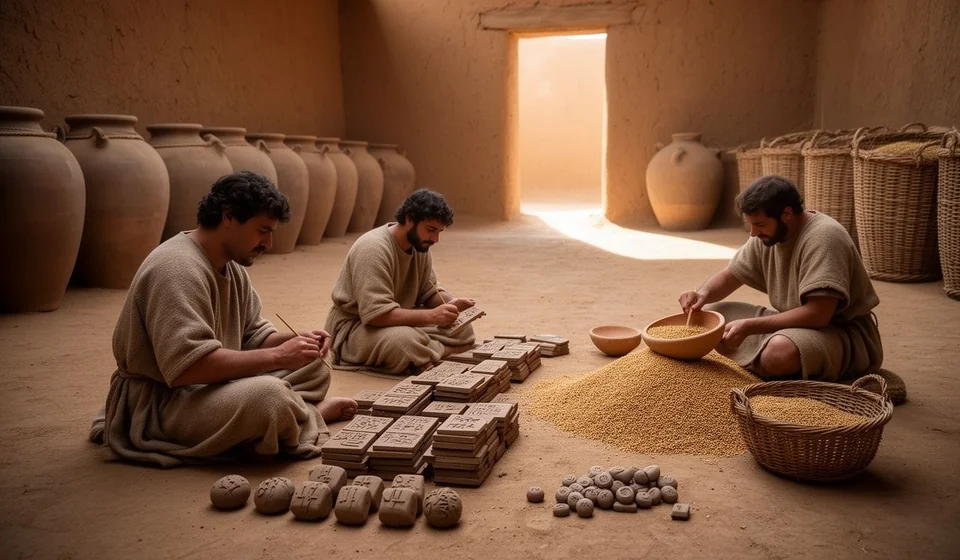
In Mesopotamia, farmers solved the problem with a system as ingenious as it was simple: small clay tokens of varied shapes (cones, spheres, discs, cylinders), where each shape stood for one unit of a specific good: a measure of grain, a jar of oil, a head of livestock. These tokens are estimated to have been in use from about 8000 BC, millennia before writing. The archaeologist Denise Schmandt-Besserat showed in the 1970s that they are the direct forerunner of writing: a flock or a cargo could be counted without a single word, simply by grouping the tokens that matched each transaction.
The system evolved once the movement of goods made it necessary to record transactions at a distance. The tokens were placed inside hollow clay balls called bullae, closed and sealed with the responsible person's seal to prevent tampering. But the contents of a closed ball could not be seen, so someone had the idea of pressing the tokens against the outer surface before sealing it: the outside then told what the inside held. The next step was logical: if the marks were enough, the ball and the tokens were redundant. Around 3200 BC, in Uruk and other Sumerian cities, those marks became signs pressed onto flat clay tablets: proto-cuneiform, the first great record-keeping system we know of.
And what did those tablets record? Above all, the stocks and movements of temple and palace storehouses. The administrative archives of archaic Uruk list grain, herds, oil and workers' wages. The scribes noted:
- Harvest receipts into the temple or palace granary.
- Daily rations delivered to workers, craftsmen and officials.
- Flocks of sheep and goats, with their increases and decreases.
- Jars of oil, beer and other stored goods.
Control did not end with the clay. Storeroom doors were closed and sealed with clay impressed by the cylinder seal of the official in charge: nobody could enter without breaking the seal and leaving evidence. In the Ur III period, around 2100-2000 BC, scribes produced tens of thousands of administrative tablets recording harvests, rations, herds and the work of the state storehouses, with grain serving as the official measure of value. And when the state decided to regulate these matters, the law backed the records: the Code of Hammurabi, from around 1750 BC, contains provisions on grain debts and on the liability of those who held deposits on behalf of others. Measuring, recording, sealing and legislating: the full repertoire of stock control was already in place.
Egypt: the pharaoh's granaries
In Egypt the same problem was solved on the banks of the Nile, on a colossal scale. The pharaoh's state lived on grain: taxes were paid in kind, and the harvest was measured with official capacity units controlled by the administration before it entered the royal and temple granaries. Scribes recorded the quantities received and issued on papyrus and on ostraca (pottery fragments used as scrap paper), and officials sealed the doors of the storehouses with stamped clay sealings, so that every opening left its trace. The accumulated reserves paid the rations of the workers on the great royal projects and saw the country through years of poor floods. This history section devotes a separate piece to accounting in ancient Egypt; here it is enough to note that the land of the Nile perfected the physical control of grain stocks with the same Mesopotamian logic: measure, record and seal.
Mycenae and Pylos: inventories in Linear B
Between roughly 1450 and 1200 BC, Mycenaean Greece kept its accounts in a syllabic script called Linear B, also written on clay tablets. The archives of the palace of Pylos, in the southwestern Peloponnese, dated to around the thirteenth century BC, are the best-preserved example: there, the palace scribes recorded inventories of chariots and their wheels, noting which parts needed repair; jars of perfumed olive oil; flocks of sheep; bronze; and work groups with their rations. This is a world of palaces that concentrated, measured and redistributed, just as in the East. The irony is that we owe their survival to their destruction: when the Mycenaean palaces burned down around 1200 BC, the fire baked the clay tablets and turned them into a nearly indestructible material that archaeologists recover today.
Greece: temple treasuries, counted
In the Greece of the city-states, stock records found a new stage: the temples, which worked at once as banks and as treasuries. At sanctuaries such as Delphi, Delos and the Acropolis of Athens, boards of treasurers received, guarded and handed over the sacred objects and the community's funds, and rendered their accounts before the assembly. The inventories of the treasury items (vessels, statuettes, offerings dedicated to the gods) were carved on stone stelae and reviewed year after year, in a documented handover between outgoing and incoming magistrates. Greek accounting in general, from public money to the banks of the temples, has its own article in this section; here what matters is its contribution to stock control: the publicity of records, periodic review, and accountability as safeguards against theft and neglect.
Rome: horrea, the annona and the empire's granary
Rome turned stock control into engineering and into politics. Already in the days of the Republic, between the third and second centuries BC, the city built large collective warehouses, the horrea, to hold wheat and merchandise along the Tiber and at its ports. When the tribune Gaius Gracchus pushed through the grain law of 123 BC, guaranteeing subsidized grain to citizens, the distribution became a permanent duty of the state, and with it came the need for public warehouses: the horrea publica, true logistics centres where the wheat was measured, inspected and guarded until it was handed out.
Under the Empire, the supply of Rome became a permanent machine known as the annona. Egypt, annexed in 30 BC, and North Africa were the great granaries of the empire, and their harvests came by sea to Ostia and Portus, the artificial harbour the emperors had built. Rome is estimated to have reached close to a million inhabitants, and feeding that multitude demanded a continuous chain of record-keeping: measuring the grain on arrival, inspecting its quality, storing it, and distributing it under control. The emperor Augustus took over the cura annonae, the care of the grain supply, and entrusted its management to a prefect of equestrian rank backed by clerks, measurers, inspectors and warehouse keepers. Entitled citizens received small tokens, the tesserae, which certified their right to a monthly ration of grain: the same principle as the Mesopotamian tokens, applied four thousand years later.
The imperial horrea were much more than silos: multi-storey buildings with raised, ventilated floors so that the grain would not dampen, divided into rented cells identified by inscriptions. Monumental examples survive at Ostia with the names of their builders carved on the facades, and there were specialized warehouses for oil, wine and spices. Alongside all this, Rome practised another form of inventory: the census. Every five years, the censors registered the citizens and their property, the basis of military service and taxation. Counting people and possessions for fiscal purposes is, at bottom, the same passion for counting and recording that drives this article.
A comparison: what each civilization controlled
The table below summarizes, for each civilization on this journey, which stocks it controlled, on what medium it recorded them, and who exercised that control.
| Civilization | What stocks it controlled | Recording medium | Who controlled it |
|---|---|---|---|
| Mesopotamia (Sumer and Ur III) | Grain, livestock, oil, work rations | Clay tokens, sealed bullae, proto-cuneiform and cuneiform tablets | Temple and palace scribes; storehouses sealed with the official seal |
| Egypt | Grain from the royal and temple granaries | Papyrus and ostraca with official measures; clay sealings on doors | The pharaoh's scribes and the granary officials |
| Mycenae (Pylos) | Chariots and wheels, oil, flocks, bronze, rations | Clay tablets in Linear B script | Palace scribes |
| Classical Greece | Sacred objects and offerings in temple treasuries | Inventories carved on stone stelae | Treasurers accountable to the assembly |
| Imperial Rome | Wheat for the annona, oil, wine, spices and other goods | Administrative records, labels, tesserae and identified cells | The prefect of the annona, clerks, measurers and inspectors; censors for people and property |
Conclusion: what changed (and what did not)
From the eighth millennium BC to the horrea of the Roman Empire, every civilization arrived on its own at the same answer, using different materials: a medium on which to write, a common unit of measure, a responsible authority, and a seal or signature to give it force. Inventory was not born as an administrative formality: it was born as a guarantee of trust (knowing that what is stored matches what is recorded) and as the basis of redistribution and of power.
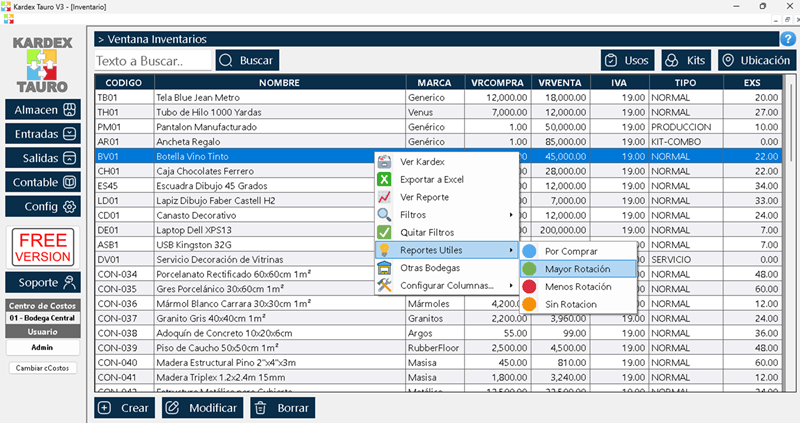
No warehouse today needs clay seals or tablets, but the question remains the same: how much is there, how much came in, and how much went out. What a scribe in Uruk pressed with a reed onto damp clay, an inventory program with stock ledger cards such as Kardex Tauro records in seconds, with the same ambition that the record, now digital, should match the reality of the storeroom. From the temple seal to the click of a keyboard, the history of inventory is the history of a promise: that what is recorded is what there is.