Accounting in ancient Egypt: scribes, papyrus and the pharaoh's granaries
Accounting in ancient Egypt: scribes, papyrus and the pharaoh's granaries
If one civilization can claim that accounting was born as an everyday need of the state, it is the one on the Nile. For more than three millennia Egypt ran without coinage: real "money" was grain, and grain had to be measured, stored, distributed and, above all, counted. That is why Egyptian accounting was, first and foremost, a colossal system of stock control and rations built on an entire profession: the scribes. Expanding the combined article of this section on Egypt, Greece and Rome, how a scribe was trained, what materials he wrote on, how the pharaoh's granaries were guarded, and how the Nile flood set the rhythm of taxation. A final table summarizes it.
The scribe: a career with a pen
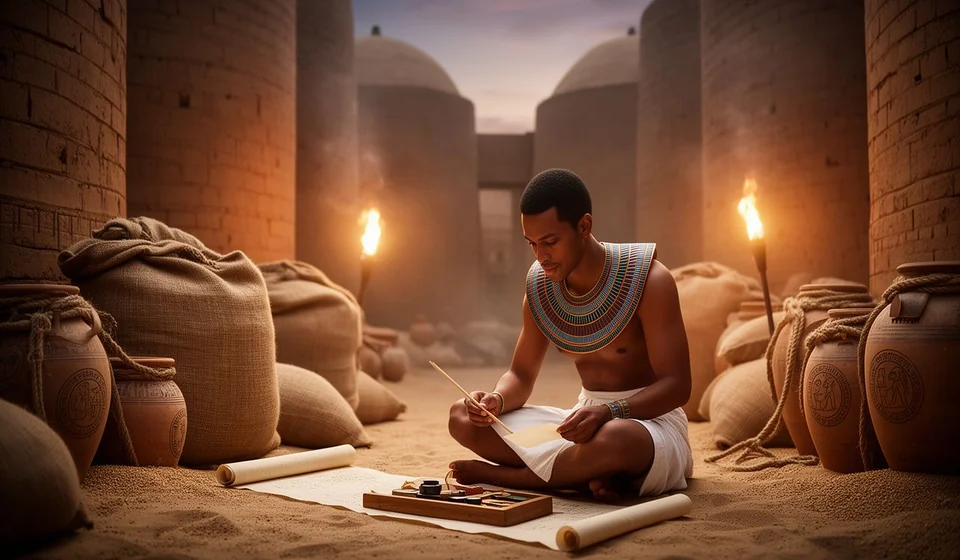
In a society in which only around one percent of the population is estimated to have been literate, the scribe was the cog that kept the state running. Future scribes were trained from childhood, at schools attached to the palace or the great temples. There they learned not only to draw signs but two scripts, monumental hieroglyphs and the cursive hieratic of everyday documents, and above all applied arithmetic: the bulk of the job was calculating how many loaves a sack of grain would yield, how much beer could be brewed from so much barley, or how to divide an amount among a gang of workers while recording even the remainder.
The prestige of the profession is captured in a famous Middle Kingdom text, the Satire of the Trades, written around 2000 BCE. In it a father walks his son through the miseries of every manual trade: the blacksmith with fingers full of soot, the soldier beaten and thirsty, the farmer devoured by taxes. The moral is repeated like a refrain: become a scribe, because the scribe is the one who gives orders and never pays with his back. That is why the statue of the seated scribe, papyrus unrolled on his lap, is one of the most repeated motifs of Egyptian art: it portrays a man who does not till or build, yet on whom the harvest, the warehouse and the army all depend.
There were scribes of the harvest, the granary, the treasury, the army, the cattle and the courts; each answered for his records to his superior, in a chain that climbed from the village to the vizier, the pharaoh's prime minister. The career was the natural gateway to the highest administration, to the point that it has been called the first great professional bureaucracy in history.
Papyrus, ostraca and boards: the Nile's office supplies
The star support was papyrus, made from the plant of the same name that grew on the banks of the Nile and the delta. The stem was peeled and cut into thin strips of pith, laid in two layers at right angles, moistened and pressed until the plant's own juices glued them into a strong sheet; several sheets were joined to form rolls many metres long. The process was laborious and the material expensive: this was not waste paper but an almost luxury product for documents worth keeping, and its trade was under state control.
That price explains two habits confirmed by archaeologists. First, reuse: scribes washed or scraped old papyri to write over them again, so that a single roll could contain accounts from different eras. Second, cheap supports for daily record keeping: ostraca, pieces of broken pottery and limestone flakes left over from any construction site. Writing on an ostracon cost nothing, and so they received the drafts, provisional calculations, delivery notes, attendance lists and jottings later copied cleanly onto papyrus.
The best example of that everyday accounting is Deir el-Medina, the village of the craftsmen who built the royal tombs of the New Kingdom, inhabited between roughly 1550 and 1070 BCE on the west bank of Thebes. Thousands of ostraca have survived recording the crew's administrative life: monthly grain rations delivered to each worker, distribution of tools, days worked and absences with their reasons. Its scribes also left accounts in table format, with columns for what was due, what was delivered and what remained outstanding: the direct ancestor of a stock-control sheet.
Egyptian accounting was single-entry: receipts and issues were noted in lists and columns with totals at the bottom. Double-entry bookkeeping did not exist and would take millennia to be formalized in mercantile Europe. What Egypt mastered was the discipline of systematic recording: dating each entry, naming the person responsible, stating quantities with their measures and keeping the document as evidence.
The pharaoh's granaries: controlling stock without money
To understand that accounting you must understand its economy, which historians call redistributive. The state and the temples concentrated the harvest, stored it and gave it back to the population as rations, wages and offerings. There was no currency: salaries were paid in kind, above all grain, bread, beer and cloth. The result fascinates the history of inventories: since money did not exist, Egyptian accounting was almost entirely accounting of stock, the record of how much grain there was, how much went out, to whom it was delivered and how much remained.
Everything was measured in official units, the chief of them the heqat, the standard grain measure equal to about 4.8 litres, subdivided into smaller units such as the hin and the ro for precise fractions; scribes also handled the oipe of four heqat and the Horus-eye fractions for dividing the heqat into successive halves, calculations found in the Rhind Mathematical Papyrus. Bread and beer, the Egyptians' liquid bread, were at once consumer goods and currency: rations were expressed in loaves and jars of beer. For what was not measured by volume there were weights: the deben, about 91 grams of metal, served as a reference of value.
Metal, cloth and precious objects were kept in the treasury, which the Egyptians literally called the house of silver, while grain was kept in the granaries, mudbrick buildings with domed silos that, in the central institutions, formed monumental complexes such as the so-called Double Granary. Overseers and granary scribes controlled those facilities in the pharaoh's name, and physical control mattered as much as the written record: jars, sacks and even doors were closed with clay seals stamped with a cylinder or scarab seal that had to be broken to open them. On that basis the scribes kept the warehouse ledger, with receipts, issues, surpluses and shortages, and periodically the remaining stock was counted and reconciled with the entries.
Taxes sized by the flood: nilometers and land register
The source of all that wealth was the Nile cycle, and the treasury learned to read its budget in it. Every summer the river flooded the fields and, as it receded, left a layer of fertile silt; the height of the flood decided everything: too low meant famine, just right meant abundant harvests. That is why the Egyptians built nilometers, stone scales beside the river, such as the famous one on the island of Elephantine, and the royal annals, like those on the Palermo Stone, recorded the height of the inundation year after year. The fiscal rule was simple and is documented in every period: the higher the flood, the larger the expected harvest and therefore the higher the taxes.
When the waters went down, the second great administrative ritual of the year began: the survey of the land. The boundaries of the plots had disappeared under water, so gangs of surveyors, the famous rope-stretchers, walked the fields with knotted ropes to redraw each plot and note who farmed it. On those surveys the kingdom's land register was built, the basis of the tax system: knowing how much land there was and who worked it, the state calculated how much grain each farmer should deliver.
The supreme example of that register is the Wilbour Papyrus, written around 1145 BCE, in year four of the reign of Ramesses V. About ten metres long, it is the largest surviving non-funerary administrative papyrus: it records thousands of plots in Middle Egypt with their size, holder, owning institution and expected tax, some 2,800 in its first section alone. Documents like this show how far the state knew who produced, how much they produced and how much they owed. On the threshing floor, collection was done sack by sack, with scribes noting each delivery.
Temples and royal works: the Nile valley's giant enterprises
The temples were the largest economic organizations in Egypt, owning land, herds, workshops and numerous staff, and their accounts were kept with rigor. The Abusir Papyri, found in the royal funerary temples of the Fifth Dynasty around 2450 BCE, are the oldest surviving administrative archive of this kind: they contain the priests' duty rosters, inventories of ritual equipment with its state of preservation, and monthly account tables of income and expenses. Since the service teams rotated, each shift checked the inventory when it took office and answered for it when it handed it over: institutional stock control more than four thousand years old.
The pharaoh's great building projects ran on the same logic. The papyri of Wadi el-Jarf, on the Red Sea coast, date from the time of the Great Pyramid, in the Fourth Dynasty, and show the accounts of an expedition in tables comparing the quantity of each product expected, actually delivered and outstanding: bread, beer, fish, tools and raw materials, all recorded by gang. In practice it was delivery control with expected, received and missing columns.
No site shows royal-works accounting better than Deir el-Medina. The craftsmen of the royal tombs were highly skilled professionals paid with monthly rations from the royal granary, and the village scribes recorded every delivery and every working day. When payment was delayed, the workers wrote it down and stopped working: around 1155 BCE the village records document one of the first strikes in history, caused by rations that never arrived.
The map of Egyptian accounting control
The following table summarizes the great control areas of pharaonic Egypt, what each one recorded, on what support and who kept it:
| Control area | What it recorded | Support | Who kept it |
|---|---|---|---|
| State granaries | Grain receipts and issues, rations, stock in heqat, shortages and surpluses | Papyrus, ostraca, clay seals | Granary scribes under overseers |
| Fields and harvest | Plots surveyed after the flood, holders, estimated tax | Land registers on papyrus, such as the Wilbour Papyrus | Surveyors and harvest scribes |
| Temples | Offerings income and expenses, equipment inventories, staff rosters | Administrative papyri, such as the Abusir Papyri | Temple scribes and priests in shifts |
| Royal works | Workers' rations and attendance, tools, materials expected versus delivered | Ostraca and papyri of Deir el-Medina and Wadi el-Jarf | Crew and site scribes |
| Treasury | Metals, cloth and precious objects, values in deben | Papyrus, weights, seals | Treasury scribes of the house of silver |
The table reveals something important: the Egyptian scribe did not count money; he counted things. Grain, loaves, jars of beer, heads of cattle and plots of land were the units of his balance sheet, Beneath it there is a moral idea: for the Egyptians the order of the world, maat, rested on the truth of what was written, and even the judgment of the dead was depicted as a weighing of accounts, the deceased's heart facing the goddess's feather. Rendering accounts was a duty that transcended even this life.
From the pharaoh's granary to the digital inventory
Egypt knew no coinage and no double entry: its accounting was always of physical quantities rather than monetary values. But it left something perhaps more valuable: the conviction that nothing should go unrecorded, that every good that comes in must be able to go out with its entry, that the warehouse is controlled with seals, counts and accountable people, and that the written document is the proof of any operation.
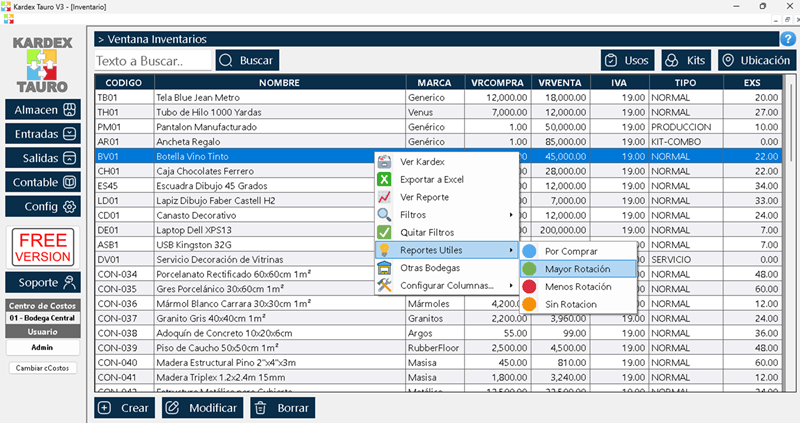
No modern business measures its goods in heqat or seals its storerooms with clay, but the question the granary scribe asked himself every evening is the same one asked by anyone who runs a modern warehouse: how much should be there, how much is actually there, and to whom was the missing part delivered? What in Thebes required brushes, ostraca and months of arithmetic, an inventory program such as Kardex Tauro solves in seconds, with the same spirit: that no receipt, no issue and no balance remains unrecorded. From the mudbrick silo to the screen, stock accounting remains, as in the time of the scribes, the art of never losing sight of what is stored.
