Accounting in ancient Greece: from public money to temple banks
Accounting in ancient Greece: from public money to temple banks
When the Greek city-state began to pay and charge in coined money, the art of keeping accounts stopped being a matter of granaries and herds and became a matter of citizens. Coinage had been born shortly before, around the seventh century BC, in the kingdom of Lydia across the Aegean, and the Greek poleis adopted it quickly during the sixth century BC: Aegina, Corinth and Athens, among others, put their own silver pieces into circulation. That small metal disc changed ancient accounting forever: it was no longer enough to note how many amphorae stood in a warehouse; now one had to record flows of money, debts, credits, interest and payments between people who might never meet. Greece did not invent the stock register, a legacy of Mesopotamia and Egypt; it invented something different: the accounting of money as a political, religious and commercial instrument at the same time.
A brief note on method: this piece goes in depth into what Greece contributed to the history of accounting, far beyond the era summary this blog already devotes to Egypt, Greece and Rome, and focuses on the details that made Athens, Delphi or Delos true laboratories of auditing and credit.
A monetary economy demands new kinds of records
Coinage brought a quiet revolution in record-keeping. With barter and payment in kind, the memory of the storehouse was enough: what came in, what went out, what remains. With money, however, transactions appeared that moved no physical object: a loan, a deposit, an order of payment, an interest that grows with time. To record them, the Greeks used the same materials as their neighbours, papyrus, waxed wooden tablets and potsherds known as ostraca, together with a numeral system of their own: acrophonic signs for official accounts and the abacus as their hand calculator. Greek officials handled considerable sums: the revenues of the Athenian empire were counted in talents, and one talent was worth six thousand drachmas. The lists of taxpayers, tribute and expenses therefore demanded meticulous care, and it is no coincidence that in the agora there was even a public slave, the dokimastes, in charge of checking that the coins passing from hand to hand had the right weight and alloy: trust in money, it was already known then, begins with accuracy of record.
What was truly new was not the material but the mentality: in classical Greece, money was something that had to be explainable. Whoever administered other people's funds, whether the state, a god or a business partner, was morally bound to render accounts, and that obligation eventually became an institution.
Public money in Athens: accounts that are audited and carved in stone
The most celebrated case is the Athenian democracy of the fifth and fourth centuries BC. The Athenians started from a radical idea: the money of the polis was everyone's business, and therefore everyone had the right to know how it was spent. To guarantee this they built a layered system of control
First came the entry filter: whoever was to hold an office handling public funds had to pass a preliminary scrutiny, the dokimasia, before the Council and the courts. During the term, officials rendered accounts periodically. And at the end of the mandate came the essential part: the euthynai, the compulsory rendering of accounts. Every magistrate, on leaving office, had to present his financial report to the logistai, a board of ten auditors chosen by lot every year, within thirty days. Once that review was approved, the euthynoi came on stage: for the following days they received complaints from any citizen who believed that a magistrate had mishandled public money. Any Athenian could bring an accusation; control was not only technical but civic, and therein lies perhaps its greatness: scrutiny did not rest in the hands of a few specialists but was open to the whole community.
This machinery left traces that can still be read today. Athenian public accounting was carved on marble stelae set up on the Acropolis, in full view of everyone: public spending as public reading. The treasurers of Athena, the tamiai, custodians of the goddess's sacred treasury kept in the opisthodomos of the Parthenon, drew up annual inventories of the precious objects, gold and silver vessels, offerings and jewels, with their exact weights, and those inventories were inscribed in stone year after year. The accounts of the construction of the Parthenon, covering the years 447-432 BC, recorded payments for materials, transport and wages, from the quarry to the finished temple. And the hellenotamiai, treasurers of the Delian League, carved each year the lists of the tribute paid by the allied cities, showing the share that belonged to Athena: from 454 BC onwards those lists, the famous Athenian tribute lists, were displayed on the Acropolis so that anyone could check how much had come in. When the League's treasury moved from Delos to Athens, precisely in 454 BC, the city became the administrator of a common fund whose accounts were exhibited as proof of honesty.
Temples as banks: safeguarding, lending and recording
The second great accounting actor of ancient Greece was religion. The great sanctuaries, Delphi, Olympia and above all Delos, were more than places of worship: they were strongrooms, archives and credit institutions. Cities deposited their surpluses and reserves there because sacred ground offered the best guarantee available: the protection of the god and the vigilance of his priests. When the Delian League entrusted its common treasury to the sanctuary of Apollo, it was simply following a custom widespread throughout the Greek world: the god as central banker.
The sanctuaries did not merely safeguard; they lent. The temple of Apollo at Delos, whose annual accounts were kept by officials called hieropoioi, granted interest-bearing loans to cities and private individuals, and the surviving documentation shows operations at an interest of around ten per cent a year. Delphi, with its amphictyonic administration, and Olympia, with the treasury of Zeus, played similar roles. Moreover, the sanctuaries kept minute inventories of their wealth: every offering of gold or silver was recorded with its weight, its origin and the name of the donor. Essentially, they were asset registers with physical control, carved so that nothing could be removed without leaving a trace.
The trapezitai: from the money changer's table to the private bank
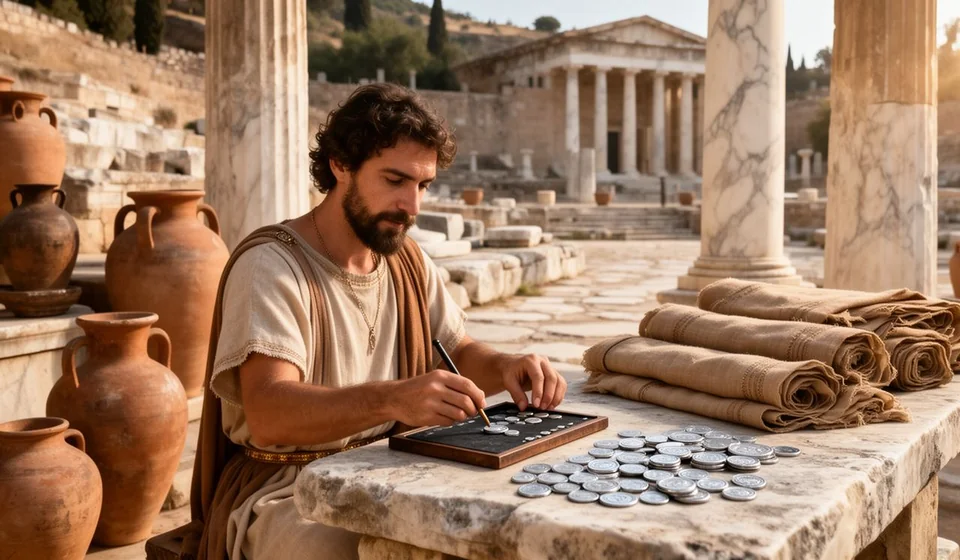
The third pillar was private and was born in the agora. Trapeza means table: the table where the money changer set up his business to exchange the coins of the different cities, which circulated with different weights and alloys. Over time, many money changers expanded their trade and became bankers, the trapezitai, who in the Athens of the fifth and fourth centuries BC already did almost everything a modern bank does without calling itself a bank: they took deposits, granted secured loans, collected and paid on behalf of their clients, financed ventures and issued written orders of payment, the diagraphai, which transferred funds from one account to another, a mechanism that historians compare with the cheque.
The most celebrated banker in Athens was Pasion, a freed slave who came to run from the Piraeus one of the soundest banks in the Greek world and eventually obtained citizenship for his services to the city. His story, and that of his bank, is known thanks to the surviving forensic speeches, above all those of Demosthenes and Isocrates, which narrate lawsuits between bankers, depositors and heirs: wills, dowries, mortgages on real estate and slaves, and disputes over accounts that did not always balance.
Here a trait appears that separates Greece from modern accounting: the evidentiary value of the document. In the Athenian courts, a book of accounts by itself was not sufficient proof; the testimony of witnesses weighed more. The written record served as memory and support, but verification was social: people were asked who had witnessed the transaction. Moreover, the bank was the person: there was no joint-stock company and no limited liability, and when a banker died, his business was usually wound up. The continuity of Pasion's house, which passed to his manager Phormio and later to his sons, was a celebrated exception precisely because the rule was the opposite.
Maritime trade: contracts that account for risk
The fourth stage was the sea. Athens lived from trade through the Piraeus, and Rhodes became the great emporium of the eastern Mediterranean, famous for its maritime law. Since voyages were long and dangerous, traders did not finance their cargoes alone: they sought investors willing to lend money on the voyage, the so-called bottomry loan, the nautikon daneion. The loan worked like this: the lender advanced the funds for a specific expedition; if the ship reached port, the borrower repaid the capital with a very high interest, proportional to the risk; if the vessel was lost, the debt died with it. It was insurance and credit at once, and its price reflected the probability of shipwreck.
What is interesting for our story is the record. Each bottomry loan was formalized in a written contract, the syngraphe, specifying the amount, the interest, the route, the goods and the term, signed before witnesses. The surviving speeches of the Attic orators, such as several by Demosthenes, preserve the details of these contracts and of the lawsuits they generated: interest rates that in the known documents range between ten and thirty per cent per voyage, clauses on the exact destination of the ship, and disputes over who should bear the loss. Thanks to those trials we know that traders kept records of their cargoes, their freight costs and the loans they had taken, and that the courts could reconstruct an entire operation from documents and witnesses.
Rhodes, for its part, gave its name to a body of maritime custom, Rhodian sea law, which regulated average, cargoes and liability and which centuries later would influence Roman and medieval maritime law. Wherever there is long-distance trade there is a need to write things down, and Greece showed that good records could sustain an empire of ships.
A synthesis in one table
The following table summarizes the main Greek control institutions, their function and the medium in which their accounts were kept.
| Greek institution | Control function | Recording medium |
|---|---|---|
| Magistrates and Assembly (Athens) | Final rendering of accounts (euthynai) before the auditors (logistai) and citizen complaint (euthynoi) | Reports submitted on leaving office; public inscriptions |
| Treasurers of Athena (tamiai) and hellenotamiai | Annual accounts and inventories of the sacred treasury and of the League tribute | Marble stelae on the Acropolis |
| Sanctuaries (Delphi, Delos, Olympia) | Safekeeping of deposits, interest-bearing loans and inventories of offerings | Annual accounts and inscribed inventories, such as those of the hieropoioi of Delos |
| Trapezitai (private bankers) | Money changing, deposits, secured loans and payments by written order | Bankers' books on tablets and papyrus; witnesses as proof in court |
| Maritime bottomry loan | Contract conditional on the success of the voyage: the lender bears the risk of the sea | Written contracts (syngraphai) signed before witnesses; lawsuits preserved in speeches |
What Greece did not invent, yet
To value the Greek legacy fairly, it is worth remembering its limits. Greece did not know double-entry bookkeeping: the method of recording every transaction twice, on the debit and the credit side, would take centuries to be born, in medieval Italy, and was only published in 1494 with Luca Pacioli's treatise. Greek private accounting was simple: records of income and expenditure, memoranda of transactions and lists of debtors and creditors, but there was no notion of a general balance sheet, nor of a business as an entity distinct from its owner. Nor was there positional numeration: calculations were made with signs representing fixed values and with the abacus, which made written operations slow and prone to error. Auditing, finally, was a brilliant public institution but not a profession: there were no independent accountants certifying the books of an individual or a firm.
What Greece did leave behind was a repertoire of ideas that modern accounting inherited: compulsory rendering of accounts, review by third parties, publication of financial information, deposit and credit banking, the contract as evidence, and the awareness that recording is not a formality but a form of collective trust.
From marble to the screen
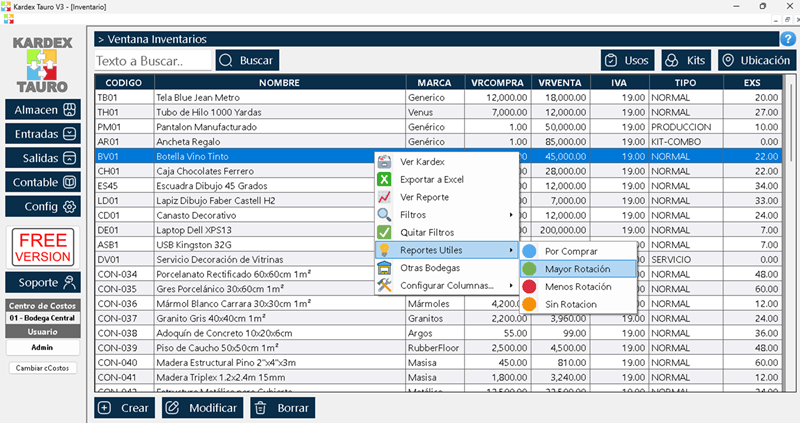
Twenty-five centuries separate the marble stele of the Acropolis from the screen of a modern warehouse, but the problem they solve is the same: to know with certainty what you have, what came in, what went out and who answers for it. What in Athens required boards of auditors, annual lotteries and dozens of stelae carved with a chisel can now be done in minutes with an orderly, permanent record. That is why the Greek lesson is still valid: accounting was born as a way of rendering accounts to others, and it still is, above all, that. If today you want to apply that same discipline to your stock, recording every entry and every exit, keeping the register up to date and being able to show it when needed, Kardex Tauro makes it easy: the inventory control that the Greeks carved in stone, now in seconds.
