Accounting in ancient Rome: from the paterfamilias to the empire's horrea
Accounting in ancient Rome: from the paterfamilias to the empire's horrea
For more than a thousand years Rome administered one of the largest territories of the ancient world with a very scarce raw material: information. Without paper, zero or calculators, its officials held the empire together with wax tablets, parchment and papyrus, and above all with a record-keeping discipline that still impresses us today. Long before the word "accounting" existed, they practised something very close: writing down what came in, what went out and what remained.
This article zooms in on the Roman case. After the combined tour of Egypt, Greece and Rome, this text goes down to ground level: the citizen's house, the censor's office, the docks of Ostia and the empire's grain warehouses, because Roman accounting was not a single invention but a mosaic of domestic, private and public practices united by the same obsession with a written record of property.
The paterfamilias, Rome's first bookkeeper
The starting point of Roman accounting was neither a company nor a ministry, but the household. The paterfamilias, head of the family with full power over its property, had to know how much he owned, how much he spent and how much was owed to him. To do so he kept two books, with a method that looks suspiciously like modern bookkeeping.
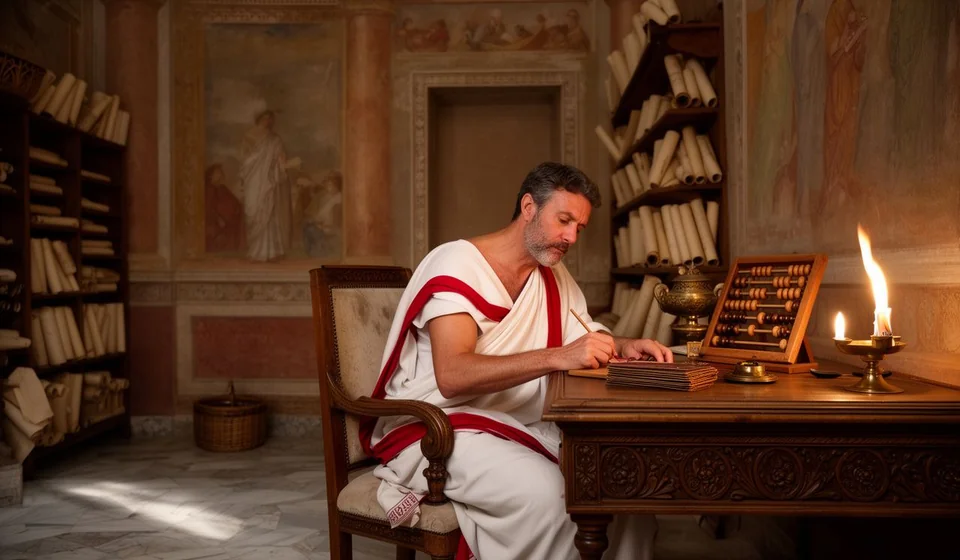
The first was the daily draft, the adversaria. There, carelessly and without strict order, the day's transactions were noted: purchases, sales, loans, payments. It was the book of immediate memory, the functional equivalent of a rough notebook. The second was the formal book, the codex accepti et expensi, also called the tabulae, into which those messy notes were transcribed in order every month. Cicero mentions these books in his speeches: in his defence of the actor Roscius, a lawsuit turns on a debt of one hundred thousand sesterces that appeared in the plaintiff's daybook but not in his codex. For Cicero the difference was moral: the daybook was written in haste and thrown away; the codex, in order and without erasures, was preserved like a family treasure.
That distinction had legal consequences. A householder's formal books could be produced as evidence in court; the daybook could not. Roman law even developed a "literal contract": entering an amount in the codex of both parties could create or extinguish a debt without a single coin changing hands; the entry was, in a sense, the contract.
The book was a register of receipts and payments with two facing pages, one for money received (acceptum) and one for money paid out (expensum), dated entries and no suspicious gaps. The Romans did not know double entry, which only became widespread in thirteenth-century Italy and was formalised by Luca Pacioli in 1494: their accounting was single entry and still sufficed to lay bare "the whole state of a man's affairs".
The wealthiest did not do it alone: in rich houses an educated slave or freedman, the librarius, held the pen, and the bankers of the day, the argentarii, kept ledgers with a personal account, a ratio, for each client. The habit was so ingrained that "keeping your books badly" was almost a character flaw: items under extraordinariae, vague sums out of place, betrayed accounts that did not add up.
The five-year census: the state's great inventory
If the paterfamilias inventoried his house, the Roman state inventoried Rome itself. Every five years, in principle, two censors were elected: prestigious magistrates who, over some eighteen months, registered every citizen and his property. The census was not a simple headcount; it was a sworn declaration of wealth.
Before the censors, each paterfamilias declared under oath his name, his age, his family, his slaves and, above all, his property: land, houses, livestock, money. The censors enrolled every citizen in his tribe and class according to his fortune. That classification was not cosmetic: it decided each man's taxes, army unit and voting weight. Hiding assets was not just tax fraud but a way of dodging military service and a form of political manipulation; those who failed to appear could lose their citizen rights.
In modern terms, the census was a state inventory with fiscal and military purposes, and it worked for centuries. At the end, the lustrum, a ritual purification, closed the five-year cycle. Under the empire it spread to the provinces: no longer only counting citizens, but measuring the taxable capacity of each territory.
The publicani: companies for collecting taxes
The state had no tax bureaucracy for distant provinces; its solution was privatisation: auctioning the right to collect. Every five years the censors sold in Rome, to the highest bidder, the revenue contracts: customs duties, public pastures, mines and the agricultural tithes of provinces such as Sicily or Asia. The buyer advanced the money and recovered it from the taxpayers, with a margin.
Those contractors were the publicani, businessmen drawn mostly from the equestrian order. Since no single individual could guarantee such sums, they formed companies, the societates publicanorum, with a strikingly modern, quasi-corporate logic: partners contributed capital and received shares (partes), a leading partner (the manceps) contracted with the state, agents ran the business on the ground, profits were split by contribution, and there was a common treasury and company books.
The system was profitable and hated in equal measure: the margin could be enormous, but private collection invited abuse of the provinces. In time the empire corrected the model, passing collection to imperial officials, the procurators; yet in the late Republic the publicani were, de facto, the first "big business" of Western history, with their own accounts and capitalist partners.
Aerarium and fiscus: two treasuries, two logics
Roman public money did not live in a single place either. During the Republic the official treasury was the aerarium, kept in the temple of Saturn and controlled by the Senate through the quaestors: into it flowed taxes, booty and state revenue, and from it came payments, public works and armies. With the empire came a second treasury, the fiscus, the emperor's personal estate, soon the real financial centre of the state.
The two treasuries reflected a political reality: Senate and emperor shared power, and each administered his own money. What matters for accounting history is that both kept offices of specialised clerks, the tabularii, in charge of the revenue and expenditure books: one of the first documented financial bureaucracies.
The horrea and the annona: the empire's warehouses
No ancient city depended on its warehouses as Rome did: with close to a million inhabitants, the capital could not feed itself, and grain arrived by ship from Sicily, Sardinia, Africa and, from Augustus onward, Egypt, to be received, measured, stored and distributed. That public supply chain was called the annona, and its physical links were the horrea.
A horreum was a warehouse, often massive and multi-storey, with floors raised on pillars against damp and rows of narrow, cool, dark rooms where grain was kept in bulk or in great clay vessels, the dolia. Rome's first public horrea date from the late second century BC; the tribune Gaius Gracchus promoted the first known one around 123 BC, the same year as the subsidised grain distribution. By the end of the empire the city had nearly three hundred horrea; the Horrea Galbae, by the Tiber, held about one hundred and forty rooms on the ground floor alone.
The horrea stored far more than grain: olive oil, wine, pepper and paper, even valuables, for some worked like banks where citizens deposited goods under lock and key. Every warehouse had its managers, the horrearii, who recorded the goods coming in and going out, looked after clients' deposits and issued receipts. Above them all watched a senior official, the prefect of the annona, with offices in Rome, Ostia and Pozzuoli and clerks (tabularii) and granary superintendents who kept the empire's stock accounts.
The distribution was itself a massive exercise in beneficiary control. From 58 BC, under the tribune Clodius, grain went free to enrolled citizens, some three hundred and twenty thousand; Caesar cut the list to one hundred and fifty thousand and Augustus stabilised it near two hundred thousand, each entitled to about five modii a month, some thirty-three kilograms. Claimants had to prove their identity with a tessera, and the lists were constantly purged. The annona was, in practice, the largest logistics programme of the ancient world, and its administrative memory, built of ships, ports, warehouses, rations and beneficiaries, was inventory control on an imperial scale.
The army: pay and supplies on record
The other great consumer of records was the army: the soldier received a regular salary, the stipendium, paid in the early empire in three instalments a year, but food, clothing and equipment were deducted first, so the gap between nominal pay and take-home pay was significant. Those deductions forced individual accounts: how much each soldier was owed and how much he had saved in the unit chest, guarded by the signifer, the standard-bearer, who doubled as the unit's banker.
We have direct evidence: pay receipts on papyrus from Egypt and wooden tablets from the fort of Vindolanda in Britain, where officers noted strength reports and supplies in handwriting still legible today. Registers of pay and equipment, lists called breves, let a legate know how many men he had and what the camp storehouse needed; without those papers, the most professional army of antiquity could not have moved.
The legacy: words that are still alive
When the western empire collapsed, much of that machinery vanished, but it left something imperishable: the vocabulary. We say credit and debit because the Romans wrote creditum and debitum, from credere, "to trust", and debere, "to owe"; account, because they reckoned with computare. Ratio, for them both the calculation and the account book, gave us reason and, through rationes, rations: the share that falls to each person. The codex of tablets named our codes, the censors' census is still today's census, and even the Spanish hórreo, the raised granary of Galicia and Asturias, descends from horreum.
Rome also bequeathed its limits: it never knew the balance sheet as we understand it, its single-entry accounts never closed against net worth, and it lacked even the concept of zero. Double entry, debit and credit in equilibrium, is a much later invention of medieval Italian merchants. What Rome contributed was more valuable in the long run: the idea that recording is not a formality but a moral duty and a legal guarantee, the conviction that anyone who administers must be able, at any moment, to account for what he has, what he owes and what is owed to him.
From the domus to the empire: a comparison
A table is the best way to summarise the journey. Each row crosses one area of Roman life with its record-keeping practice and the support that made it possible.
| Area | Accounting or control practice | Typical support and register |
|---|---|---|
| Household of the paterfamilias | Daily notes of receipts and payments, posted monthly to the formal book | Adversaria (daybook) and codex accepti et expensi, the tabulae |
| State: the census | Sworn declaration of property and family every five years | Census lists by tribe and class, in the censors' archives |
| Public treasury | State revenue (taxes, booty, rents) and expenditure | Aerarium in the temple of Saturn and the imperial fiscus, with books kept by tabularii |
| Provincial tax collection | Auction of contracts, capital contributions and profit-sharing among partners | Societates publicanorum, with shares (partes) and company books |
| Annona and horrea | Receipt, storage, custody and distribution of public grain | Registers of the horrearii and tabularii, deposit receipts and beneficiary tesserae |
| Army | Pay in three instalments, deductions, savings and unit supplies | Registers (breves), soldiers' accounts and receipts on papyrus and tablets |
From the codex to the screen
The next time someone complains about "paperwork", remember that paperwork, or its equivalent in wax and ink, is what allowed Rome to last a thousand years. The problems those administrators solved with tablets are exactly the ones an inventory system solves today: knowing what there is, how much there is, where it is and how it moves. The difference is that they took weeks to balance a province and we ask for the answer in seconds.
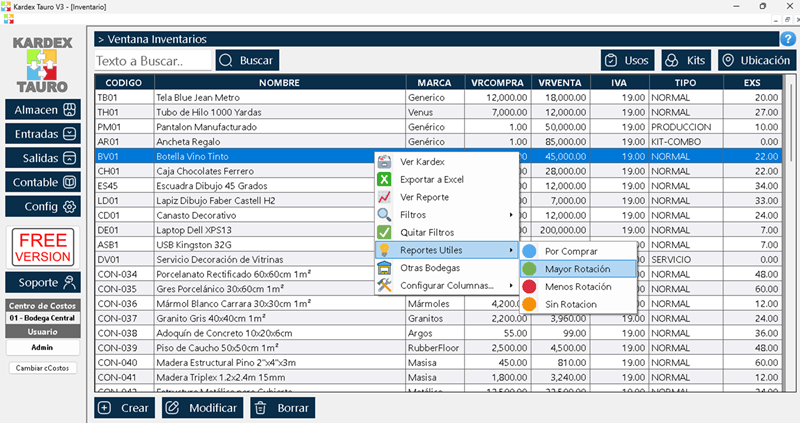
The history of accounting is the history of a promise kept only in part for centuries and completed by technology: that no asset goes unrecorded and no debt unentered. Tools such as Kardex Tauro, designed for inventory control in warehouses, stores and businesses, bring that Roman inheritance into the present: recording every receipt and every issue, keeping stock up to date and leaving an orderly record of everything. From the paterfamilias's adversaria to the empire's horrea, and from there to the screen: the need is the same, only the medium has changed.
Keep reading: History of the Abacus, from the Salamis Tablet to the official Japanese exam: how people counted before calculators and why the abacus is still alive.