Accounting in ancient China: from the mandarin to the imperial register

Accounting in ancient China: from the mandarin to the imperial register
Ask most people where accounting began, and the answer usually flies to the merchant cities of medieval Italy and the birth of double-entry bookkeeping. Yet centuries before the bankers of Venice and Florence refined that art, the eastern edge of Asia was already running the oldest continuous bureaucracy in the world, and at its heart sat a modest but decisive craft: keeping track of what came in and what went out. For the Chinese empire, counting was never a minor formality. It was a way of governing.
Between the twilight of the Zhou and the splendour of the Han, administrative record-keeping grew from a courtly practice into a system of government on a continental scale. This article walks through that story: the literate officials Europe came to call mandarins, institutional handbooks such as the Rites of Zhou, the unification of weights and measures under the Qin dynasty, and the censuses, monopolies and state granaries of the Han dynasty — not to mention the invention that made all that paperwork cheap: paper. We close with a comparison table and with a contrast that is still useful today: in China, accounting flourished in the service of the state; in Europe, in the service of the merchant.
The mandarins: literate officials in the service of the empire
The name Europeans gave to the empire's officials is not Chinese. It reached English through Portuguese mandarim, which took it from Malay menteri, itself derived from Sanskrit mantrin, meaning counsellor. The Chinese themselves used plainer words: guan for official, or the ideal of the scholar versed in the classics. The nickname stuck, and not without reason: for more than two millennia, governing China was above all a task for trained men who could read, write and calculate.
The ideal of the competent official took shape very early. Confucius, in the sixth and fifth centuries BC, taught that governing means correcting and that a prince needs capable ministers, not heirs by birth. Under the Han dynasty (206 BC-AD 220), offices were filled mainly by recommendation: local authorities put forward candidates for their integrity and talent, and the court examined them before appointment. The great competitive written examination took centuries to arrive: it was institutionalised around the year 605 under the Sui dynasty, reached its classic form under the Tang (618-907) and was perfected under the Song. Even so, from Han times onward the empire held firm to one conviction: merit, not birth, should open the doors of the administration.
That literate bureaucracy was also a numerate one. No office could be exercised without documents: orders were sealed, tributes recorded, stock counted. Many officials began their careers as scribes or minor clerks keeping the books of their district, and promotion demanded mastery not only of the classics but of numbers. In an economy where the state collected taxes in grain, cloth and personal labour, the scribe's arithmetic was as political as the general's strategy.
The Rites of Zhou: good government runs on good accounts
The founding text of this administrative culture is the Zhouli, the Rites of Zhou, one of the Confucian classics. Although it presents itself as a description of the institutions of the early Zhou kings, who ruled from the eleventh century BC, scholars place its composition much later, in the era of the Warring States (475-221 BC). More than a historical report, it is an ideal manual of institutional engineering: a blueprint for how a good government ought to be organised.
And in that blueprint, accounts hold a central place. The text arranges the court into six great departments and distributes among them very concrete offices: keepers of treasuries, guardians of granaries, collectors of tributes, and also officers whose specific task was to audit the records of others. Tradition credits this supervisory body with a practice that anticipates the audit: distinguishing daily records, monthly summaries and annual accounts, so that every level of government rendered accounts on a defined schedule. The tributes of regional lords were graded according to each state's economic capacity and delivered at regular intervals, which forced administrators to maintain taxpayer lists, delivery calendars and receipts.
The idea running through the whole text is as simple as it is powerful: good government rests on keeping good accounts. Whoever knows what he has — grain, cloth, weapons, people — can plan, levy fair tributes, pay his officials and survive a bad harvest. Whoever keeps no accounts governs blind. That link between administration and record-keeping was never forgotten: reformers of later dynasties returned to the Rites of Zhou again and again in search of a model of ministries, storehouses and controls.
Qin: one empire, one measure, one comparable register
The Qin dynasty turned that tradition into engineering on an imperial scale. When in 221 BC the kingdom of Qin completed its conquest of the other states, its first emperor imposed something unprecedented: a single empire with a single law, a single script, a single coinage and a single set of measures. Standardised weights and measures were distributed across the whole territory, the round bronze coin with a central hole became universal, and writing was unified in the style known as small seal script.
For accounting, that unification was revolutionary. Once every province measured grain with the same standards, counted cloth in the same units and expressed values in the same coinage, local records became comparable: the court could add up the stocks of distant regions, consolidate tributes and audit with one common yardstick. Standardising weights and measures is, at bottom, an accounting decision: without common units there can be no balance. The first emperors knew it, which is why they cast the new standards in bronze and imposed them by decree across the empire.
The medium of that system was the bamboo strip: long, thin slats tied with cords, written with a brush and rolled into heavy, awkward volumes. Despite their inconvenience, archaeology shows they were the administration's working paper. The most famous example is Shuihudi, at Yunmeng in Hubei: a tomb excavated in 1975 that held the archives of a local official named Xi, buried around 217 BC, together with more than a thousand bamboo strips. Among them are statutes on granaries, on coinage, on compulsory labour and on the verification of stock when an office changed hands. There, in the tomb of an ordinary bureaucrat, public accounting appears in its most concrete form: rules for counting stored grain, sealing deposits, recording receipts and issues, and checking that the physical inventory matched the books when responsibility was transferred.
On that foundation, the reporting system known as shangji — presenting the accounts upward — generalised the practice: local administrators had to send the capital periodic reports of population, land, revenue and expenditure, and on occasion the sovereign himself presided over the reception of those accounts. The empire was administered, quite literally, by reports climbing from the village to the court.
Han: censuses, monopolies and state granaries
The Han dynasty (206 BC-AD 220) turned record-keeping into statistics. The census of AD 2, preserved in the Book of Han, registered more than twelve million households and close to fifty-eight million people: a population count without parallel in the ancient world. The censuses were no statistical curiosity: they were the basis of taxation, military service and compulsory labour, and they demanded registers kept current village by village.
The state granaries formed the empire's logistics network. They received tribute grain, funded salaries — officials were paid in units of grain — fed the capital and relieved hungry regions. Every granary kept records of receipts and issues, with seals, vouchers and identifiable responsible officers. In the northwestern garrisons, thousands of wooden strips noted grain rations and deliveries to the troops in a detail we would today call stock control.
In the second century BC, under Emperor Wu, the state also took over the monopoly of salt and iron, two essential goods whose sale financed the empire's costly campaigns. The official Sang Hongyang was the mind behind much of that financial machinery. The debate over whether to keep the monopolies was so famous that the discussion held in 81 BC was preserved in a book: the Discourses on Salt and Iron.
The crowning achievement, however, was the ever-normal granary, known as changping cang, established around 54 BC on the initiative of the official Geng Shouchang. The idea was simple: the state bought grain when it was abundant and cheap, and sold it when it grew scarce and dear, levelling prices and shielding people from speculation and famine. To work, the system demanded inventory policy in its purest form: how much to store, when to buy, when to sell, how to record every operation and how to watch over shrinkage and deterioration of the reserves. The formula outlived the dynasty: the farm reserve programme that United States Secretary of Agriculture Henry Wallace promoted in the 1930s was explicitly inspired by these Chinese granaries.
Paper: when recording became cheap
All that administration had a physical problem: bamboo was heavy and silk was expensive. Paper solved both. Although archaeological finds such as those at Fangmatan, in Gansu, suggest paper already existed earlier, perhaps from the second century BC, tradition credits its refinement to Cai Lun, a eunuch of the Han court who around AD 105 presented the emperor with paper made from tree bark, hemp, old rags and fishing nets: light, cheap and suitable for mass production.
Paper did not immediately replace bamboo strips: both media coexisted for centuries. But the new material lowered the cost of recording, allowed longer books and, in the long run, freed accounting from monumental rolls. It then travelled slowly westward along the Silk Road: tradition attributes its arrival in Samarkand to craftsmen captured after the Battle of Talas (AD 751), and the first paper mills in Europe were built in the Iberian peninsula in the twelfth century. The medium that let the Chinese state register an empire was the same one that, centuries later, would serve Italian merchants writing their double-entry books.
An accounting of the state, not of the merchant
One contrast deserves emphasis. Chinese accounting flourished in the state sector: censuses, granaries, monopolies, campaign budgets. Private merchants' accounting certainly existed — trading houses kept their books — but it never reached the formal development or the reach of the great public registers. In Europe the opposite happened: double entry was born in the Italian merchant cities between the thirteenth and fifteenth centuries, was codified in 1494 in Luca Pacioli's Summa, and spread in the service of private enterprise. China, for its part, kept refining its own tools: later imperial accounting generalised the four-column formula — opening balance plus receipts minus issues equals closing balance — a scheme of balance that anticipates, centuries ahead, the basic equation of any modern inventory.
Comparison table: three dynasties, three ways of counting
| Period | Recording practice | Medium |
|---|---|---|
| Warring States (5th-3rd c. BC): composition of the Rites of Zhou | Officers of treasuries and granaries; graded tributes; daily records, monthly summaries and annual accounts | Bamboo and wooden strips |
| Qin dynasty (221-207 BC) | Unified weights and measures; statutes on granaries and stock verification (Shuihudi); shangji reports to the court | Bamboo strips in unified script |
| Han dynasty (206 BC-AD 220) | Population censuses; granary and garrison registers; salt and iron monopolies; ever-normal granaries from 54 BC | Bamboo and wooden strips, silk and paper (AD 105) |
The table summarises a trajectory: each dynasty inherited the records of the previous one and made them broader, more comparable and cheaper to produce. First came the decision about what to count; then the guarantee that everyone counted with the same units; then more controls; and finally a medium that made recording accessible. In a few lines, that is the story of how an administration is born.
From the imperial granary to the digital inventory
Two thousand years separate the granary of the Han capital from the warehouse of a modern business, but the questions are the same: how much do I have, how much came in today, how much went out, what am I missing, and who answers for the differences? The keeper of the changping cang and the modern warehouse manager share a trade: recording every movement, counting periodically and reconciling what the books say with what is actually on the shelf. The great lesson of ancient China is that administering — governing, selling, producing — begins with keeping good accounts.
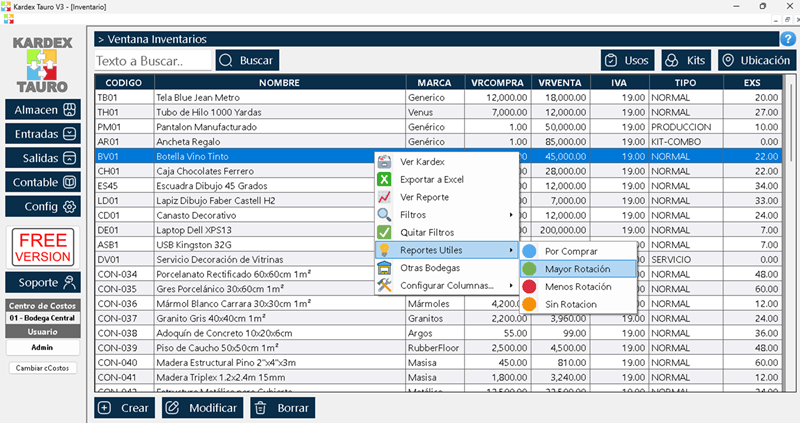
The difference is that today this work needs neither bamboo strips nor rolls of silk: inventory software does in seconds what took the imperial scribe whole days. Kardex Tauro is designed to make recording receipts and issues, knowing stock levels at a glance and reconciling physical counts a natural task, just as noting every sack of grain was for the Han official. And if the lesson of ancient China is that good government rests on good accounts, the lesson of today is that tools such as Kardex Tauro bring that same discipline to any warehouse, with no empire behind it.
Keep reading: History of the Abacus, from the Salamis Tablet to the official Japanese exam: how people counted before calculators and why the abacus is still alive.