Accounting in ancient India: Kautilya's Arthashastra
Accounting in ancient India: Kautilya's Arthashastra
Long before double-entry bookkeeping spread through medieval Europe, ancient India under the Maurya empire had already produced a treatise on public administration obsessed with a subject very familiar to any accountant: the control of money and of stock on hand. That treatise is the Arthashastra, a wide-ranging manual attributed to Kautilya, also known as Chanakya, the scholar and counselor of Chandragupta Maurya, the ruler who united much of the Indian subcontinent under a single empire around the 4th century BC. For the history of accounting, the text is an exceptional find, because centuries before the European merchant manuals it already described treasuries, transaction records, warehouses, auditing and fraud with a level of detail that still amazes historians.
This is not the oldest accounting evidence in the world: Mesopotamia, Egypt and other civilizations kept accounts thousands of years earlier. What makes the Arthashastra remarkable is something else: it is perhaps the oldest surviving manual of administrative and financial control, a book that does not merely record transactions but explains how to organize the custody of the treasury, how to audit officials and how to keep the state's money from vanishing along the way. For that reason, many authors regard it as a distant ancestor of internal control and of modern auditing.
In this article we explore what the Arthashastra is, how it conceived the kingdom's treasury, who kept the accounts, how the stock of the royal warehouses was recorded and why its war on fraud remains a living lesson for any business that handles inventory.
What the Arthashastra is
The word Arthashastra combines two Sanskrit terms: artha, which can be translated as wealth, prosperity or the material means of life, and shastra, meaning treatise or science. It is therefore often rendered as the science of wealth or the science of government. It is not a book of religion or abstract philosophy: it is a practical manual of statecraft, economy, administration, diplomacy and war, written so that a king could govern effectively and hold on to power.
Tradition attributes the work to Kautilya, a name identified with Chanakya (also called Vishnugupta), a learned brahmin said to have been the teacher and adviser of Chandragupta Maurya, founder of the Maurya empire, whose capital stood at Pataliputra. The date of composition is a matter of scholarly debate: tradition places it in the late 4th century BC, at the founding of the empire, but many historians believe the text we know today incorporates layers added and edited later, possibly into the first centuries of the Christian era. The cautious statement is that its core is attributed to the age of Kautilya and Chandragupta, around the 4th century BC, without claiming that every page dates from that exact period.
The treatise, which in its known form is organized into about fifteen books and roughly one hundred and fifty chapters, was lost for centuries and rediscovered only in the early 20th century: a manuscript found in 1905 was translated into English by the scholar R. Shamasastry. Since then, researchers around the world have found in its pages a surprisingly detailed portrait of how a great state of antiquity was administered.
The state as a great enterprise: the place of the treasury
One central idea of the Arthashastra is that the kingdom works like an organism made of interdependent parts: the sovereign, the ministers, the territory, the fortified city, the treasury, the army and the allies. Among those elements, the treasury holds a place of honor. The text insists that a kingdom without resources cannot sustain an army, an administration or public works, so taking care of the state's finances is not a minor matter but a condition for everything else to function.
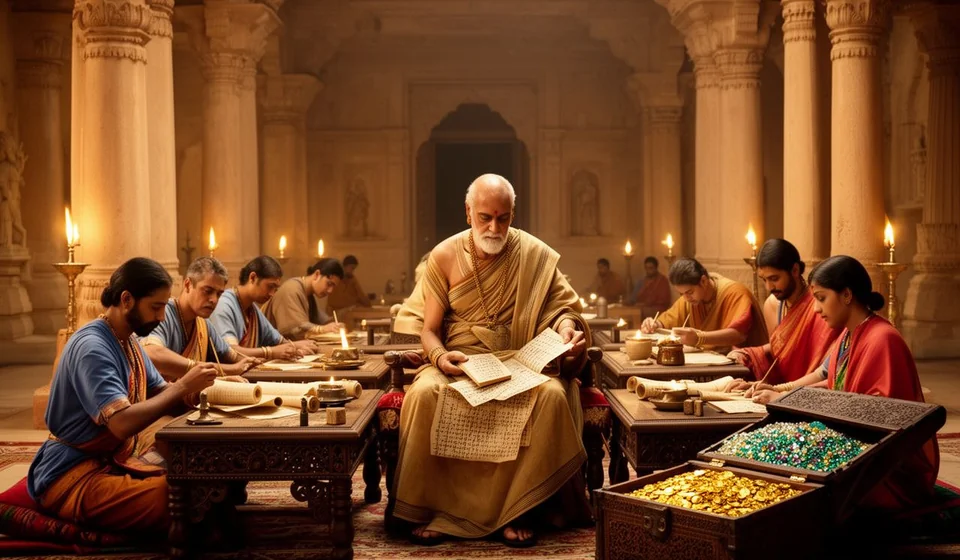
That conviction translates into concrete organizational rules. The treatise clearly distinguishes between those who collect, those who safeguard and those who record. The treasury proper, called kosha, was kept in a centralized way under the responsibility of a high palace official in charge of receiving and preserving both the money and the valuables and stock that entered the realm. Separately, a chief collector was responsible for gathering the revenues of the provinces and for supervising the state of the accounts. That separation between the person who handles the money and the person who answers for it is, in essence, what we now call segregation of duties, one of the basic principles of modern internal control.
The Arthashastra also reflects on which taxes and levies are reasonable and how the revenue should be spent, on the idea that the prosperity of the subjects eventually fills the king's coffers. Like all good administration, it understood that sustainable income beats short-term plunder: a lesson any business recognizes when it prefers customers who come back over one-time profits.
The office of accounts: receipts, expenses and balances
The accounting heart of the treatise lies in its chapters on the financial administration of the realm. There it describes a true state office of accounts, in which officials had to keep orderly records of what came in and what went out, with classified entries and defined reporting periods. The underlying idea is simple and very modern: at any moment, someone must be able to say how much was received, how much was spent and what balance remains.
The treatise pays obsessive attention to procedures. Account books were presented on stipulated dates, with seals guaranteeing that they had not been altered, and those responsible had to declare the totals of receipts, expenses and net balance of their branch. Penalties were set for the official who failed to present accounts on time, for the clerk who made recording errors or duplicate entries, and for anyone who altered figures after they had been entered. Rewards were also foreseen: an official who increased the net revenue of his department received recognition, while one who decreased it without justification had to answer for the difference.
It is worth stressing that this was not double-entry bookkeeping or a chart of accounts as we know it: there was no formal account plan, no financial statements in the modern sense and no concept of the legal person. It was a system for recording income, expenses and stock at the service of administration, with controls designed so that the king always knew what he had and what was being done with it. Even so, the distance between that office and modern accounting is smaller than is often assumed.
The superintendents: accounting by branch
Another remarkable feature of the Arthashastra is the organization of the state by branches of activity, each under the authority of a superintendent, called an adhyaksha. There were superintendents for the warehouses of goods, for the royal granaries, for the mines and precious metals, for the looms and textile production, for agriculture, for livestock, for trade and markets, and for many other economic activities.
Each superintendent had to render periodic accounts of his branch: how much was produced, how much was received, how much was sold or delivered and what balance remained under his responsibility. In this way the whole kingdom worked as a network of responsibility centers, each with its own records and with an official nominally answerable for its results. Translated into the modern company, that logic is the same one behind cost centers, departmental budgets and the performance indicators of each management area.
The auditor's eye: fraud and penalties
If the Arthashastra is famous among accounting historians, it is above all for its pages on fraud. The treatise devotes entire passages to the embezzlements of officials and starts from a realistic conviction: it is almost impossible for a public servant who handles funds not to keep a part of what passes through his hands. That idea is expressed in a well-known comparison often quoted in discussions of the work: just as it is hard not to taste honey that settles on the tongue, it is hard for an official not to take a bite of the revenue he administers.
The most remarkable point is that the text does not stop at complaint: it describes dozens of concrete embezzlement tricks and how to prevent them, so many that some scholars have counted around forty distinct forms of fraud enumerated in its chapters. Among them are practices any modern auditor would recognize at once:
- Recording less than what is received, or more than what is spent, to keep the difference.
- Declaring false losses, shrinkage or damage to justify shortages.
- Delaying the deposit of funds to use them temporarily for private gain.
- Altering dates, names or quantities in the records to conceal the diversion.
- Using rigged weights and measures, especially in granaries, warehouses and markets.
- Omitting balances, duplicating entries or erasing totals in the account books.
Against that catalogue of temptations, the treatise proposes a defense system that surprises by its modernity: sealed books that cannot be altered, strict deadlines for presenting accounts, comparison of the records of one department with those of another, mutual oversight among officials so that no one holds absolute power over a process, and graduated penalties ranging from fines proportional to the damage to restitution of what was taken and severe punishment for those who lie in their accounts. It also warns that officials must not be left alone or allowed to collude: mutual control is part of the design.
Anyone who has worked with internal auditing will recognize in those rules the ancestors of current practices such as cash reconciliation, comparison between independent records, rotation of duties, audit trails and penalty policies for irregularities. The Arthashastra did not invent auditing as a discipline, but it describes its spirit with astonishing anticipation.
Royal warehouses and the recording of stock
For the history of inventory control, the Arthashastra is also a milestone. The chapters on the administration of the realm pay special attention to the royal warehouses and granaries, where the reserves of grain, the products of tribute and the goods made by the state's workshops were concentrated. Those reserves were not treated as a carelessly piled heap of goods: the treatise requires that merchandise be counted, weighed or measured as it came in, that entries and exits be recorded and that everyone know at all times how much remained in storage.
Responsibility was personal and demanding. The official in charge of a warehouse answered for the stock under his custody and had to explain any difference between what was recorded and what was found. Counts were not a formality: they were the tool that made it possible to discover shrinkage, theft and mismatches in time, which is why the treatise integrates them into the same system of accountability that governed the treasury. In essence, Mauryan India already practiced the idea that whoever guards a storeroom must be able to prove, with records and counts, that every unit that came in is still explained: receipts, issues and balance.
A legacy that reaches your warehouse
Comparing the Arthashastra with today's business practice helps to see how much of what we take for granted has very old roots:
| Function in the treatise | Practice in the Arthashastra | Modern parallel in a company |
|---|---|---|
| Recording receipts and expenses | Office of accounts with books of income, expense and balance, presented on fixed deadlines with seals | Accounting and periodic closings; financial books and reports |
| Safeguarding resources | Centralized treasury (kosha), separate from those who collect and record | Treasury with segregated roles; bank and cash reconciliations |
| Controlling each activity | Superintendents (adhyaksha) per branch, each with his own accounts | Department managers with budgets, cost centers and indicators |
| Preventing and detecting fraud | Catalogue of dozens of tricks, sealed books, mutual oversight and penalties | Internal audit, segregation of duties and audit trails |
| Recording stock | Royal warehouses and granaries with counts and named officials in charge | Inventory control with stock cards, cycle counts and warehouse managers |
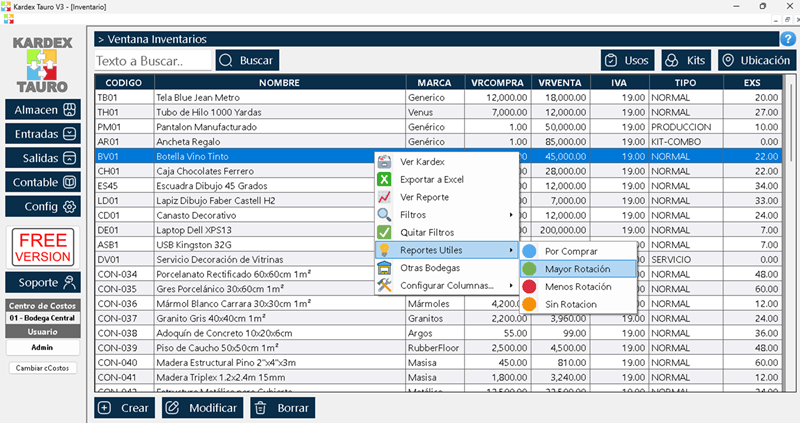
The Arthashastra reminds us that control is not a recent invention but a need as old as administration itself. More than two thousand years ago, an adviser to the Maurya empire understood that wealth without records evaporates, that power without accountability corrupts and that poorly counted stock ends up as loss. Today that same intuition lives in every company that takes care of its warehouse: recording every receipt, every issue and every balance is not bureaucracy; it is the way to know, at all times, what you have and what the business is missing. Technology replaced clay seals with screens and account books with software, but the question remains Kautilya's: can you prove, with up-to-date figures, where every dollar and every unit of your merchandise is? Keeping the stock card of your inventory in an orderly and reliable way is the modern equivalent of that palace office of accounts, and software such as Kardex Tauro exists precisely so that control stops depending on memory or paper. If ancient India could audit empires with scribes and seals, no business today should settle for less than a clear, timely and verifiable record of stock: that, in the end, is the practical heritage of the Arthashastra for anyone who manages inventory in the 21st century.
