
Accounting in the Americas before Columbus: quipus, tribute and the pochteca
Accounting in the Americas before Columbus: quipus, tribute and the pochteca
The history of accounting is usually told from Europe: double-entry bookkeeping, ledgers, Luca Pacioli. But that is only one of the possible stories. When Europeans reached the Americas in 1492, the continent already held empires that ran enormous economies without coined money or alphabetic writing. The Incas governed a territory that stretched along the Andes, from present-day Ecuador down to Chile and Argentina; the Mexica exacted tribute from dozens of subject provinces; the Maya sustained trade networks that crossed forests and coasts. None of those systems could work without keeping accounts, and they did not keep them on paper but on knotted cords, in painted codices and in the trained memory of specialized officials. Before Columbus, the Americas already had their own record keepers: the quipucamayoc in the Andes, the calpixque among the Mexica, the pochteca in long-distance trade.
This article traces those systems of recording and control, because understanding them changes the way we see accounting: not as an imported technique but as a natural function of every society that produces, stores and exchanges. Stock records, tribute collected, population counts, merchants' accounts: all of that existed in the Americas long before 1492, built on native technologies whose efficiency surprised even the conquerors.
The Andes: the quipu, a database made of cords and knots
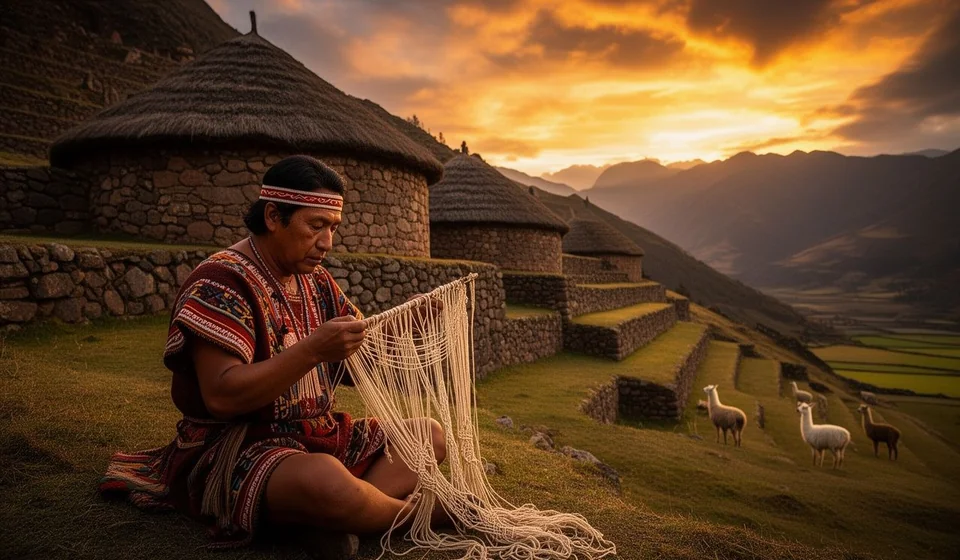
In the Andes, record keeping reached an astonishing level of sophistication with an instrument that looks nothing like what we would call a document today: the quipu (or khipu), a Quechua word meaning knot. A quipu is a set of cords: one main horizontal cord from which dozens or even hundreds of secondary cords hang, with auxiliary cords, colors and different types of knots, made of cotton or camelid fiber. To a modern eye it looks like a textile ornament; to the Inca Empire it was an official record.
What makes the quipu a true accounting system is that its knots encode quantities with a positional decimal principle: on each cord, knots represent units, tens, hundreds and so on, with values from one to nine depending on their shape, so that position and knot type determine the number. A position left empty worked, in practice, as zero. With that syntax, the quipucamayoc —the specialists trained to make and read quipus— recorded tribute, population counts, harvests, herds, pieces of cloth, the contents of storehouses and deliveries to the armies. Colonial chroniclers wrote admiringly of how quickly these officials answered questions about goods and people from years before, and the indigenous chronicler Guaman Poma de Ayala left drawings of the quipucamayoc as a servant of the state who rendered accounts before the authorities.
In practice, quipus worked as a distributed textile database: the same system was used across the whole territory to consolidate information flowing upward from the communities to Cusco, the capital. Modern researchers, such as the anthropologist Gary Urton, have documented hundreds of surviving quipus and built digital catalogs to study them; the numerical part has been deciphered, while the possible narrative content of some cords remains a matter of debate. For the history of accounting, the quipu is compelling evidence: an empire without alphabetic writing solved with cords and knots the same problems of recording, consolidation and control that Europe solved with books and ink.
Qollqas and tambos: the Inca Empire as a great warehouse keeper
Quipus did not record abstract quantities: they controlled real stock. The Inca Empire, the Tawantinsuyu, sustained one of the most impressive logistics networks of the pre-industrial world: the Qhapaq Ñan, a road network of more than thirty thousand kilometers linking Cusco with the four suyus, or quarters, of the empire. Along those roads and beside the administrative centers stood the qollqas: state storehouses built of stone with thatched roofs, set on hillsides and grouped in clusters that could total hundreds of depots. They held almost everything: maize, dried potatoes, dried meat, fish, textiles, tools, weapons and ceremonial goods.
Why did the Inca keep such large reserves? The qollqas fed the army on campaign, supplied state officials, laborers called up in turns and travelers of the empire, and worked as insurance against bad harvests —a real concern in high-altitude farming. Along the roads, the tambos served as way stations: buildings with provisions where chasquis, the imperial messengers, and caravans found food and shelter at regular intervals. For that system not to collapse, someone had to know how much came in, how much went out and how much remained in each storehouse; that was the task of the quipucamayoc, who kept the record of the depots in their jurisdiction and consolidated it upward through the administrative chain.
Translated into today's terms, the Tawantinsuyu ran on consolidated inventories, decentralized warehouses, planned distribution and periodic reconciliation. Without the quipu —and without the specialists who read it— governing such a vast and ecologically diverse territory would have been impossible. Stock control, which we now take for granted in any warehouse, was a state technology in the Andes.
The Mexica: tribute painted in codices and royal storehouses
In Mesoamerica, the political economy took a different path: tribute. After the formation of the Triple Alliance —Tenochtitlan, Texcoco and Tlacopan, around 1428— the Mexica Empire collected periodic tribute from its subject provinces. That tribute was not symbolic: it included maize, beans, chilies, cotton cloaks, clothing, tropical bird feathers, cacao, gold, shells and many other goods, depending on what each region produced. The usual question follows: how did anyone remember what each province had to deliver, in what quantities and how often?
The answer was painted in the codices. The Mexica did not develop alphabetic writing, but they did have a sophisticated pictographic system used to record history and, above all, accounts. The most famous example is the Codex Mendoza, produced around 1541 at the request of Viceroy Antonio de Mendoza: its second section reproduces, with Spanish glosses, the record of the tribute paid by the subject provinces. It is an early copy, made already in colonial times, of older tribute records, closely related to the Matrícula de Tributos, a manuscript on amate paper that survived from that same corpus. Page after page shows a province, its towns and its place signs, and next to them the glyphs of the goods with their quantities: so many cloaks, so many loads of maize, so many pieces of clothing.
Administering tribute required dedicated officials. The calpixque were in charge of collecting and managing the tribute of the provinces on behalf of the huey tlatoani, the ruler, and in the heart of Tenochtitlan stood the royal storehouses where goods entered before being redistributed among the nobility, the warriors and the state reserves. A historian of accounting finds a complete cycle here: taxpayer register, periodic rate, collection, warehousing, redistribution and recording of the whole flow in pictographic supports.
The pochteca: professional merchants with accounts of their own
Not everything in the Mexica world was state tribute: there was also professional long-distance trade, and it was in the hands of a corporation of merchants known as the pochteca. They organized expeditions to distant regions, inside and outside the empire, to bring quetzal feathers, skins, cacao, precious stones and other luxury goods consumed by the nobility. Their wealth could rival that of nobles, but they were forbidden to display it: they kept it inside their own districts, where their own laws ruled and Yacatecuhtli, their patron god of travelers, was worshiped.
The pochteca were not simple caravan traders: they formed a corporation with courts of their own. Commercial disputes were settled in specialized tribunals —the pochteca's commercial court, in Tlatelolco, the great market of the capital— where experienced judges heard disputes between merchants and punished theft in the marketplace. They also performed state functions: they sold the tribute surpluses that belonged to the nobility and, through their travels and contacts, served as informants for the empire. That volume of operations —expeditions, cargoes, credit, consignments— demanded accounts of their own: they kept pictographic records of their transactions and worked with equivalences based on goods that served as a measure of value, such as certain cotton cloaks or cacao beans.
The case of the pochteca shows that specialized commerce and the resolution of trade disputes did not wait for Europe's early modern age: in Tenochtitlan there were guilds, commercial judges, standards of value and records of operations centuries before those concepts were formalized in Europe's manuals of commerce.
The Maya and other traditions: cacao, dot-and-bar numbers and barter
Cacao deserves special mention: across wide areas of Mesoamerica, cacao beans worked as true money. Sixteenth-century sources describe prices in beans —an animal, a cloak, even services were worth so many beans— and both the Maya and the Mexica used them in daily exchange. Cacao was divisible, portable and scarce in the highlands, where it arrived only through tribute or trade; that is why it also served as a standard for recording debts and tribute.
The Maya combined barter and long-distance trade —salt, obsidian, feathers, cotton, flint— with a positional vigesimal numeral system of dots and bars able to express enormous figures. We know it mostly from calendars, but it was also a tool for counting: goods, days, cycles and agreements. Elsewhere on the continent, other societies built their own solutions: the Muisca of the eastern Andes, in what is now Colombia, maintained exchange networks of salt, cotton cloaks and emeralds with agreed values, and Andean cultures earlier than the Incas, such as the Wari and Tiwanaku, already used quipus or similar records to administer their territories. Everywhere the same rule held: where there is surplus, storage and exchange, someone is keeping count.
A comparative view
Set side by side, the American solutions show a great variety of techniques and a shared administrative logic:
| Civilization and region | Recording system | What they controlled |
|---|---|---|
| Inca Empire (Tawantinsuyu, Andes) | Quipus of knotted cords with decimal notation, managed by the quipucamayoc | Tribute, censuses, harvests, herds and the stock of the qollqas along the Qhapaq Ñan |
| Mexica (central highlands of Mexico) | Pictographic tribute codices such as the Matrícula de Tributos and the Codex Mendoza, with calpixque officials | Periodic tribute from subject provinces and the royal storehouses of Tenochtitlan |
| Pochteca (Mesoamerica) | Their own pictographic records and equivalences in goods such as cotton cloaks and cacao | Trading expeditions, cargoes, credit and disputes settled in merchant courts |
| Maya and other Mesoamerican cultures | Vigesimal dot-and-bar numerals and the use of cacao as currency | Long-distance exchanges, debts and tribute expressed in cacao beans |
The lesson of the table is twofold. First, no great American civilization ran its economy without some kind of recording system, however different it was from the European ledger. Second, those systems were not local curiosities: they supported entire empires, with dedicated officials, rules and even courts for commercial conflicts.
What do we take from all this? That accounting is not a European invention but a function of every complex society: recording who owes, who delivers, how much is stored and how much is consumed appears in the Andes with the quipus, in Mesoamerica with the codices and everywhere with the merchants. And the problems the quipucamayoc and the calpixque solved are exactly those of any business today: knowing what is in the warehouse, how much came in, how much went out and what is still owed. The technology changed, not the craft: where an Inca hung a knotted cord, today an inventory system records every movement instantly. Keeping stock control up to date, as the qollqas did with their quipu records, remains the foundation of sound administration; tools such as Kardex Tauro now do in minutes what took a quipucamayoc years of training. The cords became screens, but the need to keep count is the same.
