Francesco Datini and the ledgers of the Merchant of Prato

Francesco Datini and the ledgers of the Merchant of Prato
Long before spreadsheets, inventory systems or internal audits existed, a man ran a trading empire with three paper tools: a daybook, a ledger and relentless correspondence. His name was Francesco di Marco Datini, he came from Prato, a small Tuscan town near Florence, and when he died in 1410 he left behind an archive of some 150,000 letters and roughly 500 account books. Those papers, preserved almost by miracle, still teach us how a business was run in the fourteenth century, and how much modern accounting owes to medieval merchants.
Who he was: from an orphan in Prato to the papal court of Avignon
Francesco was born in Prato around 1335 into a modest family. The Black Death, which swept Europe in 1348, took his father and left him an orphan at thirteen. Barely fifteen years old, around 1350, he took the road that changed his life: he set off for Avignon, the city on the Rhône where the papacy had resided since 1309 and where bishops, bankers and merchants from all over Europe gathered.
Money flowed through the seat of the papal curia, and the young Tuscan knew how to make the most of it. He began trading a wide range of goods and steadily expanded his business until he became one of the most prosperous merchants in the city. He was no solitary genius: he was a patient builder of trust, able to take partners, delegate tasks and, above all, keep control.
In the early 1380s, wealthy and with some thirty years in Avignon behind him, he returned to Tuscany, not to retire but to orchestrate from Prato and Florence a network of companies dealing in woollen cloth, international trade and financial business, with branches and agents in several Mediterranean cities: besides Avignon, in Barcelona, Valencia, Majorca and Ibiza, and in the Italian cities of Genoa, Pisa, Florence and his native Prato. Each company had its own partners, its own capital and, above all, its own account books.
The archive that survived in a stairwell
That we know so much about Datini is partly a stroke of luck. In his will the merchant ordered that his papers be preserved, and his fortune went to a charitable institution in Prato. But the bundles of letters and registers ended up stored in a recess of the stairwell of his palace, where dust protected them for centuries.
In 1870 someone found them: the largest private documentary treasure of medieval Europe. The Datini archive holds around 150,000 letters and about 500 account books, today kept at the State Archive of Prato. For economic historians it is the richest source that exists on how business was done in the fourteenth century; no comparable collection survives anywhere else in such quantity and detail.
The extraordinary thing is not only the volume but the variety. There are letters from his wife Margherita, who wrote to him from Prato while he travelled; letters from his factors in every branch; partnership contracts, marine insurance policies, bills of lading and price lists. And there are books of every kind: daybooks, ledgers, cash books, secret books and books of remembrance. For an accounting historian, it is like finding the central server of a fourteenth-century company.
Daybooks, ledgers and letters: running an empire on paper
Datini's system was simple in concept and rigorous in execution. Every transaction was first entered in the daybook or memorial, in chronological order and with all its details: what was bought or sold, with whom, at what price and on what terms. From there the information moved to the ledger, the great book of debtors and creditors, where each person or matter had its own account with two columns: debit and credit.
That scheme of charging and crediting was no theory: it was double-entry bookkeeping in its practical form, applied with remarkable maturity. Every entry was made in double entry, so that each debit had its corresponding credit, and at the close of the year the books allowed the result to be calculated and the profits to be shared among the partners. Specialists have documented that the Avignon company even produced, around 1410, one of the earliest synthetic balance sheets known.
Accounting discipline was also kept company by company: each firm kept its own books and the accounts of one branch were never mixed with those of another. The secret book held the partnership contracts, each partner's capital and the profit accounts, something like the founding deed, the equity and the income statement of every business. Cash books recorded the money coming in and going out, and merchandise books tracked cloth, spices or hides warehouse by warehouse, branch by branch.
And then there were the letters, the true nervous system of the empire. Datini could not be in Barcelona and Valencia at the same time, so he governed from a distance: he wrote to his factors, the agents who ran each house, with precise instructions on what to buy, at what maximum price, to whom to sell, how to collect payment and which risks to avoid. Every outgoing letter was copied into a register and every answer was filed. Correspondence was not an appendix to the accounts: it was accounting in motion.
'In nomine Dei e di guadagno': God and profit on the first page
On the first page of many of his books Datini had a short formula written that sums up his mindset: 'In nomine Dei e di guadagno', that is, 'in the name of God and of profit'. For the Merchant of Prato there was no contradiction between faith and business: profit was legitimate if earned through hard work, honesty and a kept word, and precisely for that reason everything had to be written down.
That inscription, which today sounds like a pious curiosity, was a statement of principles. The account book was not a mere record: it was the written memory of a pledged word, the proof that every debt was acknowledged and every credit respected. In a world without digital contracts or credit bureaus, reputation was built on well-kept paper.
A merchant's obsessive control: copy, file and demand accounts
Scholars who have studied Datini agree in portraying him as a distrustful, demanding man with an obsession for control that today we would call management through permanent audit. He copied his outgoing letters to keep proof of his orders; he filed those he received in order to check them; he kept a register of incoming and outgoing mail; and he demanded from his factors periodic accountings, with every expense justified and every delay explained.
His letters are full of reproaches when the accounts do not balance or when an agent overspends on a purchase. That systematic distrust, applied relentlessly for decades, was one of the keys to his success: for him, control was not a formality but the way to sleep soundly, knowing what was happening in every port of the Mediterranean.
Double entry before Pacioli: practice without a treatise
Let us be precise: Datini did not invent double-entry bookkeeping and never wrote a treatise about it, and it is not he whom tradition credits as the father of accounting, but Fra Luca Pacioli, who in 1494 published in Venice the first printed description of the method. Yet Datini's books prove something perhaps more valuable: that double entry was already practised in a mature form in fourteenth-century Tuscany, about a century before Pacioli set it down in writing.
The technique circulated as workshop knowledge: young apprentices absorbed it by copying entries and working alongside veteran merchants, not in classrooms. What Datini and his Tuscan contemporaries did was turn it into a management tool: thanks to the books and the letters, a single man could govern companies in eight or nine different cities, know what each one was worth and detect in time a fraud, a bad customer or a line of business that did not pay.
That is why Datini matters so much in the history of accounting: he is the best-documented example that modern accounting discipline was born on the counters and in the warehouses of the Mediterranean long before it was born in printed books.
What each register was for
The following table sums up the system of the Merchant of Prato and translates it into the language of a present-day business. It is a useful way of checking that, seven centuries later, the need for control has not changed that much:
| Datini's register | What it was for | Modern equivalent |
|---|---|---|
| Daybook or memorial | Recording every transaction in order, in detail and without omissions | Daily log of movements and business records |
| Ledger of debtors and creditors | Knowing, person by person, who owed him and to whom he owed | Accounts receivable and payable, with ageing of balances |
| Cash book | Tracking money coming in and going out in cash | Cash counts and cash-flow control |
| Merchandise book | Following stock warehouse by warehouse and branch by branch | Inventory card (stock ledger) with entries, issues and balances |
| Secret book | Keeping partnership contracts, partners' capital and results | Company deed, equity and income statement |
| Letter registers | Instructing and supervising factors in other cities | Email, purchase orders and traceability of decisions |
| Factors' accountings | Verifying each period what every agent had done | Periodic reports, reconciliations and internal control |
Every row in the table shares a single origin: the conviction that what is not written down does not exist for management. That conviction, put into practice with bound books and a goose quill, is the same one that today sustains inventory programs and accounting systems.
A seven-century lesson for today's business
What can a fourteenth-century merchant teach a twenty-first-century company? The first lesson is that meticulous recording remains the foundation of everything: whoever does not know what they have, what they owe and to whom they owe it does not run their business, they guess at it. The second is that information must be kept separate by business unit and by warehouse, so that you can tell which one performs and which one does not. The third is that control at a distance demands constant communication and accountability: Datini's factors received weekly letters; a modern manager receives daily reports.
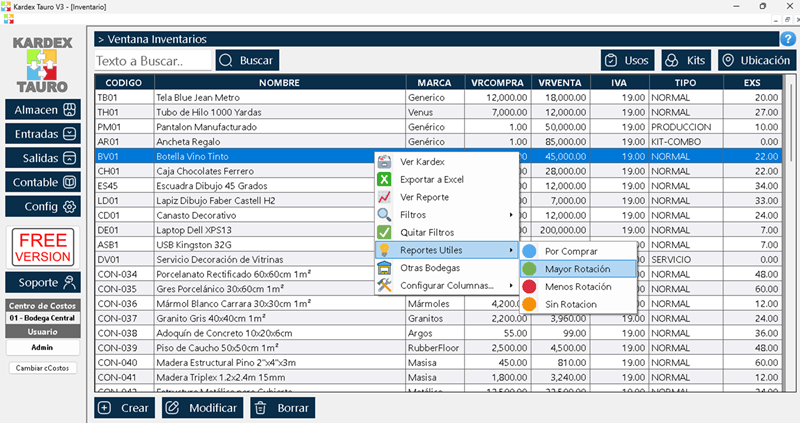
What has changed is not the principle but the tool. Where Datini used bound ledgers and handwritten copies, a modern company uses software that records, organises and retrieves the same information in seconds. An inventory-control system such as Kardex Tauro is, in that sense, the direct heir of the Prato archive: it lets you know what is in each warehouse, what it is worth and which movements changed it, with the same obsession for accuracy that moved the Tuscan merchant. The Merchant of Prato needed five hundred books to govern his empire; with a system such as Kardex Tauro, that same certainty now fits on a screen. Because, as Francesco Datini knew well, those who keep good records govern well.
