The 1673 Ordinance: when the state forced merchants to keep books
The 1673 Ordinance: when the state forced merchants to keep books
In 1673, a French merchant opening a business in Paris, Lyon or Rouen had to do something unthinkable for his grandparents: buy a blank book, take it to a consul to be signed and foliated, and pledge to record every transaction in it from that day forward. The demand came not from a guild or a local custom but from the King of France, in an ordinance that, for the first time in modern history, turned the merchant's books into an obligation imposed by the state. To understand where the idea comes from that a business must leave a written, verifiable and periodic trail, the very idea behind any inventory software today, it is worth looking calmly at that year and at that law.
Louis XIV, Colbert and the drive to order the economy
The France of 1670 was the most populous country in Europe and the continent's cultural model, yet its trade still lived under medieval rules: local customs, courts that changed from city to city and practices that varied from one fair to the next. Over that patchwork ruled Louis XIV, the Sun King, determined that his kingdom should also become the world's leading economic power. His instrument was Jean-Baptiste Colbert, controller-general of finances from 1661 and architect of the policy later known as mercantilism: trade as an instrument of state power. Colbert founded royal manufactures, built fleets, created trading companies for the colonies and shielded French producers from foreign competition, but he knew that no policy would bear fruit if commerce itself did not inspire trust.
Every war, every bad harvest and every failed speculation dragged into insolvency merchants who had received credit from suppliers and bankers. When a trader failed, creditors had no common rules to recover what was owed, and many simply lost everything. Fraud went unpunished and good practice unrewarded, because nobody could prove how a business had been run. In Colbert's eyes, a rich kingdom needed two things: more trade and less chaos. And chaos, he was convinced, was cured by clear rules and by papers that told the truth. That conviction led the crown to ask, for the first time, what merchants really did with their accounts, and to answer the question with a law.
Colbert did not legislate from his desk. He gathered commissions of jurists and, above all, of merchants, and asked them to write down, title by title, the practices that French commerce already considered sound. Among the merchants consulted was a name destined to be joined to the law forever: Jacques Savary, a Paris wholesaler renowned as an honest arbiter of disputes. The result of that work was the Ordinance on Commerce of 1673, known to historians as the Savary Code.
March 1673: the birth of the Savary Code
In March 1673, from Saint-Germain-en-Laye, Louis XIV promulgated the Ordinance on Commerce, the Ordonnance de Commerce: 122 articles arranged in twelve titles regulating apprentices, brokers, partnerships, bills of exchange, business books, bankruptcy and the consular jurisdiction. Its declared purpose was not to invent new law but to write down, in a single binding law of the realm, what good merchants already did by custom. The novelty lay in the form: what had been a private virtue became a legal duty, with consequences for those who failed to honour it. Title III was devoted to the books and registers of merchants, traders and bankers, and there the historical turn took place.
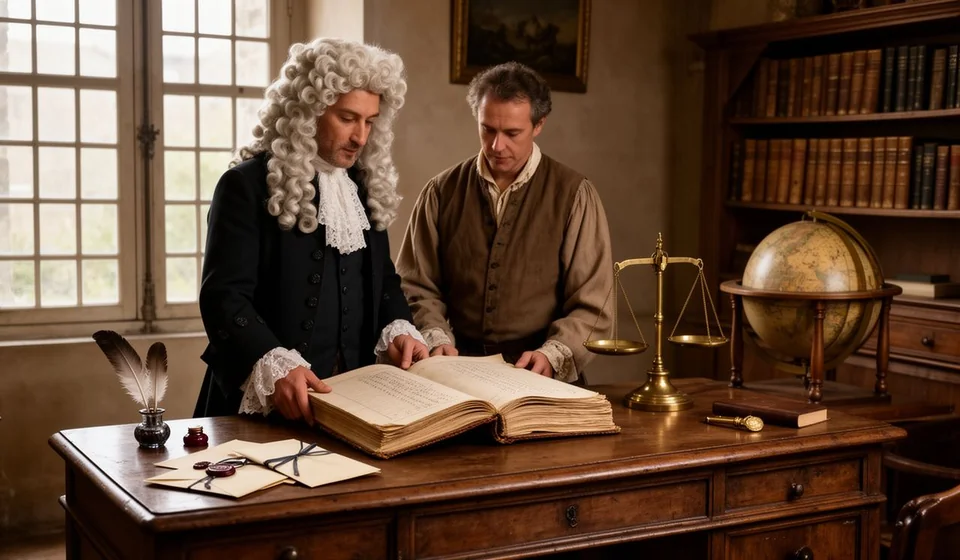
Which books did the ordinance require? The centrepiece was the daybook, the livre journal, in which the merchant had to enter his transactions one by one and in order of date, leaving none out. The law surrounded that central record with formal safeguards: the books had to be signed and foliated, initialled by a consul of the jurisdiction free of charge, so that official record existed of how many pages the volume held and no one could tear out or add leaves. The ordinance distrusted books full of erasures and blank spaces: a current, clean register with no gaps was the visible mark of the good merchant. Around the daybook the rest of the business documentation was organised: the letter books in which commercial correspondence was copied, and the inventory book. On this last one the text was explicit: its article 8 obliged every merchant to draw up, under his own signature, an inventory of all his movable and immovable property and of his active and passive debts, and ordered that this inventory be reviewed and renewed every two years.
That mandate was a small cultural revolution: until then, bookkeeping had been the merchant's private affair, an aid to memory that each man kept as he could or as he pleased. From 1673 onwards, in France, keeping books stopped being optional: the state demanded a permanent record of commercial activity because it needed to know, when conflict arrived, who had acted in good faith and who had not. The merchant who kept no books lost the protection of the law at the very moment he needed it most; the one who kept them badly carried the suspicion. Books regularly kept acquired evidentiary force between merchants, while defective ones could be used against their owner: pen, ink and paper became, by royal command, instruments of justice.
Jacques Savary: the merchant who taught merchants to keep clear accounts
Behind the ordinance stood a man whose hands were stained with the ink of trade: Jacques Savary, born in 1622 in Anjou into a family devoted to commerce, and dead in 1690. Savary was a wholesale haberdasher, made his fortune in Paris and earned a reputation for settling disputes between merchants; when his protector, the superintendent of finances Nicolas Fouquet, fell from power in 1661, Savary survived precisely thanks to that fame as an honest arbiter. Colbert called him to the commissions preparing the reform of commercial law, and Savary wrote so many briefs and opinions on the practice of trade that someone, probably the minister himself, finally asked him to turn them into a book.
That book appeared in 1675, two years after the ordinance, under the title Le parfait négociant, the perfect merchant: a general instruction on the commerce of France and of foreign countries. It was an immediate editorial success: dozens of editions, translations into several languages and over a century as the standard manual of the European trader. In its pages Savary explained in detail which books to keep and why: clear and current accounts, correspondence copied and filed, periodic inventory as a faithful portrait of the business's wealth. His underlying idea was simple and powerful: the merchant who records his activity in an orderly way governs himself better, inspires credit and trust in others and, when adversity comes, can prove that he acted in good faith. The ordinance of 1673 went down in history under the nickname of Savary Code, and his son, Jacques Savary des Brûlons, extended the family work with the monumental Universal Dictionary of Commerce (1723), for decades the standard commercial encyclopaedia of Europe.
Bankruptcy and books: the law separates the unlucky from the dishonest
The most delicate part of the ordinance was the one regulating insolvency, to which it devoted several complete titles. Before 1673, bankruptcy was a confused territory in which the ruined merchant was left at the mercy of his creditors while the fraudster vanished with other people's money. Colbert's law brought order to that ground with a distinction that still lives in modern law: separating fortuitous failure from culpable failure. The merchant who failed through misfortune, through a bad turn of the market, war or a catastrophe beyond his control, could resort to the surrender of assets: he handed over what he had, the creditors shared the remainder, and the debtor was protected from persecution. It was the legal recognition that commerce is a risky trade, and that being ruined is not the same as stealing.
Very different was the fate of those who failed by deceit: the law distinguished the banqueroutier, the trader who fled leaving his shop closed, who hid merchandise or presented false accounts. Against such frauds the ordinance deployed the full weight of the state: the penalties were extremely harsh and, in the gravest cases, could reach the death penalty. In that landscape, the business books became the queen of evidence, the only instrument capable of telling the unlucky man from the swindler. A sincere inventory and current records could prove that a failure had been fortuitous; missing, falsified or gap-ridden books turned insolvency into presumed guilt. Consular judges could order the books produced, and experts examined them page by page: with that regulation, bookkeeping ceased to be the merchant's private affair and became a public instrument of justice - it protected the creditor, punished the defrauder and rewarded whoever kept his accounts in order.
From 1673 to 1807: the Napoleonic Commercial Code and its heirs
The ordinance outlived Louis XIV and the monarchy itself: its principles governed French commerce throughout the eighteenth century, largely thanks to the spread of Savary's manual and its successors. When the Revolution and the Napoleonic empire reorganised French law, the drafters looked straight at 1673. On 15 September 1807 Napoleon promulgated the French Commercial Code, a text of 648 articles that entered into force on 1 January 1808, and in its opening titles the Savary inheritance rings clear: the merchant had to keep a daybook, copy his correspondence and draw up a signed inventory of his property and debts every year, copying it into a special register kept for that purpose. The Napoleonic code also refined the formal rules the ordinance had sketched: books had to be kept in order of date, with no blanks, no gaps and no transfers into the margin, and the daybook and the inventory book had to be initialled and sighted periodically - only the letter book was exempt. Books had to be preserved for ten years.
That model became the mould of nineteenth-century commercial law. When nations wanted to modernise their trade, they copied the French scheme and, with it, the inheritance of 1673: Spain had its Commercial Code in 1829, Portugal in 1833 and Brazil in 1850, and the young Spanish-American republics adopted throughout the century codes of similar inspiration. The idea that the state demands records had become a universal rule of trade. Even today, the current French Commercial Code keeps the principle in Article L123-12: chronological recording of operations and control by inventory at least once every twelve months. From the two years of 1673 to the one year of 1807 and the modern accounting cycle, the thread has never been cut.
The road of obligation, in a table
It is worth summarising in a table the line running from Colbert's ordinance to the digital world: each milestone turned into a rule something that had previously depended on the merchant's good will.
| Norm or milestone | Year | What it required | Why it matters |
|---|---|---|---|
| Ordinance on Commerce, the Savary Code | 1673 | Signed and foliated books, a daily record of transactions and an inventory of property renewed every two years | The state turned the merchant's bookkeeping into a legal obligation with evidentiary value for the first time |
| Le parfait négociant, by Jacques Savary | 1675 | The manual of the good merchant: clear accounts, copied correspondence and periodic inventory | It spread across Europe the idea that sound books are the basis of credit and trust |
| French Napoleonic Commercial Code | 1807 | Annual signed inventory copied into a special register; books preserved for ten years | It fixed the model of the inventory book and of mercantile record-keeping that the nineteenth century copied |
| Commercial codes of Europe and the Americas | 1800s | Equivalent rules on the merchant's bookkeeping | The state's demand for records became a universal rule of commerce |
| Digital accounting and stock control | Today | Up-to-date records and counts, with electronic support holding evidentiary value | What the ordinance demanded with pen and paper is now done with software |
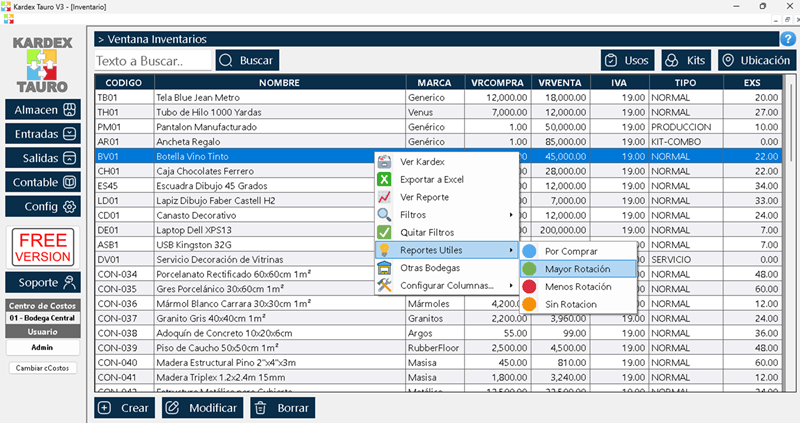
From the foliated book to the digital register
What the ordinance of 1673 understood with astonishing clarity is that the record is not paperwork but the memory and the proof of a business: the inventory Savary wanted renewed every two years was a question every business owner must answer - what do I have, what is it worth and whom do I owe? For centuries that answer was written by hand in books initialled by a consul; later it was mechanised; and today it lives in programs that record every movement the moment it happens. Inventory software such as Kardex Tauro does in minutes what a seventeenth-century merchant took weeks to do: it keeps entries, exits and balances of every product up to date and turns the periodic count, that old duty of 1673, into an almost automatic task. The Sun King demanded signed books so that nobody could lie about his business; today's technology pursues the same goal with verifiable digital records, instantaneous and free of any possible erasure. The form has changed; the need that the ordinance first declared, that commerce must leave a true trace, remains exactly the same.
