The history of inventory: from the temple granary to the barcode
The history of inventory: from the temple granary to the barcode
Keeping count of what is stored is almost as old as storing itself: every household that lays in provisions, every workshop that sets aside materials and every pantry practices some form of inventory, even if only in the mind. The history of inventory as a craft begins the moment someone had to answer a simple question with precision: how much do we have, where is it, and what is it worth? From the temple granaries of antiquity to today's automated warehouses, the way that question is answered has shaped how shops, factories and entire companies are run.
The earliest inventories on record were written thousands of years ago by the scribes of Mesopotamia, Egypt and other early civilizations, who noted the receipts and issues of temple and palace granaries on clay tablets, papyri and ostraca. That era, fascinating on its own, has a dedicated article on this blog about inventory records in the first civilizations. Here we step back to trace the full arc: from those sacred granaries to the barcode, the scanner and cloud-based inventory software.
The age of merchants: stock inside the account books
Between the fourteenth and eighteenth centuries, European trade changed in scale and geography. The great Italian merchant-bankers of Florence, Venice and Genoa, together with their Flemish counterparts in Bruges and Antwerp, moved wool, cloth, spices, metals and dyes between ever more distant ports. Their great tool was double-entry bookkeeping, refined and spread through the Italian cities during the fourteenth and fifteenth centuries: every transaction was recorded twice, and the ledger always stayed in balance. In that scheme merchandise still had no register of its own: the goods held in the warehouse were recorded as accounts inside the books and appeared in the balance sheet at year end, when the merchant drew up his inventory, the valued list of everything he owned, to learn what his business was truly worth.
Ocean routes brought the great chartered companies, and with them inventory became a matter of corporate life and death. The Dutch East India Company, the famous VOC founded in 1602, coordinated whole fleets laden with pepper, nutmeg, cloves, tea and porcelain between the warehouses of Amsterdam and its trading posts in Batavia, in today's Jakarta. Every ship kept its cargo books of loading and unloading; every post sent back statements of goods received, shipped and on hand. Distance, dampness, shrinkage, theft and shipwreck turned record keeping into an obsession: what was not written down could not be managed, and an inaccurate list could ruin a shipowner or an entire company.
In those centuries the inventory also played a legal and social role. It appeared in partnership contracts, inheritances, dowries and in the post-mortem inventories that notaries drew up to protect creditors. The word inventory then meant a solemn act: listing goods before witnesses, with their description and value, so that no one could later dispute what existed and to whom it belonged.
The Industrial Revolution: the factory, the storekeeper and the annual count
In the nineteenth century the factory changed the scale of the problem forever. A cotton mill, an iron foundry or an engineering workshop held raw materials, work in progress and finished goods at the same time, in quantities no medieval merchant had ever known. Keeping that in order demanded new trades and new practices. The storekeeper was born, an employee dedicated to receiving, safeguarding and issuing materials, answerable for every unit that entered and left the storeroom.
Alongside the storekeeper came the stock books, auxiliary registers where every receipt and every issue was entered with its date, its origin or destination and its quantity. And a practice that is still alive today became standard: the periodic physical inventory. Once a year, or section by section, the factory stopped and the clerks went out to count piece by piece, reconciling what the shelves actually held with what the books said. The differences revealed losses, theft, posting errors or damaged materials, and forced adjustments before the balance sheet could be closed.
The railway multiplied the possibilities of large-scale storage. Along the tracks rose silos, grain elevators and transit depots that could hold wheat, coal or general merchandise for months. For the first time a business could buy in large lots, store far from the point of sale and ship by train to whole cities, which made it essential to know what was in every depot and every wagon. For the young discipline of cost accounting, the warehouse stopped being a dark corner of the firm and became a center of responsibility with a value of its own.
The twentieth century to 1950: cards, department stores and wars
As retail trade grew in the cities, the problem was no longer just counting: it was knowing quickly. A department store or a parts warehouse could handle thousands of items, and ledgers alone were no longer enough. So the stock card spread: one card per item, with its receipts, its issues and a balance updated with every movement. That is the origin of the manual stock ledger file, the card system that gave its name to an entire way of controlling inventory, a story this blog tells in a dedicated article. The card also brought the idea of the perpetual inventory: the balance is known at any moment, without waiting for the annual count.
Retail itself was being reinvented. The department stores born in the nineteenth century became cathedrals of consumption, and in 1916 the first self-service grocery opened in Memphis, United States: Piggly Wiggly, where customers took goods from the shelves instead of asking for them at the counter. In the 1930s the supermarket became widespread. For stock control that was a quiet revolution: sales no longer passed over the counter, and recording came to depend on the cash register and on the shelf-stocker refilling the aisles, which pushed merchants to think in terms of turnover, shrinkage and reorder points.
The world wars, for their part, were a brutal school of logistics. Supplying millions of soldiers across several continents required gigantic depots, scheduled convoys and strict control of food, ammunition, fuel and medicine. Those inventory management techniques, developed under military pressure, moved into civilian industry after each conflict, and much of today's supply chain vocabulary comes from that heritage.
From 1950 to today: the barcode and the digital age
The modern turning point has a date and a place: June 26, 1974, at a Marsh supermarket in Troy, Ohio, in the United States. There, a pack of Wrigley's Juicy Fruit gum became the first product in the world ever sold using a barcode scan, a reading that lasted seconds and changed commerce forever. The idea of the code, patented in the early 1950s, had needed two decades to become standardized: the Universal Product Code, known as the UPC, and laser scanners reliable and cheap enough to live on a checkout counter.
The barcode turned the point of sale into an inventory terminal: every sale automatically subtracts from the balance, every receipt adds to it, and for the first time the warehouse data traveled in real time from the counter to the books. In the factory, the material requirements planning systems developed between the 1960s and the 1970s, and then the ERPs of the 1990s, integrated purchasing, warehousing, production and finance into a single database. In parallel, Toyota popularized just-in-time, or JIT: instead of piling up stock, produce and replenish only what is needed, when it is needed. The idea, conceived by Kiichiro Toyoda in the 1930s, was turned into a working system by the engineer Taiichi Ohno between the 1950s and the 1970s, and it has inspired factories around the world ever since.
The scanner was not adopted overnight: through the second half of the 1970s pioneering supermarkets proved that the system saved queues and errors, and in the following decade the barcode became commonplace in retail almost everywhere. Today it is printed on any package, read at the checkout, on the loading dock and on a phone, and it remains the physical link between the product, its price and the book balance.
Since the late twentieth century, radio-frequency identification, or RFID, has made it possible to read dozens of tags without direct contact, and modern distribution centers combine scanners, voice picking, automated carousels and software that decides where to put every box. The final step has been the cloud: today inventory lives in databases that can be reached from anywhere and on any device, and the humble barcode remains the common language that links supplier, warehouse, store and final customer.
The ages of inventory at a glance
A table helps show how each era solved the same problem, knowing what exists and what it is worth, with the tools of its time:
| Era | How it was controlled | Recording medium | Big challenge |
|---|---|---|---|
| Antiquity | Scribes recording the granaries and treasuries of temples and palaces | Clay tablets, papyri and tally marks | Knowing with certainty what was stored and what was owed |
| Age of merchants, 14th-18th centuries | Merchandise entries in double entry and closing inventories | Bound ledgers, pen and ink | Valuing cargoes, branches and distant partnerships |
| Industrial Revolution, 19th century | Storekeeper, stock books and periodic physical inventory | Auxiliary ledgers and paper | Reconciling what was counted with what was posted in huge factories |
| First half of the 20th century | Stock cards or stock ledger and perpetual inventory | Cards and filing cabinets | Thousands of items in shops, depots and armies |
| Second half of the 20th century | Barcode, point of sale, MRP, ERP and just-in-time | Scanners, computers and databases | Integrating warehouse, production and sales in real time |
| 21st century | Cloud inventory software, RFID and online data | Internet, mobile devices and smart tags | Coordinating global supply chains |
From the temple granary to the screen: inventory today
The essentials have not changed: every organization needs to know how much it has, where it is and what it is worth, and needs to say so quickly and without error. What changed is the tool. What was a clay tablet for a scribe in antiquity, and a bound book for a nineteenth-century storekeeper, is today a database updated with every sale, every receipt and every transfer, reachable from a phone.
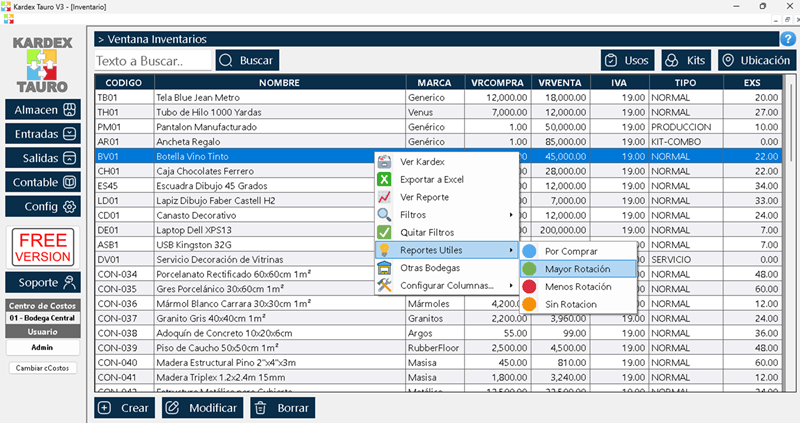
That thousand-year heritage now reaches small and medium businesses through tools built for their size. Inventory software such as Kardex Tauro makes it possible to record receipts and issues, know the balance of every product and rely on trustworthy data when buying and selling: the same question asked at the temple granary, now answered at the speed of a click. The history of inventory is, at heart, the history of how humanity learned to trust what it writes down.