The history of food preservation: from salting to canning
The history of food preservation: from salting to canning
Today it seems ordinary to open a can of tuna, a jar of preserves or a bag of dried beans and forget that for most of human history fresh food spoiled within days. Before sterilization and modern packaging existed, milk turned, meat rotted, fish went off and fruit fermented: nature imposed a harsh deadline between harvest and consumption.
That deadline was no domestic detail. It set the size of the stocks a family, a merchant or an army could keep, and the distance at which it made sense to transport food: what could not be preserved could not be stored, and what could not be stored could hardly be traded. The history of preservation is, at heart, the story of how humanity learned to build pantries, first with salt, smoke and cold, later with sealed heat and science. This journey from salting to canning also explains why warehouses today can hold food for months without losing it.
The underlying problem: food that goes bad
Spoilage is a natural process. Fresh food contains water and nutrients that microorganisms, enzymes and insects exploit; without barriers, mold, bacteria and time itself transform it until it is inedible. Ancient societies did not know about microbes, but they knew their effects very well: they saw mold on bread, the smell of fish in the sun and meat rotting in summer, and they learned that heat, moisture and air hastened the ruin.
The consequences were enormous. Food production is seasonal: the harvest arrives once or twice a year, but consumption is daily. Without a way to keep the surplus, the abundance of the harvest became scarcity months later, and seasonal famines were part of the calendar. Armies on campaign could not carry weeks of provisions: they lived off the land, which limited their routes and their size. Ships could move away from the coast only as far as their water and food lasted. And the merchant who shipped a cargo of fresh fruit or meat raced against time: if the voyage dragged on, he arrived with losses, or with nothing.
For millennia, then, the skill of preserving was almost as valuable as the skill of producing. Those who could keep grain, dry fish or salt meat had wealth in winter, under siege or on a long voyage; those who could not depended on consuming everything at once. Preservation was the first great stock-management technology: it turned perishable surplus into lasting reserves, and those reserves were the foundation of trade and power.
Ancient techniques: salt, smoke, cold and fermentation
Long before science, humanity discovered by trial and error a handful of methods still in use today. Each attacks the same problem, water, air, heat or microorganisms, with the resources available in each region:
- Sun and air drying. The oldest and most universal technique: removing water from food keeps bacteria and fungi from thriving. Grains, legumes, fruit, meat and fish were dried in the sun, in the wind or by the fire, and so kept for months.
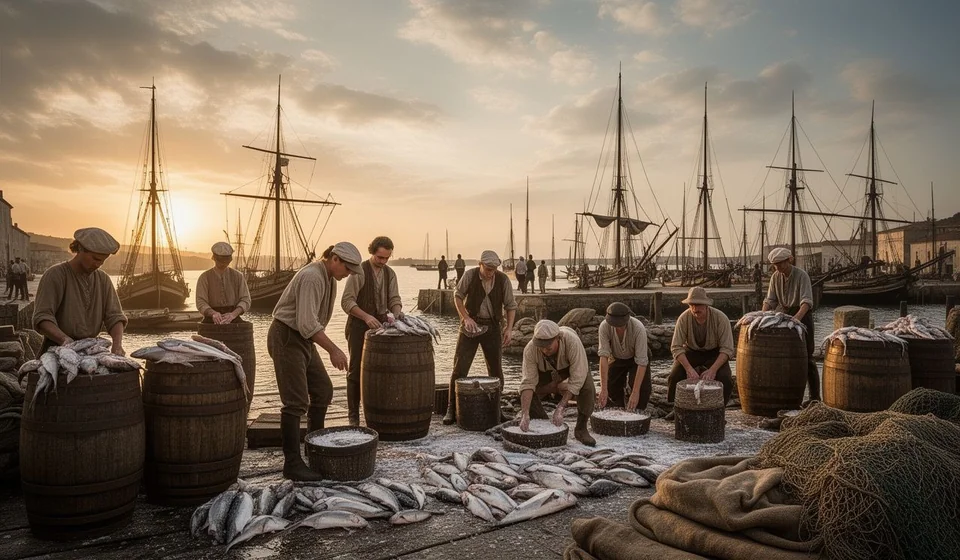
- Salting. Salt draws water out of tissues and creates an environment hostile to microorganisms. Fish and meat were rubbed with salt or soaked in brine and packed into barrels or jars. For centuries salt was a strategic good, so valuable that it was sometimes used as payment or heavily taxed.
- Smoking. The smoke of the fire dries the surface and deposits compounds that slow decay and add flavor. Meat and fish hung over the smoke kept for weeks or months and gained a distinctive taste.
- Fermentation. The paradox of using microorganisms to defeat microorganisms: useful bacteria and yeasts transform the food and produce acids or alcohol that protect it. Cheese, yogurt, sauerkraut, pickles, beer, wine and bread all come from this ancient technique, which also preserved milk and vegetables.
- Honey, oil and vinegar. Submerging fruit in honey, vegetables in oil or fish in vinegar cut them off from the air or created an acidic medium that prevented decay. The Romans kept fruit, vegetables and meat this way in their pantries.
- Cold and underground storage. Cold slows decay. Since antiquity people dug ice houses and cold stores, like the yakhchal of Persia, to keep winter snow and ice until summer, and cellars and underground silos that held a steady, cool temperature for grain, wine, cheese and vegetables.
Every method had limits: it changed the taste, demanded plenty of salt or fuel, or worked only on certain foods. But together they made possible what seemed impossible: eating in winter what was harvested in summer, and sending across distances what was produced in one place.
Trade that depended on preserving
The great food-trade routes were built on preservation techniques. Salted cod and brined herring fueled North Atlantic commerce: Basque fishermen and then entire fleets crossed to Newfoundland, while the Hanseatic League distributed barreled herring across Europe. Cured hams and long-maturing cheeses travelled from region to region as valuable, stable goods.
Rome pushed that logic to its limit: the empire depended on grain from Egypt and North Africa reaching the capital. To do this it built public granaries, the horrea, and a fleet dedicated to supply, while wine and olive oil sailed in sealed clay amphorae across the whole Mediterranean. Garum, a fermented fish sauce, was exported in jars the way an industrial product is exported today. Grain silos were, in practice, the strategic inventory of ancient states: reserves for the army, the city and the bad years.
The Age of Discovery pushed the problem to the extreme. Ships crossing the Atlantic or sailing around the world spent months without touching land, and their holds had to feed the entire crew. The diet on board, hard biscuit, salted meat, dried fish, legumes and water, was monotonous and fragile: damp rotted the biscuit, salted meat ran out, and the lack of fresh food caused scurvy, the disease that decimated so many crews. Captain James Cook proved in his eighteenth-century voyages that provisioning discipline saved lives: he imposed sauerkraut, fermented cabbage rich in vitamin C, insisted on stops to replenish water and fresh food, and lost very few men to scurvy. Preserving well was not just comfort: it defined which routes were possible and how many men came home.
The turning point: Appert and the birth of the tin can
The decisive leap came with the Napoleonic Wars. France needed to feed enormous armies operating far from their depots, and its government offered a prize of twelve thousand francs to anyone who developed a way to preserve food in quantity. Nicolas Appert, a Parisian confectioner, took up the challenge and spent about fourteen years experimenting with glass bottles.
His method was deceptively simple: fill the container with food, seal it tightly and heat it in boiling water for a time. The French navy tested his preserves in 1806 and found them in good condition; in January 1810 the Ministry of the Interior awarded him the prize, on condition that he publish his process. That same year his book appeared, known as The Art of Preserving Animal and Vegetable Substances for Several Years, the first modern treatise on food preservation. Appert set up the world's first food-preserving factory in Massy, near Paris, which operated until 1933. Curiously, the confectioner did not know why his method worked: he had only proved that it did. The scientific explanation would arrive half a century later.
Almost in parallel, in England, the merchant Peter Durand patented a process on 25 August 1810 for preserving food in containers of glass, pottery, tinplate or other metals. Durand chose tinplate, iron coated with tin, and so the tin can was born: sturdy, light and easy to transport, far more practical than Appert's fragile glass. He sent test cans aboard Royal Navy ships, which found them in perfect condition months later. Durand sold his patent in 1812 to the Englishmen Bryan Donkin and John Hall, who set up the first commercial canning factory in London and supplied the British navy with canned meat from around 1813.
Throughout the nineteenth century the canning industry grew without pause: fruit, vegetables, fish, condensed milk and soups began to be packed in series. The first cans were thick and hard to open, the can opener was not invented until 1858 and before that they were opened with a chisel and hammer, but the principle was established. The wars of the nineteenth and twentieth centuries gave the final push: canned food became military rations, and army demand expanded the factories, improved quality control and lowered costs until the can reached every pantry in the world.
The science that explained the method: Pasteur
Appert had found the solution without knowing the problem. The answer came in the 1860s, when Louis Pasteur showed that fermentation and decay are the work of invisible microorganisms and that heat destroys them. Suddenly, preservation ceased to be an empirical art and became a science with measurable laws: temperature, time and sterility.
With microbiological theory, controlled sterilization was born. Pasteur applied gentle heat to wine and beer, the process that bears his name, pasteurization, and later to milk; his collaborator Charles Chamberland perfected the autoclave in 1879, which makes it possible to heat above the boiling point and sterilize safely and reproducibly. Now people knew exactly why a sealed, heated jar lasted for years: heat had killed the organisms that would have spoiled it, and the seal kept new ones out.
The impact on food inventory
Modern preservation did not only change the table: it changed the storeroom. Being able to store food for months, and some foods for years, transformed military, naval, urban and commercial logistics. Armies stopped depending on what they found along the way and built supply depots and long-lasting rations; navies became independent of ports for months; cities accumulated reserves for winter, drought or siege; and merchants could ship foodstuffs across whole continents.
For those who manage stock, the change was profound. Food warehouses went from being passage spaces, where goods came in and went out before spoiling, to true stores with inventory: safety stocks to cover the unexpected, planned rotation and less shrinkage. People learned to record what was on hand, how long it would last and in what order it should be consumed, the first-in-first-out logic, and controlling dates and quantities became as important as the product itself. Preservation made accumulation possible; warehouse accounting made it possible to use what had been accumulated.
Methods, eras and effects on storage
The following table summarizes the whole journey, from salting to canning:
| Method | Era | How it works | Effect on storage |
|---|---|---|---|
| Sun drying | Since prehistory | Removes the water microorganisms need | Grains and fruit kept for months in granaries and pantries |
| Salting | Antiquity | Salt draws out water and creates an environment hostile to bacteria | Barrels of fish and meat that travelled thousands of kilometres |
| Smoking | Antiquity and Middle Ages | Smoke dries and deposits protective compounds | Meat and fish hung for weeks or months |
| Fermentation | Since the Neolithic | Useful microorganisms transform and acidify the food | Cheese, sauerkraut, beer and pickles without any need for cold |
| Honey, oil and vinegar | Antiquity, Rome | Cut off the air or acidify the medium | Fruit and vegetables kept in Roman pantries |
| Cold and underground rooms | Antiquity and Middle Ages | Low temperature slows decay | Ice houses and cellars extended the life of fresh food |
| Heat sealing | 1809-1810, Appert | Cooking food in a sealed container destroys the agents of decay | Preserves that lasted for years in the storeroom |
| Tinplate can | 1810, Durand | Sealed metal container protects the treated food | Naval and military stores with long-lasting rations |
Closing: from the art of preserving to the art of controlling
Today industrial cold, vacuum packing and the cold chain solve almost the whole problem of preserving: a food can last for months without being lost. The modern challenge is different: knowing precisely what is in the warehouse, how long it has been there and what expires first. Preserving made it possible to accumulate stock; controlling it, by batch, date and quantity, is what keeps stored goods from turning into shrinkage, old stock from hiding new stock, or an expiry date from arriving as a surprise. Keeping that record in order, as inventory software such as Kardex Tauro helps to do, is the modern way of not repeating the ancient drama: watching what cost so much to preserve be lost to disorder.