The history of the cold chain: from natural ice to industrial freezing
The history of the cold chain: from natural ice to industrial freezing
We take it for granted that milk travels chilled, that meat arrives from the other side of the world without spoiling and that the supermarket keeps a whole aisle of frozen food. Behind that normality lies a technical feat two centuries in the making: the cold chain, the network of equipment and processes that keeps food at low temperature from the moment it is produced until it is consumed. This article follows it from its origins, when cold existed only where nature left it, to the world of industrial freezing.
A companion piece in this series told the story of preservation through salt, smoke and canning. Here the protagonist is cold, which demanded something no brine ever needed: an unbroken chain. A table at the end summarizes the milestones of that story.
Ice before the machine: pits, snow and ice houses
For millennia, cold was not produced but captured. The earliest written records of the practice come from Mesopotamia: around the eighteenth century BCE, in the kingdom of Mari in present-day Syria, so-called ice houses existed, underground stores where blocks brought from the mountains were kept to chill the wine of the court.
The most sophisticated version was born in Persia, where the yakhchal, literally ice pits, have stood for more than two thousand years, since around the fourth century BCE. They were mud-brick domes sheltering a deep pit, flanked by shading walls and shallow ponds: on the cold desert nights the water froze, workers gathered the ice at dawn and packed it into the pit, where the thick walls kept it for months. Thanks to them, chilled water and ices could be served in the middle of summer.
The practice spread across the ancient world: in China, ice was stored for the court many centuries before our era, and Greeks and Romans kept snow in pits covered with straw to chill the wine at banquets. In medieval and early modern Europe, the ice houses of palaces and monasteries played the same role: having ice in summer was for centuries a luxury of nobles and kings. Cold existed, but it was seasonal, expensive and local: it had yet to become a commodity.
The Ice King: Frederic Tudor and the natural-ice trade
That transformation was the work of a Boston merchant, Frederic Tudor, nicknamed the Ice King. In 1806, at the age of twenty-three, he loaded a brig, the Favorite, with about one hundred and thirty tons of ice cut from the frozen ponds of Saugus and sent it to the Caribbean island of Martinique. The press treated the plan as a joke. Much of the cargo melted and the venture ended in losses, and Tudor even spent time in debtors' prison between 1812 and 1813, but he never abandoned the idea.
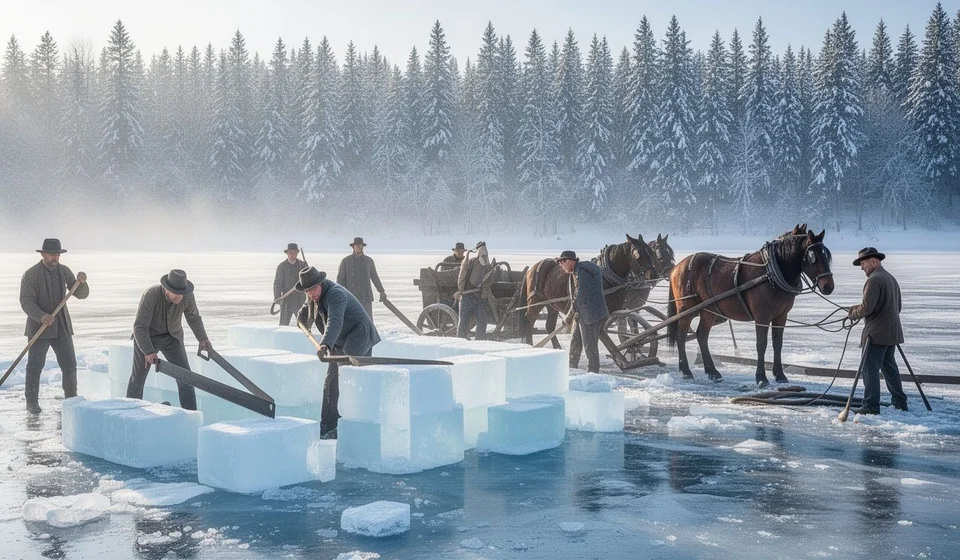
His genius lay in insulation: he learned to protect the ice with sawdust and straw inside double-walled holds and to build cold stores at destination ports, such as the ice house he raised in Havana in 1815. Around 1825, inventor Nathaniel Wyeth gave him the missing tool: a horse-drawn ice plow that scored the frozen lakes and allowed enormous blocks to be cut in hours. Ice was no longer cut by hand, block by block: it became an industrial product.
His crowning achievement came in 1833, when the brig Tuscany sailed from Boston to Calcutta with one hundred and eighty tons of ice in her hold. The voyage took months and many believed it was a hoax, but the ship arrived with about one hundred tons intact. Calcutta became Tudor's most profitable market for two decades; the ice trade became one of the great businesses of the nineteenth century.
That trade carried cold into the home. From the 1840s onward, factories mass-produced domestic iceboxes, wooden cabinets with walls insulated with cork or sawdust where a block of ice cooled the food on the shelves, and the iceman came by with his cart every few days to replace it. In 1907, a survey of New York City found that eighty-one percent of families had some form of icebox. For the first time in history, milk and meat could wait several days outside the pantry.
Mechanical refrigeration: the machine that made cold
While Tudor sold natural ice, scientists were looking for ways to make it. The principle was well known: when a volatile liquid evaporates, it absorbs heat and cools its surroundings. In 1805, the American Oliver Evans described a closed vapor-compression cycle that would produce cold continuously, although he never built it. The practical leap came from Jacob Perkins, who in 1834 patented in England an apparatus for producing ice and cooling fluids: a vapor-compression machine using ether as the refrigerant which, built and demonstrated by John Hague in 1835, ran continuously.
Mechanical refrigeration took off along two paths. One was the absorption machine, which used heat rather than a compressor to drive the refrigerant: in 1859, the Frenchman Ferdinand Carré patented his ammonia-water absorption system, and at the 1862 London World's Fair one of his machines produced two hundred kilograms of ice per hour. Artificial ice ceased to be a laboratory curiosity: by the end of the nineteenth century, city ice plants displaced the natural ice of the lakes.
The other path was compression applied to industry, led by the Scottish-Australian James Harrison, regarded as the father of refrigeration. Settled in Geelong, Australia, he built his first experimental machines around 1851, cooling by compressing and evaporating ether, and patented his process in 1856. The first commercial machine was sold in 1857 to a London brewery, and soon his equipment was cooling the wort of Australian breweries such as the one in Bendigo. Beer was the first great customer of mechanical cold because brewing demands controlled temperatures: by the mid-nineteenth century, cold had become an industry.
Cold industrializes meat: refrigerated ships and trains
The next challenge was to move the cold along with the cargo. Until then, meat that crossed oceans traveled alive or salted, at enormous cost. In 1876, the Frenchman Charles Tellier, nicknamed the father of cold, converted a sailing ship into the refrigerated vessel Le Frigorifique: he installed methyl-ether compression machines, insulated the hold and loaded freshly slaughtered meat at Rouen. The ship reached Buenos Aires in December, after about one hundred and five days at sea, with the meat in good condition: the first time a cargo of fresh meat crossed the Atlantic thanks to artificial cold. Tellier was ruined by the venture, but he had proved the way.
Others turned it into commerce: in 1880 the steamer Strathleven carried beef and mutton from Australia to London, and in 1882 the Dunedin sailed from New Zealand with thousands of frozen lamb carcasses and reached England in good condition. Thus was born the great transoceanic trade in frozen meat: the packing plants of Argentina, Uruguay, Australia and New Zealand began to feed Europe with meat from the southern hemisphere.
In the United States, cold conquered the railroad. The packer Gustavus Swift, based in Chicago, understood that shipping live cattle to the eastern markets was terribly wasteful: every animal arrived thin or dead, and two-thirds of its weight was bone and offal. In 1878 he hired engineer Andrew Chase to design a refrigerated car: an insulated boxcar with an ice bunker in the roof, from which cold air sank over the hanging carcasses. The big railroads refused to move his cars because they profited from cattle on the hoof, so Swift used a Canadian route, the Grand Trunk. In 1880 he took delivery of his first cars and created his own refrigerator line; a year later he had some two hundred cars carrying about three thousand carcasses a week to Boston. Dressed beef, slaughtered and chilled in Chicago and consumed fresh in the eastern cities, changed the livestock geography of the country, and rivals such as Armour followed suit.
Clarence Birdseye and quick freezing
Refrigeration keeps food for days or weeks; freezing, for months. But freezing badly ruins it: if the cold advances slowly, large ice crystals form, rupture the cells and, on thawing, the food turns watery and tasteless. The key was speed, and the man who found it was the American naturalist Clarence Birdseye: in 1916, on an expedition to Labrador, he watched fish frozen instantly in the Arctic air and noticed that they kept the taste of fresh fish when thawed.
Birdseye carried that lesson into industry: in 1924 he founded General Seafoods in Gloucester, Massachusetts, and developed machines that froze food quickly between metal plates chilled to about forty-five degrees below zero. Quick freezing formed tiny crystals that did not damage the tissues. In 1929 he sold his company and patents for about twenty-two million dollars to Postum, the future General Foods, which launched the Birds Eye brand.
The moment of public proof came on March 6, 1930, when the first mass-market frozen foods went on sale in eighteen stores in Springfield, Massachusetts: twenty-six products, from spinach and peas to fruits and cuts of meat, displayed in specially designed frozen-food cases. Sales were slow at first, but frozen food truly took off after the Second World War, when the home freezer and the supermarket's frozen aisle became everyday realities.
One continuous chain: from the plant to the home freezer
The twentieth century turned those isolated inventions into a system: the integrated cold chain. The idea is simple to state and hard to deliver: food must be kept at the right temperature without interruption from the moment it leaves the plant or the slaughterhouse until it reaches the table. Every link has its equipment: the producer's cold store, the refrigerated truck, the distributor's warehouse, the supermarket display case and, at the end, the home freezer. If a single link breaks, even for a few hours, the goods lose quality or spoil in silence.
The great enabler of the century was the container: from mid-century on, refrigerated containers, the so-called reefers, allowed fruit, meat and fish to cross oceans without ever leaving the chain. Thanks to that continuity, the modern supermarket sells all year round products that were once seasonal, and the same cold discipline now applies to vaccines and biological medicines. The logistics of cold have become as important as production itself.
Cold and the inventory of perishables
Let us be clear: cold does not stop time, it slows it. A refrigerated or frozen food still has a limited shelf life, and that shelf life runs from the moment it is produced. The cold chain changed how food is stored, but it did not remove the need to manage what is stored; on the contrary, it made that task more delicate. Whoever keeps cold food must know which batch arrived first, which batch expires first, how much is in the cold room and how much was lost to a temperature failure. Supermarkets, restaurants and distributors live on that balance: stock that rotates well is freshness and profit; stock that sits still is waste.
| Milestone | Year | What it made possible |
|---|---|---|
| Ice houses in Mesopotamia and snow pits in Persia, Greece and Rome | From the eighteenth century BCE | Keeping winter cold for summer use |
| Frederic Tudor ships Boston ice to the tropics | 1806 and 1833 | Ice as a global commodity and the home icebox |
| Jacob Perkins patents vapor compression | 1834 | The first working refrigeration machine in history |
| James Harrison brings mechanical cold to breweries | Circa 1851-1857 | Artificial cold in the service of industry |
| Ferdinand Carré patents the ammonia absorption machine | 1859 | Artificial-ice plants that displaced natural ice |
| Le Frigorifique crosses the Atlantic with meat | 1876 | Fresh meat between continents; the refrigerated ship is born |
| Swift and his refrigerated railcars | 1878-1880 | Chicago meat for every city in the country |
| The Dunedin carries frozen lamb from New Zealand to London | 1882 | The great transoceanic trade in frozen meat |
| Clarence Birdseye develops quick freezing | 1924 | Frozen foods that keep their flavor and texture |
| First retail sale of frozen foods in Springfield | 1930 | The supermarket frozen-food aisle |
| Refrigerated containers and the integrated chain | From the mid-twentieth century | Food from any latitude all year round, with no break in the cold |
The history of the cold chain is, at bottom, the story of how humanity learned to manage the time of food: capturing winter, manufacturing it with machines and transporting it along an unbroken chain. Each stage extended how long a stock of food could last without losing value, and each extension brought new demands for records and control.
Today, physical preservation is only half the task; the other half is information. Knowing what is in the cold room, in which batch, since when and until when it can be used is what separates food that is used from silent waste. That is the work of modern inventory control, the same work that tools such as Kardex Tauro help businesses of every size carry out: recording food stock and its movements, tracking batches and expiry dates and knowing what is sitting still. From the king's snow pit to the code that logs every batch, cold and its management have never stopped going hand in hand.