The history of the public accounting profession in Colombia: from the colonial treasuries to modern regulation
The history of the public accounting profession in Colombia: from the colonial treasuries to modern regulation
When a Colombian public accountant signs a set of financial statements today, he or she is closing an institutional cycle that began more than four centuries ago. That signature carries a public faith granted by law, but the authority behind it did not appear overnight: it is the result of a long evolution that runs from the scribes and royal officers of the Spanish Crown to the adoption of international financial reporting standards. Knowing that history helps to understand why accounting is not just a recording technique, but an institution built around trust in figures.
In the territory that is now Colombia, accounting practice served the royal treasury for three hundred years. After independence, the craft was transformed together with trade and the republican state, until it became a university profession, regulated by law and overseen by state bodies. This article traces that path: the colonial treasuries, the republican public finances of the nineteenth century, professional education, the laws that organized the practice and today's regulation.
The colonial era: treasuries and courts of accounts
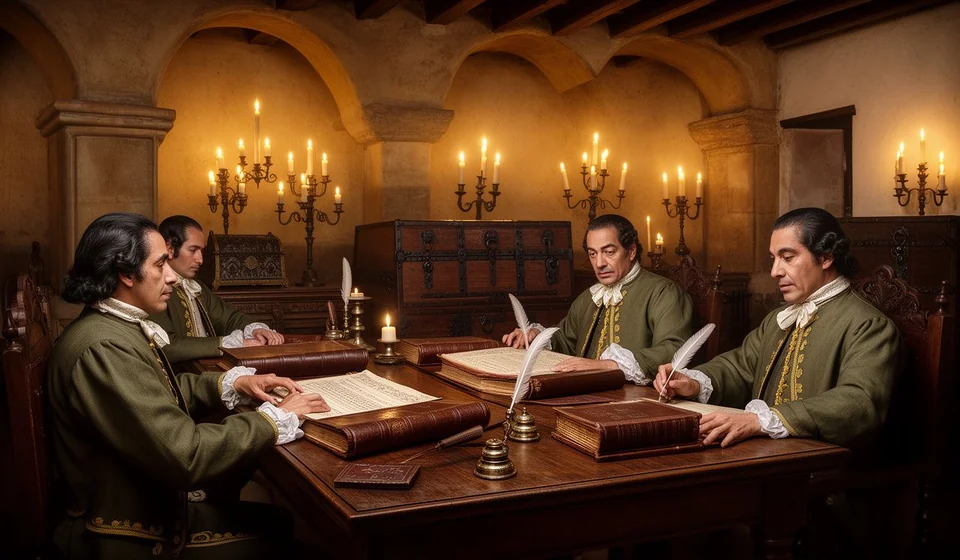
During the colonial period, the New Kingdom of Granada was part of an enormous fiscal system designed to finance the Spanish Crown. In the main cities of the territory there were royal treasuries, known as cajas reales: offices in charge of collecting tribute and managing the king's funds. There worked the royal officers, officials with specialized roles: some handled the money, others kept the account books and others safeguarded goods. Among the revenues they managed were tributes such as the royal fifth, a tax on the production of precious metals, and the alcabala, a sales tax collected in the cities of the viceroyalty.
The Crown was not satisfied with the officers simply writing down income and expenses: it wanted to control those who handled its money. For that reason it set up oversight mechanisms. The accountants and other officers had to render accounts periodically, and special officials reviewed their work. It was an accounting designed above all for control: every peso collected had to be traceable from the local treasury to the Crown's coffers.
That drive for control led to the creation of courts devoted exclusively to examining accounts. In 1605, during the reign of Philip III, the establishment of courts of accounts was ordered in the main centres of the American empire, including Santafé de Bogotá. Thus was born the Court of Accounts of Santafé, in charge of supervising the accounting of the royal treasuries within its jurisdiction. Its accountants audited the books kept by the royal treasury officers, checked that declared income matched what had actually been collected, and ordered corrections to poorly kept entries. They also regulated how operations had to be recorded, so that all offices followed uniform procedures.
The system worked for centuries, though not without difficulty. Documentation grew so much that by the late eighteenth century some courts were many years behind in their audits: there was more paper than accountants to examine it. Even so, the colony left a valuable legacy: the idea that anyone who handles public funds must record operations and submit them to review, and the existence of specialized officers whose trade was precisely to keep and audit accounts.
The nineteenth century: from royal treasury to republican finance
With independence, the new Colombian state had to organize its fiscal administration from scratch. The colonial structure disappeared and in its place the offices of the republican public treasury were created: ministries, general accounting offices and collection offices in charge of national revenue. The first republican governments inherited empty coffers and an economy ruined by war, and much of their effort went into establishing how taxes would be levied, how they would be recorded and who would answer for them.
While the state organized its accounts, trade grew, and with it the need to keep orderly records. Commerce demanded knowing how much one owed, how much one owned and how much one earned, so accounting gradually became an essential skill for business people. The commercial codes issued in Colombia during the nineteenth century reflected that need: they required merchants to keep accounting books, such as the journal and the ledger, and to preserve the documentation of their operations. A trader who operated without those books risked losing the evidentiary value of his records before the courts.
At that time there was still no university degree in accounting. Those who mastered accounting technique were, to a large extent, bookkeepers trained in commercial practice or in private schools, together with officials who learned the trade in state offices. There were also the so-called sworn accountants, people recognized for their expertise who were entrusted with giving opinions on accounts and commercial matters. It was professional practice without a formal title: trust in the person counted as much as technical knowledge, and any commercial dispute could depend on the quality of well-kept books.
Professional education: the National School of Commerce and the road to the university
The leap towards professionalization came with the new century. On 9 February 1905, at the initiative of the government of General Rafael Reyes, the National School of Commerce of Bogotá was founded: a public institution created to train those who would dedicate themselves to commerce and accounting work. Its creation reflected a modern conviction: if the country wanted to progress, it needed people with systematic training in accounts, trade and administration, not just improvised apprentices behind the counters.
The National School of Commerce was the seed of higher accounting education in Colombia. Over time it became the National Faculty of Accounting, one of the first settings in which accounting was studied as an academic discipline at university level. Throughout the twentieth century, several universities across the country began to offer the public accounting degree, and the profession gained status: the accountant ceased to be seen as a mere assistant to the merchant and became a university professional with responsibilities towards society.
The regulation of the profession: Law 145 of 1960
During the first half of the twentieth century, accounting was practised without a uniform legal framework. There were university degrees, but also people who practised on the basis of experience alone, and the state lacked a reliable register of who was qualified to give faith on the accounts of companies. That situation changed decisively in the 1960s.
The founding milestone of professional regulation was Law 145 of 1960, issued on 30 December of that year, which regulated the practice of the public accounting profession. The law defined what is understood by public accountant: a natural person who, through the registration that certifies professional competence, is authorized to give public faith on certain acts. It established that practising the profession required a university degree and registration with the Central Board of Accountants.
The Central Board of Accountants had been created a few years earlier, in 1956, as a result of the first regulation of the profession; Law 145 of 1960 consolidated it and gave it its definitive form: a body with disciplinary powers, attached to the Ministry of National Education, in charge of deciding on the registration of candidates, keeping the register of public accountants and sanctioning breaches of ethics and of the law. Since then, the professional card issued by the Board became the hallmark of the Colombian public accountant. The profession ceased to be an open trade and became an activity reserved for those who could prove training and competence.
Law 43 of 1990 and the Technical Council of Public Accounting
Three decades later, the growth of the economy and the complexity of companies made a deep update of the legal framework necessary. That update came with Law 43 of 1990, issued on 13 December of that year to supplement and reorganize the regulation of the profession. Law 43 of 1990 is regarded as the organic statute of Colombian public accounting: it defined the accountant's functions more precisely, among them giving opinions on financial statements, and established the organs of the profession.
There are two such organs. On the one hand, the Central Board of Accountants, in charge of the registration, inspection and oversight of the profession. On the other, the Technical Council of Public Accounting, a permanent body created by the same law, in charge of the technical and scientific guidance of the profession and of the study of accounting principles and of auditing standards generally accepted in the country. The law also incorporated a professional code of ethics, with the rules of conduct that must guide the accountant in professional practice.
With Law 43 of 1990, Colombian public accounting was organized along the lines of other liberal professions: a university degree, a compulsory professional register, a body that oversees the practice and a code of ethics defining the professional's responsibilities towards society. On that basis, years later, the opening to international standards would be built.
International convergence: Law 1314 of 2009
The globalization of the economy posed a new challenge: investors, banks and authorities in other countries needed to read Colombian financial statements under the same criteria they used for those of any other nation. The answer was Law 1314 of 2009, which regulated the accounting and financial information principles and standards accepted in Colombia, together with information assurance standards, and ordered the convergence of the Colombian accounting framework with international standards.
That law opened the way for the gradual adoption, by groups of companies, of the International Financial Reporting Standards, known as IFRS, and of international standards on assurance of information. The change was profound: Colombian accounting moved from a model centred on local rules and mainly tax-driven criteria to a model based on international principles, aimed at making figures reflect the economic reality of companies. The Technical Council of Public Accounting and the state's economic authorities became the technical references for that transition process.
The Colombian public accountant today
What does it mean today to be a public accountant in Colombia? In essence, to be the person to whom the law recognizes the ability to give public faith on financial information: his or her signature certifies that financial statements were prepared in accordance with the standards, and that certification is the basis of the trust of shareholders, banks, suppliers and the state itself. Many companies are required to have a statutory auditor, and whoever holds that position must be a public accountant. Oversight of the practice remains in the hands of the Central Board of Accountants, today a special administrative unit attached to the Ministry of Commerce, Industry and Tourism, while the Technical Council of Public Accounting continues its technical guidance work.
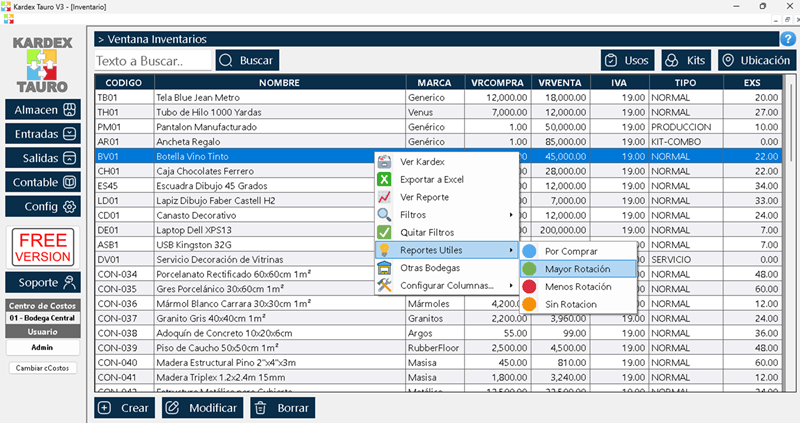
In daily work, the accountant depends on information born long before the financial statements: that of the company's real operations. Among those operations, inventory management holds a central place, because the cost of sales, the valuation of assets and, ultimately, the business result all depend on the goods in stock. Reliable accounting presupposes orderly records of what is bought, sold and kept in the warehouse.
| Period | Milestone | What changed |
|---|---|---|
| Colonial era (16th-18th centuries) | Royal treasuries and Court of Accounts of Santafé (1605) | Royal officers kept treasury books and courts of accountants audited the accounts |
| 19th century | Organization of republican finances and commercial codes | The republican state orders its accounts and the law requires merchants to keep books |
| 1905 | Founding of the National School of Commerce of Bogotá | Accounting education becomes formal and gives rise to university training |
| 1956 and 1960 | First regulation and Law 145 of 1960 | The public accounting profession is regulated and the Central Board of Accountants takes charge of registration |
| 1990 | Law 43 of 1990 | Professional practice is reorganized and the Technical Council of Public Accounting is created |
| 2009 | Law 1314 of 2009 | Colombia begins its convergence towards international financial reporting standards |
Looking back makes it possible to value how far the road has come: from the ledgers of the royal treasuries, written by hand to answer to the king, to the signing of financial statements prepared under international standards. At the centre of that journey lies the same conviction: accounts must be kept with order, method and honesty, because on them rests the trust of the whole economy. That same need for order lives on in every company today, and technology is its companion: specialized programs such as Kardex Tauro help keep the inventory records up to date, that everyday information which the public accountant turns, with his or her signature, into figures the country can rely on.