The history of storage: silos, horrea, warehouses and distribution centers
The history of storage: silos, horrea, warehouses and distribution centers
Storing is a need older than writing: ever since the first communities harvested more than they could eat, someone had to decide where to put the surplus so it would not spoil, feed the rodents or be stolen by the neighbors. The history of inventory, which this blog covered in an article devoted to stock control through the ages, tells how humankind learned to record what it kept. This article tells the other half of the story: the evolution of the physical place where things are kept. From a pit dug in the ground to the concrete silo, from the Roman horrea to the automated distribution center, every generation redesigned its warehouses to preserve, protect and move goods on an ever larger scale.
Before the warehouse: pits, silos and raised granaries
Around ten thousand years ago, as farming spread through the Fertile Crescent and other regions, the grain surplus stopped being an exception. The first great solution was the pit: a hole dug in the ground, lined with basketry, clay or stone, filled with grain and sealed at the mouth. In dry soils and at depth, the low, stable temperature and the lack of oxygen slowed germination and kept insects and rodents away. Remains of such pits and of large storage jars appear in sites across the Levant, Anatolia and the Balkans dating to the first millennia of agriculture.
The second great solution was to raise the granary. In many parts of Africa and prehistoric Europe, granaries were built on posts: a chamber of wood, mud or wicker lifted off the ground, reached by a removable ladder. The height kept the harvest away from ground damp and flood water, while the posts, sometimes fitted with discs, made it hard for rats to climb; air circulated below the floor and smoke from the hearth helped drive off insects. That logic never disappeared: raised granaries on stilts are still used today in rural regions of West Africa and elsewhere.
The household pantry and the great jars buried up to their necks completed the storage landscape of the early village. None of these systems needed scribes or inventories: the memory of the head of the household was enough. When the stored grain outgrew the domestic scale, the first great infrastructure appeared: the granary of the temple and the palace.
Monumental antiquity: state granaries, horrea and qollqas
The first civilizations turned storage into public works. In Egypt, the state and temple granaries depicted on the walls of Theban tombs, with scribes measuring and noting the grain, held the pharaoh's harvests and fed the workforce, the army and the court in years of scarcity. Rows of round mud-brick silos formed complexes that archaeologists have documented in cities such as Amarna. The scale was no longer domestic but that of the state, which accumulated grain as a strategic reserve and redistributed the surplus according to the scribes' records.
Rome carried that idea to a higher level with the horrea, the storehouse par excellence of the ancient world: the word covered everything from the public granaries of the state to private warehouses serving trade. At Ostia, Rome's port, excavations reveal large brick horrea arranged around porticoed courtyards, with very thick walls, high, narrow windows and mezzanines that kept the grain clear of damp. They were buildings conceived at once as silo, fortress and office: grain arrived by ship, was weighed, graded and placed under custody, with officials keeping account of what was deposited and withdrawn. Rome went on to build monumental horrea along the Tiber from the second century BC, expanded by the emperors to secure the capital's food supply.
At the other end of the world, the Inca Empire developed a solution shaped by the Andes: the qollqas, stone storehouses built on hillsides, in high, airy spots where the cold, dry air preserved potatoes, maize, dried meat and other products. Laid out in rows along the empire's roads, they supplied armies on the march and relieved regions hit by bad harvests. Inca administrators recorded the quantities stored and delivered in the quipus, the knotted cords this blog described in its article on the records of pre-Columbian America: an information system made of string and knots serving a network of stone silos.
Monastic larders, arsenals and the warehouses of the trading ports
During the European Middle Ages, storage became again largely local and defensive. Monasteries and manors kept their harvests in great barns, sometimes of massive timber with broad roofs that aired the grain: tithes and rents were collected in kind and had to be preserved. In the household, the pantry, the cellar and the granary guarded the bread, wine and grain of the year.
The revival of long-distance trade between the twelfth and sixteenth centuries created the warehouse of the merchant city. Venice and Genoa, Bruges and later Seville and Amsterdam raised depots by the water, because goods arriving by galley had to be unloaded, weighed, marked and reloaded without crossing the town. In Venice, the Fondaco dei Tedeschi lodged, supervised and stored the goods of the German merchants under state control, while the Arsenal, founded at the beginning of the twelfth century, worked for centuries as the largest industrial complex in Europe: with its basins and workshops organized as a production line, it outfitted galleys in series with standardized parts. The Hanseatic ports of the north, such as the timber warehouses of the Bryggen wharf in Bergen dating from the fourteenth century, show the same logic: warehouse and office on the water, a step away from the ship.
In Amsterdam during the seventeenth century, the canals were lined with tall, narrow warehouses with beams and hoists that raised barrels to the upper floors: height multiplied capacity where land was worth its weight in gold. Beside these depots flourished the exchanges, where merchants dealt with the goods in sight, and with them came marks of ownership, official measures, public weighing and accountable custodians. The warehouse stopped being a private place and became a piece of the public infrastructure of commerce.
The industrial age: grain elevators, railways and public warehouses
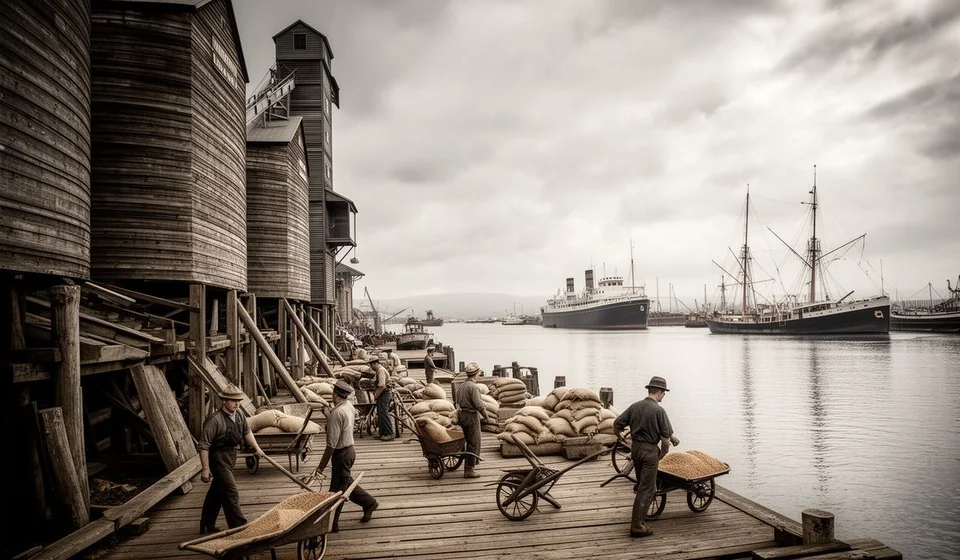
The nineteenth century changed warehouse engineering forever. The bottleneck was no longer the field but the port: in the United States, the opening of the Erie Canal in 1825 made Buffalo, on the Great Lakes, the gateway for the grain of the Midwest, yet unloading the sacks by hand took days. In 1842 the merchant Joseph Dart and the engineer Robert Dunbar built there the first steam-powered grain elevator: a wooden tower with buckets driven by a belt, the so-called marine leg, which lifted bulk grain from a vessel's hold into tall storage bins. What once took a week now took hours; within fifteen years a dozen elevators ringed the port, and Buffalo became the world's largest grain port. Chicago and Minneapolis followed the same path, and the storage tower, with its vertical cells and its weighing machinery, became the symbol of modern agricultural trade.
The wooden elevators, however, burned easily: grain dust and friction sparked devastating fires and explosions. Around 1900 steel and above all reinforced concrete prevailed, with cylindrical cells that resisted fire and the thrust of millions of kilos of cereal. The railroad, for its part, spread the transit warehouse: every major station had its goods sheds, and the great companies built warehouses beside their yards to consolidate freight that crossed the continent.
The scale of trade demanded new institutions as well. In the grain ports of the United States and Europe there arose the public or general warehouse: independent firms that received goods, held them and issued the depositor a receipt certifying ownership and quantity. In France, an 1858 law promoted the warrant, a negotiable instrument attached to those receipts that let a producer pledge stored goods as collateral and obtain credit without moving them. The model spread through Europe and the Americas in the following decades: stored goods could be sold, pledged and financed while standing still, because the paper that represented them circulated in their place. The warehouse no longer only preserved things: it generated trust and, with it, money.
The twentieth century: pallets, forklifts, containers and cold
The twentieth century mechanized the inside of the warehouse. Until then, moving goods meant carrying them by hand, sack by sack. The first powered lift trucks appeared at the beginning of the century, and during the Second World War the United States armed forces spread the pallet: a platform that grouped hundreds of kilos into a single unit load, moved by the forklift and stacked on ever higher racks. Palletization was not just a gain in speed: it changed the layout of the warehouse, organized around aisles and racks designed for the machine rather than for the loader's back.
The other great leap was containerization. In 1956 Malcom McLean, an American businessman from the trucking industry, sent the ship Ideal X from Newark to Houston carrying fifty-eight metal containers that were loaded and unloaded as closed boxes, without touching their contents. If goods travel inside a standard box, the same container passes from truck to ship and from ship to train without being opened, and a port unloads in hours what once took days. In the following years the standard sizes were fixed, the twenty-foot and forty-foot containers that today carry most of world trade, and ports were redesigned around gantry cranes. The container transformed storage because the warehouse ceased to be only a building: the box itself, stacked on a ship or in a port yard, is storage space in motion.
Mechanical refrigeration, developed in the late nineteenth century and spread through the twentieth, added the cold store: refrigerated wagons and ships that carried meat, fruit, dairy and fish across continents and oceans. The cold chain, which this blog treats in its own article, turned the warehouse into a link in a continuous system where temperature matters as much as the roof. In parallel, the great retail chains of the twentieth century built networks of private warehouses to supply their stores: the depot stopped being a passive storehouse and became a distribution center that received, broke down and reshipped goods on measured schedules.
Today: distribution centers, robots and warehouses that think
The contemporary warehouse is a node in a logistics network. The modern distribution center runs on the logic of flow: goods enter through one dock, are registered, located and sent on to shops or customers within hours. Techniques such as cross-docking, spread from the 1980s on, push that idea to the limit: freight passes from an inbound truck to an outbound one with barely a pause.
Automation has also entered the warehouse. Automated storage and retrieval systems, the AS/RS, were born in the 1950s at the hands of German engineering: in 1962 the firm Demag installed in Gütersloh, for the publisher Bertelsmann, the first fully automated warehouse, with stacker cranes traveling along aisles twenty meters high under punch-card control. Since then, stacker cranes, conveyors and mobile robots that bring the goods to the operator have turned the warehouse into an environment where information moves faster than boxes, and its management relies on software that knows the location, condition and history of every item.
From the Neolithic pit to the distribution center
The table sums up the journey: each era solved a concrete problem of preservation, security or flow with its own engineering.
| Era | Facility | Innovation | Problem it solved |
|---|---|---|---|
| Neolithic | Pits, silos and granaries on stilts | Storing the surplus underground or raised up | Damp, rodents and pests |
| Antiquity | State granaries, Roman horrea, Andean qollqas | Public works, thick walls and ventilation | Scale, security and reserves against poor harvests |
| Middle Ages and Renaissance | Monastic barns, arsenals, port warehouses | Urban depots by the water and exchanges | Goods in transit between distant ports |
| Industrial Revolution | Grain elevators and railway depots | Mechanical bulk unloading and in-line weighing | Bottlenecks in the grain ports |
| Nineteenth century | Public and general warehouses | Warehouse receipts and negotiable warrants | Financing goods without moving them |
| Twentieth century | Palletized depots, cold stores, container ports | Pallet, forklift, standard container and cold | Speed, density and preservation on a global scale |
| Today | Distribution centers and automated warehouses | AS/RS, robots and warehouse management software | Constant flow and real-time information |
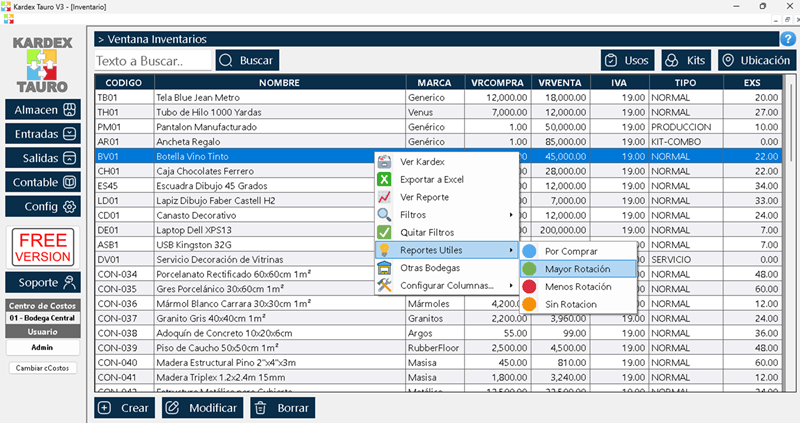
From the Neolithic pit to the automated warehouse, the history of storage is the history of a single ambition: that what is produced today is available tomorrow, in the right place and in the right condition. Today that promise is also kept on a screen: knowing what sits in every warehouse, what it is worth and where it is has become as decisive as the building itself. Inventory programs are the digital heirs of that long line of custodians, scribes and warehousemen: Kardex Tauro records receipts and issues and lets you know at any moment what remains in each warehouse, the same question asked by the Egyptian scribe, the Roman horrearius and the warehouseman of the port of Amsterdam. The infrastructure changed; the need to know what we keep remains the same.