What is a bill of exchange?
What is a bill of exchange?
The bill of exchange is one of the oldest commercial documents in existence and, at the same time, one of the most misunderstood outside the world of business. People tend to associate it with antique paperwork and slow procedures, but it is very much alive in today's commerce: financing a credit sale, securing a collection or obtaining liquidity from a bank are operations that still rely on it. Understanding what it is and how it works helps any company manage its receivables with greater confidence.
In simple terms, a bill of exchange is a written order of payment. Through it, one person, called the drawer, orders another person, called the drawee, to pay a sum of money to a beneficiary on a specified date. It is not money in itself but a negotiable instrument: a document that embodies a right to collect and that, in commercial practice, circulates as a means of payment and as a credit instrument.
What makes a bill of exchange special?
Like any negotiable instrument, the bill embodies a right in the document itself: the right to collect the amount written on it. That right is attached to the paper, so whoever holds it lawfully, the holder, can demand payment by presenting it. Three features define it:
- It is an order to pay. The drawer does not promise to pay: the bill instructs another party to do so.
- It is unconditional. Payment does not depend on conditions outside the document, and the amount must be fixed or easily determinable.
- It is negotiable. It can be transferred to another person by endorsement, which makes it an agile instrument for trade.
One point is worth stressing: the bill is not money. It is a deferred means of payment and, above all, a credit tool. The buyer gains time to pay for the goods, while the seller receives a document that can be collected, endorsed or discounted.
The parties involved
Several people may take part in a bill of exchange, each with a different role. Identifying them clearly avoids misunderstandings when it is time to collect:
| Party | Role in the bill |
|---|---|
| Drawer | Creates and signs the bill and orders the payment. Usually the seller or creditor in the underlying transaction. |
| Drawee | The person to whom the order of payment is addressed, normally the buyer or debtor. Until acceptance, the drawee is not bound by the bill. |
| Payee or holder | The person entitled to receive payment. It may be the drawer himself or a third party; if the bill has circulated, the holder is whoever lawfully possesses it at any given moment. |
| Aval guarantor | Someone who guarantees payment by signing the bill as backing for another party. The commitment is independent: if the principal debtor fails to pay, the guarantor answers. |
When the drawee accepts the bill, by signing it, the drawee becomes the acceptor and assumes the main obligation to pay it at maturity. From that moment, whoever holds the bill can claim payment directly from the acceptor.
Essential requirements of a bill of exchange
For a document to work as a bill of exchange it must meet certain formal requirements. Without them it loses its nature as a negotiable instrument or makes collection difficult. In general terms, a bill must contain:
- The express statement that it is a bill of exchange, to distinguish it from other documents.
- An unconditional order to pay a fixed or determinable amount of money.
- The name of the drawee, the person who must pay.
- The maturity date or the way to determine it.
- The place where payment must be made.
- The name of the payee, the person to whom payment must be made.
- The date and place of issue.
- The drawer's signature, without which the document has no effect.
Each country details these requirements in its own way, but the logic is the same: it must be clear who orders, who pays, who is paid, how much, when and where. The more complete and clear the information, the less room there is for disputes at collection time.
The life cycle of a bill: from issue to collection
The life of a bill of exchange usually follows a typical path, although not every bill goes through every stage:
- Issue. The drawer creates the bill and delivers it to the payee.
- Acceptance. The bill is presented to the drawee so the order can be accepted. With the drawee's signature, the drawee becomes obliged to pay it.
- Endorsement. If the payee wants to transfer the right to collect, the bill is endorsed and delivered to another person, who becomes the new holder.
- Collection or discount. At maturity, the holder presents the bill and collects. If cash is needed earlier, the bill can be discounted at a bank, which advances the funds for a fee.
What happens if the bill is not paid? Protest
When a bill is not paid at maturity, the holder can record the default through protest: a formal act, usually carried out before a notary, certifying that the bill was presented for payment and was not paid, or that it was not accepted. Protest has a very practical purpose: preserving the holder's right to claim against the other parties liable on the bill, such as the drawer, endorsers or guarantors. The deadlines and formalities depend on the country, so it is wise to act quickly and seek advice before any term expires.
Bill of exchange, promissory note, check and invoice: key differences
The bill of exchange coexists with other documents that serve similar purposes, and confusing them is common. These are the fundamental differences:
- Promissory note. It is a promise to pay: the person who signs it undertakes to pay directly. In a bill, by contrast, one person orders and another pays; in a promissory note, the issuer and the payer are the same person.
- Check. It is an order of payment payable on demand, drawn against the funds the holder keeps in a bank account. A bill, on the other hand, usually has a future maturity and does not require any deposit to exist in a bank beforehand.
- Invoice. It evidences a sale: who sold, what was sold and for how much. As a general rule it is not, by itself, a negotiable instrument like a bill of exchange; its role is to prove the transaction, although some countries offer mechanisms to assign it or give it collection force.
Practical uses of the bill in commerce
Far from being a relic, the bill of exchange remains useful in transactions where credit and trust between businesses come together:
- Financing credit purchases: the buyer receives the goods today and pays when the bill matures.
- Securing collections: with the drawee's acceptance and, if desired, with the backing of an aval guarantor, the seller holds a firm document that supports the right to collect.
- Obtaining liquidity: instead of waiting until maturity, the holder can discount the bill at a bank and access the funds earlier.
- Paying suppliers: whoever received a bill can endorse it to a third party to settle, in turn, one of the holder's own obligations.
Comparison table of payment documents
| Document | What it is | Who is obliged to pay | Typical use |
|---|---|---|---|
| Bill of exchange | Written order of payment | The drawee who accepts it, together with endorsers and guarantors | Credit purchases, financing and bank discounting |
| Promissory note | Written promise to pay | The person who signs it | Loans and personal or business credit |
| Check | Order of payment payable on demand | The bank, against the account holder's funds | Immediate payments backed by a bank account |
| Invoice | Document evidencing a sale | The seller answers for the transaction; an invoice does not order a payment by itself | Proving sales and supporting commercial and tax obligations |
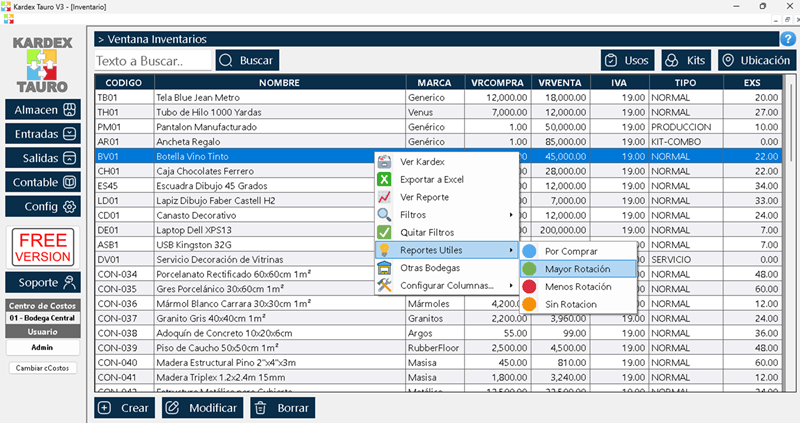
The bill of exchange was born centuries ago, but the logic behind it, ordering a payment, guaranteeing it and making it collectable, is still the heart of trade credit. Knowing its parties, requirements and life cycle allows any business to decide wisely which documents to accept and how to manage its collections. Meanwhile, keeping the daily operation in order, selling, delivering goods and controlling inventory, is easier with specialized software such as Kardex Tauro.
Final note: the exact rules on bills of exchange, including formal requirements, deadlines and the effects of protest, vary from country to country. Before issuing, accepting or protesting a bill, check your local regulations or consult a trusted adviser.