What is warehouse management?

What is warehouse management?
Warehouse management is the set of decisions and routines that organize the life of the storeroom: receiving the goods that arrive, assigning them a place, protecting them while they wait, pulling them out when they are needed, and checking again and again that what sits on the shelves matches what is recorded. In a small or medium business, the warehouse is usually the least visible part of the operation and yet most costly mistakes are born there: an order that goes out incomplete, a product damaged because it was stored in the wrong place, a duplicate purchase because nobody knew how much stock was left. Managing the warehouse is, at its core, removing those mistakes through method.
Warehouse management does not mean only keeping boxes neatly stacked. The term covers the full cycle of goods inside a warehouse, store or cost center: receiving against the supplier document, inspecting quantities and condition, deciding where to place every item according to its turnover and its characteristics, protecting the conditions that prevent damage and expiry, preparing and dispatching orders, handling returns, and periodically verifying stock. Each of these stages has people, procedures and documents behind it. When one of them fails, the failure shows up in sales, in purchasing or in the financial statements, even if nobody has walked into the storeroom for weeks.
For small and medium businesses, warehouse management is also the difference between a company that can promise delivery dates and one that improvises. A well-run warehouse lets you serve customers with what really exists, buy only what is missing, and know quickly how much your stored goods are worth. That is why it is worth understanding what warehouse management is, which functions make it up and how it is measured, which is exactly what this article covers.
Warehouse management and inventory control: two complementary views
A common confusion is treating warehouse management and inventory control as synonyms. They are close but different disciplines, and telling them apart helps you identify which one is failing when a problem appears. Inventory control works with records and values: how many units the system says exist, how much the stock is worth, which movements changed it and how to reconcile those figures with the accounting reality. It operates on documents, stock cards and valuations.
Warehouse management, by contrast, deals with the physical operation of the space: where each box is, how goods come in, how they are preserved, how they are prepared to leave and how much is lost through handling. Its focus is the real journey of products inside the warehouse, not the figures in the general ledger. That is why a warehouse can look perfect on the records and be a physical chaos, or be perfectly tidy and still show differences because movements were never documented. Warehouse management attacks the first problem; inventory control attacks the second. Both are needed: management keeps the warehouse operating well and control verifies that the operation is faithfully reflected in the system.
What each warehouse function solves
A practical way to understand warehouse management is to look at it function by function. Every activity in the warehouse exists to solve a specific problem, and when it is skipped the problem comes back. The following table summarizes that logic.
| Warehouse function | Problem it solves | Typical error when missing |
|---|---|---|
| Receiving and checking | Verifying that what arrived is what was ordered, in the right quantity and condition | Receiving without counting or inspecting: you pay for shortages and damage that came with the shipment |
| Putaway and location | Giving every product a defined, known and labeled place | Placing goods wherever there is room: later nobody finds them and you buy more |
| Storage and custody | Keeping goods in good condition while they wait to leave | Stacking without criteria and mixing dates: expiries, crushed boxes and damage |
| Picking and dispatch | Preparing exactly what will be delivered, complete and on time | Dispatching from memory: incomplete or wrong orders that drive customers away |
| Counting and verification | Detecting early differences between physical stock and records | Discovering the difference only at the annual inventory, when it has become a big surprise |
| Returns handling | Registering goods that come back and deciding their destination | Sending returns straight back to the shelf unchecked: good stock gets mixed with damaged stock |
The table shows a common pattern: most serious warehouse problems are not caused by bad intentions but by the absence of a function that somebody should perform systematically. Defining the functions is the first step toward a warehouse that manages itself, without depending on the memory of the person who has worked there the longest.
A walk through the key functions of the operation
Each function deserves a closer look, because the details are where warehouse control is won or lost in daily work.
- Receiving. The operation starts when goods arrive at the door. Receiving well means checking against the purchase order or the delivery note, counting units, inspecting packaging, noting exceptions and signing only for what actually arrived. Rigorous receiving avoids paying twice for the same goods and gives reliable records their starting point.
- Putaway. Every product should have a fixed, known location. That requires defining the warehouse layout, numbering locations and recording where each lot was placed. The right location reduces search time and prevents duplicate purchases caused by not finding goods that already exist.
- Storage and custody. Stored goods must keep their value: respect stacking weights and heights, control temperature when needed, apply expiry criteria and separate damaged items from sellable ones. Custody is not guarding; it is keeping the conditions that prevent losses.
- Picking and dispatch. Prepare orders with method: read the full order, take each line from its location, confirm quantity and packaging, and hand the goods to the carrier with a signed document. Dispatch is the moment where the customer perceives the quality of your warehouse, for better or worse.
- Counting. Verify stock periodically and compare it with records. When counts are done continuously over small groups of items, differences become small corrections instead of annual surprises.
- Returns. Goods that come back from a customer or remain from an operation must follow a process: condition check, destination decision and movement record. Without that process, the warehouse accumulates products that nobody knows are fit for sale.
Concepts that organize the work: layout, locations, ABC rotation and handling losses
To put these functions into practice, warehouse management relies on a few concepts that appear in any warehouse diagnosis and are worth mastering.
Layout is the physical design of the warehouse: how the receiving, storage and dispatch zones are distributed, how people and goods circulate, and how clear the aisles are. A good layout separates activities that interfere with each other, shortens the travel of the most demanded products and leaves safe room to maneuver. Redesigning the layout is often the cheapest improvement with the largest impact for a small business: many times the problem is not lack of space but poorly used space.
Locations and racks are the mailing address of the goods. Instead of saying that a product is at the back, the warehouse assigns a composite reference, for example aisle, rack, level and position. Each location is marked with a label and each product has its main location; if there are several, all are recorded. With that system, any person can find any item without asking, and search time drops from minutes to seconds.
ABC rotation classifies products by how often they leave. Class A items are the ones dispatched most often, so they are placed near the preparation zone; class C items, with slow turnover, go to the higher or farther zones. This ordering reduces daily travel: if a small share of the references concentrates most dispatches, that share should be at hand.
Handling losses are the losses generated while moving goods: bumps, falls, torn packaging, spills and counting errors. Every time a product is touched, moved or relocated there is a small risk of damage or loss. Warehouse management seeks to minimize those movements with clear procedures and with documents that back every transfer, so that loss is not a mystery but a figure you can measure and reduce.
Measuring the warehouse: an example with numeric indicators
Warehouse management can also be measured. Indicators turn the operation into figures that can be compared month after month, and they are the best defense against intuition. The following example shows a small warehouse with 1,200 active references that dispatches 48 orders per day on average.
| Indicator | What it measures | Example with figures | How to read it |
|---|---|---|---|
| Orders dispatched per day | The output capacity of the warehouse | 48 daily orders on average, up from 40 last month | Operations are growing without chaos if the other indicators hold |
| Counting accuracy | How well physical stock matches records | 97 out of every 100 lines matched in this week's cycle count | The remaining 3 percent is investigated before it becomes a shortage |
| Putaway time | Minutes between receiving and reaching the storage location | 22 minutes average per receiving, down from 35 when the layout redesign began | A shorter route frees hours of work every week |
| Loss rate for the period | Value lost through damage and errors against the value moved | 1.2 percent of the value dispatched in the quarter | If it rises two months in a row, review handling and packaging |
| Complete orders delivered | The final quality of dispatch | 46 of the 48 daily orders left complete and on time | Every incomplete order is a customer at risk that does not show up in sales |
No indicator works alone: the value lies in the trend and in comparing indicators with each other. A warehouse that dispatches more orders but lowers its counting accuracy is not improving; it is running faster toward the same problem. That is why measurements are reviewed together, ideally every week and with the same person responsible for the operation.
Warehouse management best practices for small businesses
Professional warehouse management does not require large investments. Small and medium businesses get most of the benefit from simple, consistent practices like these.
- Daily order and cleanliness. A place for everything and everything in its place, with clear aisles and floors free of loose boxes. Order is not decoration: it is safety and search speed.
- Systematic labeling. Your own code for every product, a visible label on every location and aisle signs. If labeling is up to date, any new person can run the warehouse without depending on whoever knows it from memory.
- One responsible person per shift. In small warehouses, receiving, putting away, dispatching and counting should have a clear owner per shift. That does not prevent others from helping, but it ensures that every decision has an accountable person and that documents are filled consistently.
- Cycle counts. Instead of one general inventory per year, count a small group of references every week, prioritizing the fastest-moving and most valuable ones. Differences are then corrected in small doses and the annual inventory stops being a crisis.
- Always receive against a document. Never accept goods without comparing them with the order or delivery note, and nobody signs an entry without verifying quantities. That discipline avoids the most expensive arguments with suppliers.
- Short written procedures. One page per process with clear steps is enough to standardize operations and to train new staff without improvisation.
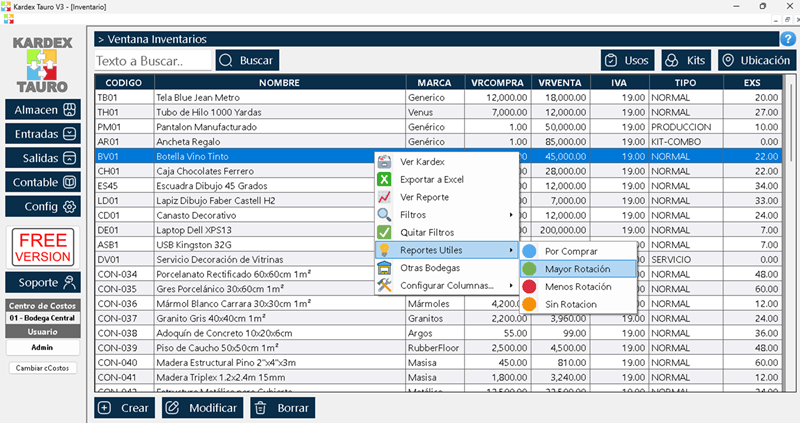
In practice, warehouse management relies on two kinds of tools: those that organize the physical space, such as layout and labeling, and the programs that record movements so the operation stays documented. A system like Kardex Tauro lets you control stock and locations and record the documents typical of a warehouse, such as internal transfers between stores, warehouse consumptions and losses and decreases; that way, every physical movement is backed by a record that can later be reconciled with counts.
A well-managed warehouse is not a luxury of large companies: it is a decision about method that any small business can take this very week, starting with tidying up, labeling and assigning responsibilities. When the physical operation is under control, the rest of the business, purchasing, sales and accounting, works with data you can trust. And when the operation grows, having a program that records stock, locations and warehouse documents helps the order of today hold up tomorrow as well.