What is stock (inventory)?

What is stock (inventory)?
Stock, also called inventory or merchandise on hand, is the quantity of goods a business has available at a given moment to sell to its customers or to use in its own operations. In plain words: it is everything stored in the warehouse, the stockroom or the shop shelves, waiting for its next movement out. When a customer buys, stock goes down; when an order arrives from a supplier or new goods are produced, stock goes up. That idea sounds trivial, but a large part of a small business's financial results depends on knowing at all times how much stock it has, where it is and what it is worth.
It helps to tell stock apart from other similar words used in trade. The catalog, for example, is the complete list of products the business handles or has handled; stock, on the other hand, is the real quantity available of each of those products. A business can have a catalog of a thousand references and still hold stock of only three hundred. Stock is also not the same as purchasing: you buy to replenish stock, but several days can pass between placing the order and receiving the goods, and during that time available stock keeps falling because of sales. Understanding these differences avoids very common confusion in daily operations.
Stock is measured in units and also in value
The most natural way to measure stock is in units: how many boxes, bottles, meters, kilos or pieces there are of each product. But units do not tell the whole story, because not all products are worth the same. That is why stock is also measured in value, that is, multiplying the units of each product by the cost of acquiring or producing it. Think of a business that has 40 units of a product whose unit cost is 10,000 monetary units: that line represents 400,000 monetary units of stock in value, even though in units it is just one more row on the list.
Measuring stock in value is what makes it possible to answer questions such as how much company money is sitting in the warehouse, which products concentrate most of that money, or whether it is worth clearing slow-moving goods to free up capital. A business that only looks at units may feel very well stocked while most of its money is trapped in products that barely sell. Combining both views, units and value, is what gives a complete picture of the inventory.
Why it pays to know your stock every day
Knowing stock is not an office luxury: it is information used daily at the counter and in the warehouse. With a reliable figure you can promise a customer that their order will leave today, you can calmly decide whether to buy again from a supplier, or you can notice in time that a product is being left behind on the shelves. The lack of that information produces the two classic problems of commerce: running out of goods when there is demand and piling up goods that nobody asks for. Both are avoided, to a large extent, by knowing the stock and tracking it every day, not only when the time comes to do a full count.
Types of stock worth telling apart
Not all stock plays the same role inside the business. Although at first glance every box in the warehouse looks alike, it is worth classifying them to understand why they are there, what risk each type carries and how much attention it needs. The following table summarizes the most common types of stock in a small business.
| Type of stock | What it is | Why you keep it |
|---|---|---|
| Available | The goods ready to be sold or used right away | To fill orders and sales without delays |
| In transit | Goods already purchased that are traveling from the supplier | Because you order before delivery; it is already yours even if it is not in the warehouse yet |
| Safety stock | An extra reserve that covers unexpected demand or supplier delays | So you do not run out of product when something goes differently than planned |
| Consignment | Goods owned by a third party that sit in your store and are paid for only when sold | To offer more variety without paying cash in advance |
| Obsolete or slow-moving | Products that have not sold for a long time or no longer sell at all | Because they were left behind; it is worth clearing or returning them to free space and capital |
| Work in process | Goods being manufactured or transformed that are not finished yet | Only if you produce: raw material or semi-finished goods that cannot be sold yet |
The boundary between one type and another is not a theoretical whim: each type demands a different decision. Available stock is protected and measured every day; goods in transit require following up on the order until they arrive; safety stock is touched only in emergencies; consigned goods need a clear agreement with the third party; and obsolete stock calls for a decision to liquidate or discard. Classifying stock is the first step toward managing it with criteria instead of treating it all as one uniform mountain of boxes.
Maximum stock, minimum stock and reorder point
Once you understand what stock is, the natural question is how much you should keep. The answer of basic inventory management is not a single number but a range between a minimum stock and a maximum stock, with a reorder point that warns you when it is time to buy again. Minimum stock is the lowest quantity with which the business still feels safe to operate; below it, any surprise leaves the business out of stock. Maximum stock is the ceiling you should not exceed, because the surplus ties up money and takes up space for no reason. The normal level of inventory moves between the two.
The reorder point is the stock level that triggers the purchase from the supplier: when available stock reaches that number, you place the order immediately, even though there are still units left to sell. Let us put numbers to the idea with a simple example: a store sells on average 60 packages of a product per month, that is, about 2 units a day. The owner defined a minimum stock of 30 units, which equals about 15 days of sales, and a maximum stock of 120 units, which equals two months. The supplier takes 7 days to deliver. In that scenario the reorder point sits at 45 units, as summarized in the table.
| Concept | Example value | How to read it |
|---|---|---|
| Monthly demand for the product | 60 units | What is sold, on average, each month |
| Estimated daily sales | 2 units | Monthly demand divided by 30 days |
| Minimum stock | 30 units | About 15 days of sales; below this the business is exposed |
| Maximum stock | 120 units | Two months of sales; above this, do not buy more |
| Supplier lead time | 7 days | Days between placing the order and receiving the goods |
| Reorder point | 45 units | The level that triggers the purchase: at 45 you order from the supplier |
Why is the reorder point 45 and not the minimum of 30? Because during the 7 days the supplier takes, about 14 more units are sold (2 a day for 7 days). If you ordered when reaching 30, the goods would arrive with stock already at zero or even sold out. By ordering at 45, the business consumes those 14 units while waiting and receives the order just as stock hovers around the 30 minimum, without interrupting sales. To know how much to order you use the maximum: if there are 45 units when ordering and the ceiling is 120, the suggested purchase is 75 units, which bring stock back up to the maximum level without overshooting.
These three numbers are adjusted with experience: if the supplier starts taking longer, the reorder point goes up; if a product sells more than expected, the minimum and the maximum go up too. What matters is that the business defines the rule before it needs it, and that it reviews stock often enough to notice in time that it has crossed the reorder point. Buying in a hurry, when nothing is left, almost always costs more than buying by rule, when there is still room to negotiate.
Holding stock costs money, and so does not holding it
Stock is usually seen as an asset, and it is. But remember that it is also sleeping money, and keeping it has a real cost that often goes unnoticed because it does not arrive as a separate invoice. Good stock management does not seek to hold the maximum possible, but the minimum necessary to sell without stumbling.
What holding stock costs
Every box that stays in the warehouse represents money that was paid and has not come back yet. These are the most common costs of holding stock:
- Tied-up money: the cash used to buy the goods is not available to pay suppliers, wages or other debts while the product remains unsold.
- Space: the warehouse, the shelf or the store costs money, and a product that does not rotate takes a spot that better-selling goods could use.
- Risk of expiry and obsolescence: food goes past its date, fashion changes season, technology becomes outdated; time in the warehouse can turn a good product into a loss.
- Shrinkage, damage and losses: products get bumped, dampened, expired or misplaced the longer they stay stored.
- Costs of looking after it: security, insurance, handling and store maintenance are also spread over the boxes kept in stock.
That is why surplus stock is not savings or a harmless reserve: it is capital standing still that also deteriorates over time. Accumulating "just in case" beyond the maximum usually ends in discounted clearances or direct losses.
What not holding stock costs
If holding too much stock is expensive, the solution is not, then, to go to the opposite extreme and run with zero inventory, buying only what was already sold. That model, sometimes called zero stock or make to order, works for certain custom-made products, but for most businesses it has costs that are just as real:
- Lost sales: the customer who finds an empty shelf today does not wait for the goods to arrive; they leave and buy somewhere else.
- Customers who leave for good: two or three visits without finding the product are enough for the buyer to switch regular suppliers.
- More expensive emergency purchases: restocking in a rush, with express freight or alternative suppliers, is usually paid with higher prices.
- Damage to your image: a business that promises and fails to deliver because of lack of goods loses trust, and trust is hard to recover.
The practical conclusion is that neither permanent maximum stock nor zero stock is the goal. The goal is to stay within the range between the minimum and the maximum, buying by rule at the reorder point. That balance is precisely what is known as managing stock instead of merely having it.
Physical stock versus accounting stock
In practice, two versions of stock coexist and it is important not to confuse them. Physical stock is what is really in the warehouse and on the shelves: the boxes you can touch and count. Accounting stock, also called book stock or theoretical stock, is what the records or the inventory program say, that is, the sum of all entries minus all exits that have been registered. Ideally both match, but in the real world they tend to drift apart a little.
Differences between physical and accounting stock almost never appear from a single cause. The most frequent reasons are these:
- Errors when registering entries and exits, such as selling one product and recording another.
- Damaged, expired or misplaced goods that were never written off the records.
- Theft or internal losses that are not detected in time.
- Customer returns that go back into the warehouse without being registered.
- Purchase receipts counted badly, with fewer units than the invoice says.
The bridge between the two versions is the physical count: periodically counting the real goods and comparing them with the records. When the count finds a difference, the accounting stock is adjusted so it reflects reality again, and the cause is investigated so it does not repeat. Small businesses can count everything at once once or twice a year, and those that handle many products usually count in cycles, one group of references each month.
It is worth stressing that counting is not a punishment or a formality: it is the only moment when the business verifies that its information and its reality agree. An accounting stock that is never compared with the physical one can be very wrong without anyone noticing, and then every decision made on that number, buying, promising, planning, is made on a false basis. The difference that appears during the count is known in trade language as inventory discrepancy, and the smaller it is, the better managed the business is.
The language of stock in the business
In daily life, stock is named with set phrases that the whole team understands, even when they do not always have a formal definition. Recognizing them helps make conversations about inventory more precise:
- "We are out of stock": the product is sold out and there are no units available to sell until a replenishment arrives.
- "Dead stock": goods that have not sold for a very long time and probably will not sell at the normal price anymore; they take up space and money with no return.
- "We have overstock": more was bought or produced than demand justifies, and the level went above the desired maximum.
- "Stockout": the moment a product reaches zero while there is still demand, almost always because the reorder point was not respected in time.
- "Stock turnover" or "inventory turnover": the speed at which goods are sold and replenished; a fast-turning product frees space and returns money quickly.
- "Restocking" or "replenishing": filling the shelves and the warehouse back up to the levels defined as normal.
These expressions are not informal by carelessness: they are the way the business talks about its inventory levels, and translating them into numbers is precisely the task of inventory control. When someone says there is dead stock, behind it there is a list of products with low turnover; when someone says we are out of stock, behind it there is a reorder point that was not respected.
Conclusion: stock is managed with information
Stock is, in short, the goods available to sell or use, measured in units and in value, protected by rules such as the minimum, the maximum and the reorder point, and watched over by the count that keeps paper and reality aligned. Holding it costs money, but so does not holding it, so the goal is not the extreme but the balance inside a range designed for each product.
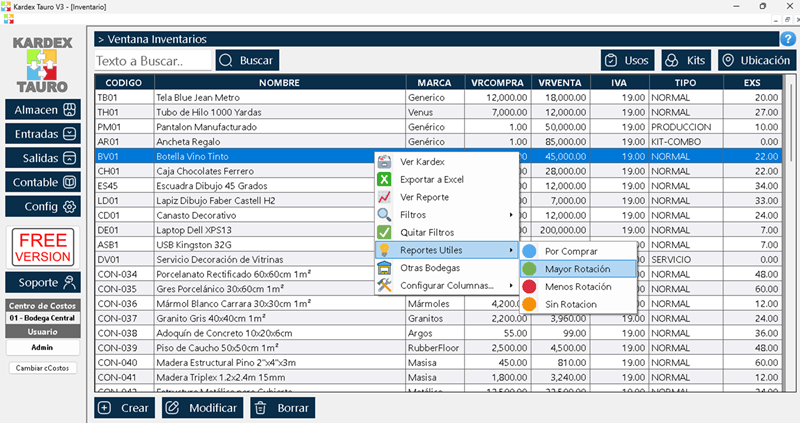
That balance is impossible to sustain from memory when the business handles hundreds of references. This is where technology comes in: an inventory program such as Kardex Tauro tells you at any moment how many units you have of each product, how much that stock is worth and which lines are sitting still, with the information organized so you can decide based on data instead of hunches. With Kardex Tauro, stock stops being a vague worry and becomes an exact number that the business can consult, review and correct whenever it needs to.