What is an inventory program?
What is an inventory program?
If you run a business that sells products, sooner or later you will ask yourself three questions: how many units of a given item do I have left, what did the latest purchases cost me, and how much is everything in my stockroom worth today? While the business is small, you answer from memory, by counting shelves or by checking invoices one by one. But when products, customers and orders grow, the answers arrive late, arrive incomplete or do not arrive at all. An inventory program exists precisely to answer those three questions every single day, with organized data and without depending on anyone's memory.
In this article we will look at what an inventory program is, how it changes the way you work compared with a notebook and a spreadsheet, what modules it usually includes, what types exist and when it makes sense to adopt one. We will also talk about what a program cannot do for you, because knowing that prevents false expectations. By the end you will have a clear guide to decide whether your business is already at the point of needing one.
A simple definition
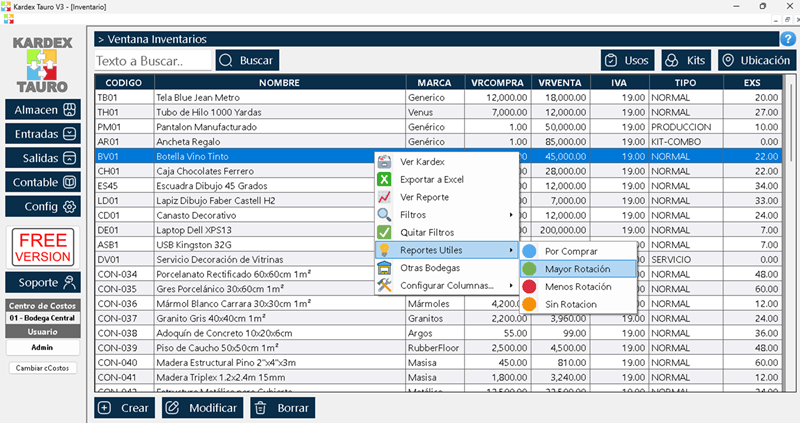
An inventory program — also called inventory software or a stock control system — is a tool in which you record the products your business handles and every movement that affects them: the inflows, such as purchases from suppliers, customer returns or adjustments for surplus, and the outflows, such as sales, internal consumption, shrinkage or transfers between warehouses. Based on those records, the program calculates on its own how many units of each product should be on hand and how much that inventory is worth, with no manual math and with up-to-date information.
The key is a simple idea: every time a document happens — a purchase, a sale or a return — the program adds or subtracts automatically and leaves a record with the date, the quantity, the value and the document that caused it. That log of movements per product is known as a stock card (stock ledger) and it is the heart of any serious inventory control. With the stock card up to date, you can say at any moment how many units of each item you have, how many came in, how many went out and on which date.
Besides quantities, the program stores the basic information of each product in a catalog record: code, name, unit of measure, cost, sale price, usual supplier, location inside the warehouse and a minimum stock level. That record is created only once and is then reused in every document, which speeds up daily work and reduces typing errors.
- Register each product once and reuse its data in purchases, sales and counts.
- Record inflows and outflows backed by the document that caused them.
- Know the available stock of any item in seconds.
- Know how much the inventory is worth according to the cost of the products.
- Review the complete movement history of each product.
- Detect items approaching their minimum before you run out of them.
From the notebook and the spreadsheet to the program
For decades, inventory was kept in a notebook or on cardboard stock cards filed away in a box. Every sale was written down by hand, every purchase was added separately and the balance was calculated with a pencil and a calculator. That method works, but it costs dearly in time and errors: one forgotten, repeated or misread entry is enough for the balance to stop telling the truth, and nobody finds out until the next count.
Then came the spreadsheet, a big improvement, because additions and subtractions were done automatically with formulas. However, the spreadsheet also has well-known limits. A sheet shared between several computers ends up multiplied into different copies; one badly dragged formula contaminates a whole column; a file is erased or overwritten without notice; and there is no reliable record of who made each change or which document backed it up.
What changes with an inventory program is the way information is updated. When you register a purchase, the stock card updates itself: the stock goes up, the value is recalculated and the movement is saved with its date and document number. When you register a sale, the same happens in the opposite direction. You no longer need to retype the balance, recalculate totals or reconcile one sheet against another: the system does that work for you and keeps the traceability of every movement.
What modules an inventory program usually has
Most inventory programs are organized into modules — sections of the system with a clear function. Knowing them helps you understand what to expect from the tool and to check that no important piece is missing. These are the typical modules and their purpose:
| Module | What it is for | Example |
|---|---|---|
| Product catalog | Stores the record of each item: code, name, unit, costs and prices. | Creating a new product in minutes and using it later in any document. |
| Purchasing and receiving | Records orders to suppliers and the arrivals of merchandise at the warehouse. | Receiving a purchase of fifty boxes and watching the stock go up automatically. |
| Sales and invoicing | Records the outflows caused by sales and, when applicable, issues the invoice. | Invoicing an order and deducting the merchandise from the warehouse in the same step. |
| Stock card and movements | Shows the history of inflows and outflows of each product with its running balance. | Checking on which date and with which document the last units of an item went out. |
| Counts and adjustments | Supports the periodic physical inventory and corrects the differences found. | Counting one area of the warehouse and registering the adjustment when the count does not match the system. |
| Reports | Summarizes stock, inventory value, movements and product turnover. | Seeing on one screen how much the whole inventory is worth and which items concentrate the most money. |
| Users and permissions | Defines who can view the information and who can register each type of document. | Giving the salesperson view-only access and the warehouse manager the right to register inflows and outflows. |
Types of inventory programs
Not all programs are the same, and the first major difference is where the information lives. A local program, also called desktop software, is installed on one computer of the company: the data stays on that machine, it works without an internet connection and it is usually paid once, but it is tied to a single device and a physical place. A cloud program is used from the browser: it can be accessed from several computers, tablets or phones and the information is backed up on remote servers, normally in exchange for a monthly subscription and with the need for a stable connection.
The second important difference is the scope of the program. A generic one works for any kind of business: it stores products, records inflows and outflows and reports stock. A sector-specific one adds concepts of a particular industry, such as expiration dates and batches in food or pharmacy, sizes and colors in clothing, or serial numbers in appliances and equipment. The practical advice is not to overcomplicate things: if your business does not need those concepts yet, a simple program used well pays off more than a sophisticated one used halfway.
It is also worth placing the level of complexity. At the simple end are spreadsheets; at the complex end, integrated management systems that also handle accounting, payroll and other processes. A standalone inventory program sits in the middle: it focuses on stock control, is faster to implement and costs less, and it is the natural choice for most small and medium businesses.
Signs that your business already needs a program
The most frequent question is: when do I leave the notebook or the spreadsheet behind? There is no rule based on the number of products or the amount of sales, but there are very concrete symptoms showing that the current way of keeping inventory is already costing money. If you recognize several of the following, it is probably time to make the move:
| Sign | Risk if nothing changes |
|---|---|
| Several people view and update the same inventory, each with their own copy of the spreadsheet. | Two versions of the truth exist and a purchase is made based on outdated data. |
| The business has more than one warehouse, store or point of sale. | The merchandise is in one place and the paper says it is in another, with losses that only appear at the big count. |
| You sell on credit, set merchandise aside or handle pending orders. | The available stock does not reflect the commitments already made to customers. |
| Every physical count ends with differences nobody can explain. | You cannot tell whether the problem is theft, shrinkage, registration errors or a mix of everything. |
| An accountant, a partner or an institution asks for an inventory report and it has to be put together by hand. | Rebuilding the history takes days and still ends up with gaps and doubts. |
| The money invested in merchandise represents a large part of the capital of the business. | You do not know how much capital is sitting on the shelves or which products should be rotated or cleared. |
What a program does not solve
It is worth saying this clearly to avoid false expectations: an inventory program records, organizes and calculates, but it does not count the merchandise for you and it does not replace the discipline of the process. If nobody carries out a periodic physical count, the system may be perfectly fed and still not reflect what is really on the shelves. The count is done by a person, and the differences found must be adjusted honestly so that the stock card matches reality again.
Neither does it fix messy processes. If a purchase arrives and is not registered, if a sale goes out without a document or if a transfer between warehouses is done without notice, the stock card will drift away from reality no matter how good the software is. The program is a mirror: it shows exactly what was recorded in it. That is why, alongside the tool, you need a clear person in charge and minimum routines: register every inflow and outflow on the same day, schedule periodic counts by area and review the difference reports calmly.
An inventory program for your small business
If you recognized yourself in several of the signs above and you are looking for an inventory program for a small business, Kardex Tauro is an option designed precisely for that case: inventory software created for small businesses that want to leave the notebook and the spreadsheet behind, built around the stock card as the basis of stock control, without the complexity or the cost of large corporate systems.
The important thing is to take the first step in an orderly way: choose the tool, load the products with their real information, register movements from the first day and carry out an initial count so that you start from a true figure. The program takes care of the rest: keeping the accounts up to date and letting you know, every morning, how much you have, how much it is worth and what you should order.