How to control product batches (lots)

How to control product batches (lots)
Any business that manages inventory — a grocery distributor, a food warehouse, a convenience store or a beverage depot — finds that batch control separates tidy operations from those that lose money without knowing why. A batch that is properly identified and recorded lets you answer questions that once seemed impossible: when did this merchandise arrive, which supplier sent it, which units are close to expiring, which customers received this batch, and how much is still on the shelf? This article explains, with practical methodology, what a batch is, why controlling it matters, how to identify batches, how to record them when receiving and dispatching goods, and which common mistakes destroy traceability.
What is a product batch
A batch is a group of units of the same product that were manufactured, packed or received together, under the same conditions and at the same moment. For that reason, all the units of one batch share a code or a date that identifies them and sets them apart from other units of the same product that arrived on a different date or from a different supplier.
A simple example makes it clear: a store has two hundred bags of corn flour. One hundred and twenty arrived on Monday and eighty arrived on Friday, in two different deliveries from the same supplier. Even though the product is identical, they are two different batches. If the Monday bags have a sealing defect, only the one hundred and twenty units from that delivery are affected; if the batches are not distinguished, the business will not know which bags to pull or which customers to notify.
The basic characteristics of a batch are:
- It groups units with a common origin: the same production run, the same receipt or the same supplier.
- It is identified by a batch code, by a date, or by the combination of both.
- It can have its own expiration date, different from the dates of other batches of the same product.
- It allows following the complete journey of the merchandise: when it entered, where it was stored, how long it stayed in the warehouse and where it went.
- It is linked to a quantity that changes with every movement: it enters complete, leaves in parts, and at the end a remaining amount that must be countable is left.
Why batch control matters
Batch control is not an administrative formality: it is a direct protection for money, for customer health and for the reputation of the business. These are the concrete reasons:
- Expirations: most food and beverage products have a consumption deadline. If nobody knows which batch is older, the staff dispatches at random and the oldest product stays at the back until it expires and becomes shrinkage.
- Traceability for complaints and returns: if a customer reports a spoiled product, the batch code shows whether the problem affects one specific delivery or an entire group of units, so you can act with precision instead of checking the whole warehouse blindly.
- Recalls: when a supplier or a health authority asks to withdraw a defective batch, you can only respond quickly if the business knows how many units it received, where they are and to whom they were sold.
- Orderly rotation: with identified batches you can apply the rule of dispatching first what expires first, which reduces losses and keeps merchandise fresh.
- Quality control: if one batch shows repeated problems, the historical record reveals which supplier or which date was involved, and it serves as evidence to negotiate returns or to change suppliers.
- Reliable counts: when you count inventory by batch, differences are detected quickly, because each group of units has its own expected quantity.
How to identify batches
A batch is identified by an internal code, by a date, or by both. The code is usually alphanumeric and can encode useful information: the year, the month or even the production shift. The recommended practice is to combine a readable batch code with the expiration date, so that anyone in the warehouse can sort the merchandise without relying on memory. The manufacturer code, when it exists, is kept as a reference; the internal code of the business, on the other hand, is assigned according to its own convention, for example using the receipt date.
Each unit or each container should carry a label that at least shows:
- The batch code (for example, L2401 or 24A-118).
- The date of receipt or the date of entry to the warehouse.
- The expiration date, when the product has one.
- The product name and, when applicable, the supplier of origin.
- The number of units or the weight of the container.
Labels must be placed in a visible spot and must withstand warehouse conditions such as humidity or constant handling. When the product already carries a printed batch code from the manufacturer, keep it and use it as a reference in the internal records, because it is the code the manufacturer will recognize in case of a recall. When there is no manufacturer code, the business assigns its own internal code and writes it on the label before storing the merchandise. The rule is simple: if a unit has no identifiable batch, it should not enter the shelf.
Traceability example for one batch
To understand what controlling a batch means in practice, it helps to follow a complete case. Imagine a distributor that receives batch L2401 of a fruit juice, with its corresponding expiration date. The traceability record for that batch would look like this:
| Date | Movement | Detail | Units |
|---|---|---|---|
| January 2 | Receipt | Entry of batch L2401, received from supplier Alimentos del Valle, with its expiration date recorded. | 1,200 |
| January 2 | Storage | Location assigned on rack B, separated from other batches of the same juice. | 1,200 |
| January 15 | Sale | Dispatch to La Esquina store, a regular customer. | 400 |
| January 28 | Sale | Dispatch to El Barrio minimarket. | 500 |
| February 10 | Count | Cycle count: physical units are verified against the record. | 300 |
| February 20 | Early withdrawal | Units close to expiring are withdrawn in advance according to the internal policy. | 60 |
| February 28 | Final inventory | 240 units of batch L2401 remain, with their expiration date still valid. | 240 |
With a table like this, the company answers in minutes questions that would take days in a business without batch control: batch L2401 arrived from supplier Alimentos del Valle on January 2, 900 units were sold to two customers, 60 were withdrawn because of the expiration policy, and 240 units are still available. If tomorrow the supplier announced a problem with that batch, the company would know exactly which customers to call and how many units to recover. That is the real value of traceability: accurate information at the moment it is needed.
How to record batches when receiving goods
Batch control starts at the receiving dock. If the batch is not recorded when the merchandise enters, it will be almost impossible to reconstruct it later. The recommended procedure is:
- Check the merchandise against the invoice or the purchase order and verify that quantities match.
- Identify the batch code carried by each group of units, whether printed by the manufacturer or assigned by the business.
- Write down the batch and the expiration date of each product in the entry record, together with the supplier and the receipt date.
- Label the containers that do not have clear identification before storing them.
- Store the merchandise keeping batches separate, so that the oldest batch is at the front or on top.
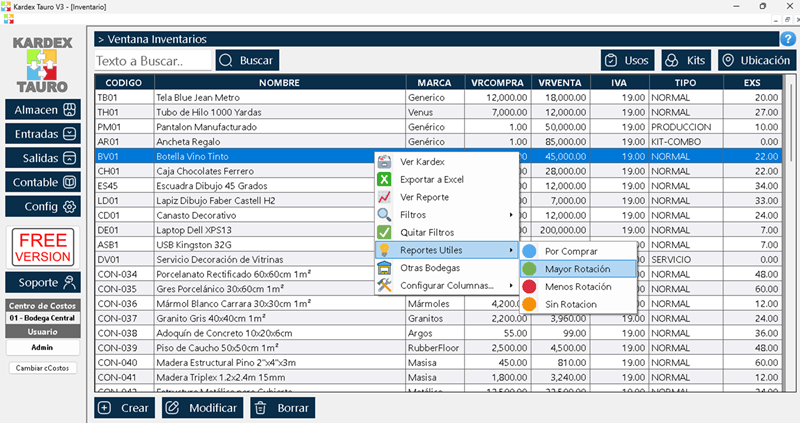
Recording the batch at the receiving stage does not mean creating unnecessary paperwork: the entry can take seconds per line when it is done on the spot, using a receiving sheet, a spreadsheet or the capture module of an inventory program. A system such as Kardex Tauro, for example, lets you capture the batch number of every unit at the exact moment the merchandise enters, automatically grouping the units that share the same batch for reports and traceability. What matters is consistency: record always, on every receipt and for every product, with no last-minute exceptions. If merchandise arrives in a hurry one day and is not recorded, that group of units falls outside the control and can no longer be traced.
How to choose the right batch when dispatching
Having identified batches is of little use if the staff grabs any unit without looking when dispatching. The golden rule is to dispatch first the batch whose expiration date is closest, a technique known as first expired, first out. When the product has no expiration date, the equivalent principle applies: what entered first leaves first, so the merchandise does not grow old on the shelf.
Practical rules for dispatching by batch:
- Read the label before taking the merchandise and confirm the batch code.
- Always dispatch the batch with the closest expiration date, even when it is at the back or at the bottom.
- Do not mix batches in the same dispatch container if the customer or the record prevents it; if they are mixed, write down the quantities of each batch.
- When the salesperson or the delivery driver takes merchandise, record which batch leaves in each sale or dispatch.
- At the end of the day, update the available quantity of each batch so the record reflects reality.
This discipline turns the shelf into an orderly flow: merchandise enters from the back and leaves from the front, and what expires earlier is never forgotten at the bottom.
Common mistakes in batch handling
Most batch problems do not come from a lack of tools, but from repeated operating mistakes. Recognizing them is the first step to correcting them. The following table summarizes the most frequent mistakes, their consequence and the recommended control:
| Common mistake | Consequence | Recommended control |
|---|---|---|
| Not marking expiration dates when receiving. | Staff does not know which batch expires first, dispatch is random, and expired merchandise piles up as shrinkage. | Record the expiration date in the register and on the label at the moment of receipt, product by product. |
| Not recording the batch when receiving the merchandise. | If the supplier reports a defect or a complaint arrives, it is impossible to know which units are involved or which customers received them. | Make batch recording a mandatory step of every receipt, with no exceptions. |
| Mixing different batches in the same container or pallet. | Traceability is lost: nobody knows which of the mixed batches is close to expiring or which one is compromised. | Separate batches physically and label every container before storing. |
| Relying on memory to know which batch is the oldest. | The criterion changes with every person or shift, and old batches are forgotten at the back of the warehouse. | Use visible labels and a written or digital record that any employee can consult. |
| Leaving expired product next to valid product. | Expired product is dispatched by mistake or damages the image of the sales area. | Immediately move expired or soon-to-expire product to a separate area, with its exit recorded. |
Rotation by batch: applying the first-expired rule
Rotation is the daily application of batch control. It consists of arranging the merchandise so that the batch that expires first is always within reach and leaves first. To put it into practice:
- When storing, place the new batch behind or below the previous batch, never in front.
- At every receipt, check whether stock of the same product already exists and compare the expiration dates.
- When dispatching, take from the batch with the closest date and record the exit.
- At every physical count, confirm that the order on the shelf follows the rule and fix whatever is inverted.
- Record movements by batch, not only by product, so you know how much of each group remains.
Rotation by expiration does not require a sophisticated system: it requires consistency. With clear labels, an up-to-date record and staff that understand the rule, even a small warehouse can keep merchandise fresh. When volume grows, counting by batch and batch stock reports turn the review into a matter of minutes instead of hours.
Expiration policy: withdrawing in advance
Waiting until a product expires to decide what to do with it is the most expensive way to manage inventory. A healthy policy withdraws the product in advance, before it reaches the deadline, to leave time for the right decision. Some practical recommendations:
- Define how many days in advance a product is removed from the sales area; for example, review everything that expires within the next thirty days.
- Set a review calendar by category: short-life products such as dairy or bread are checked every week; long-life products, every month.
- Keep a list of batches close to expiring, sorted by date, to know what must be dispatched or promoted first.
- Decide in advance the destination of product close to expiring: return to the supplier when the agreement allows it, promotion with a discount, controlled internal consumption, or a formal write-off as shrinkage.
- Record every early withdrawal with its batch and its quantity, so the physical count always matches the record.
Withdrawing in advance turns an urgent problem into a planned decision. The business loses less money, protects the trust of its customers and keeps the warehouse free of expired product.
Conclusion
Batch control is one of the inventory practices with the best return: it does not require a large investment, but it prevents losses from expiration, speeds up the response to complaints and recalls, and organizes the daily work of the warehouse. The methodology fits in a few lines: identify every batch when receiving, label it with its code and its expiration date, record it in every entry and exit, dispatch first what expires first, and withdraw in advance what is about to expire. Tools help sustain the discipline: an inventory program such as Kardex Tauro makes it easy to record and group batches from the receiving stage so traceability is one report away, and labels with paper records work just as well in small operations. What no tool can replace is the consistency of recording always, because a batch that is not recorded, in practice, does not exist.
