How to connect production and inventory
How to connect production and inventory
In a company that manufactures, the warehouse and the workshop do not work separately. The raw material that arrives from the supplier lives in inventory until production consumes it; the product that comes off the manufacturing line returns to inventory, this time as a finished product, until it is sold. The whole journey is a single circuit of stock, and inventory control can only be reliable if every stage is recorded: what is purchased, what is consumed to manufacture, and what is received already finished.
This article explains how production and inventory connect in a small business that manufactures: the natural cycle of stock, why so many businesses lose money with an unbalanced inventory, how the production order acts as a bridge between the two worlds, and which reports you should review so the cost of what you make is real.
The production cycle inside inventory
The inventory of a manufacturing company holds two large groups of stock. On one side are the raw materials and supplies purchased to manufacture. On the other side are the finished products that result from that manufacturing and are offered to customers. Between one group and the other there is a third element in motion: the production work that turns one into the other.
When you buy raw material, inventory increases. When that raw material is consumed to manufacture, the supply inventory decreases and the cost of the product in process is born. When the batch is finished, the manufactured product is received in the warehouse and the finished product inventory increases. Finally, when it is sold, inventory decreases again. Every one of those stages touches the stock, which is why production cannot be treated as an event separate from inventory.
- Purchase: raw material enters inventory.
- Consumption: raw material leaves the warehouse toward the production order.
- Reception: the finished product enters inventory.
- Sale: the product leaves inventory toward the customer.
If the company records the purchase but not the consumption, or records the sale but not the reception of what was manufactured, the inventory shows quantities that do not match what is actually in the warehouse. The mismatch is not a cosmetic problem: it is the gateway to silent losses.
Why the inventory gets out of balance in manufacturing SMEs
The most common mistake in productive small businesses is recording only half of the circuit. Some businesses subtract the raw material from inventory at the moment of purchase, as if it had already been consumed, and then forget to load the finished product when manufacturing concludes. The result is an inventory that loses value without anything being sold: the raw material appears as an output, but the manufactured product never appears as an input.
The reverse case also happens: the company receives the finished product and adds it to inventory, but never subtracts the raw material that was consumed to make it. Then the system shows supply stock that no longer exists in the warehouse and a finished product whose cost is incomplete. In both scenarios the inventory gets out of balance, the cost of what was manufactured is calculated wrongly, and purchasing and pricing decisions are made on false data.
The root of the problem is that manufacturing is not buying or selling: it is an internal transformation that moves value from one group of stock to another. If that transformation is not documented with a movement of its own, inventory ends up counting the same thing twice or losing track of what was already consumed.
The production order as the bridge
The practical solution is the production order: a document that declares, before starting, what is going to be manufactured, with which raw materials and in which quantities, and how much product must remain at the end. The order acts as a bridge between production and inventory because it ties the two movements together: the consumption of supplies that leaves the warehouse and the reception of the finished product that comes back in.
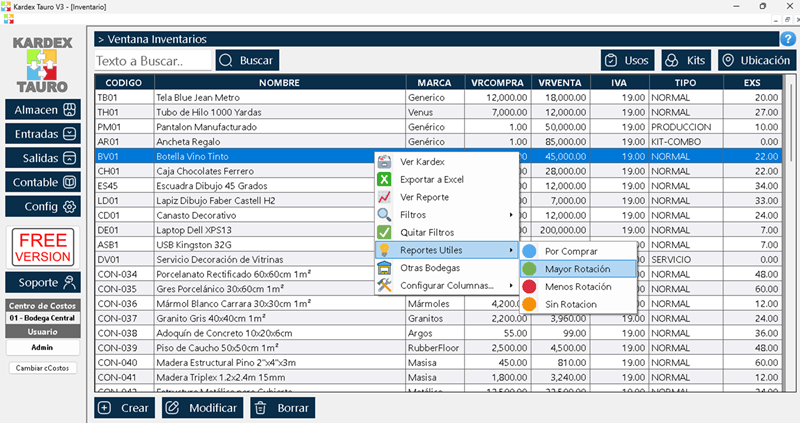
In Kardex Tauro this bridge works directly: the production orders module lets you create the document, record the raw material consumptions against that order, and receive the manufactured production in partial entries as the work progresses. Each consumption is linked to the order and so is each reception, so at the end the order shows what was planned to be manufactured, which supplies were consumed, and how much product was received.
For an order to work, the product to be manufactured must be marked in inventory as a production line type, and its recipe is defined separately in the component list, where the raw materials and the quantities that each unit consumes are indicated. With that base, the system knows what must go out and what must come in when the order is executed.
Numeric example: manufacturing 100 units with two raw materials
To see the bridge in numbers, imagine a production order that manufactures 100 units of product P. Each unit of P consumes 0.5 kg of raw material A and 2 units of raw material B; therefore, the whole batch consumes 50 kg of A and 200 units of B. With a cost of 6 per kg of A and 1 per unit of B, the total raw material cost of the batch is 500, which equals 5 per manufactured unit.
| Movement | Product | Quantity | Value | Effect on inventory |
|---|---|---|---|---|
| Production order created | Product P | 100 units | — | Plans the manufacturing without moving stock |
| Raw material consumption | Raw material A | -50 kg | -300 | Decreases the stock of A by 50 kg |
| Raw material consumption | Raw material B | -200 units | -200 | Decreases the stock of B by 200 units |
| Production reception | Product P | +100 units | +500 | Increases the stock of P by 100 units |
Notice the balance: 500 leaves inventory in raw materials (300 of A and 200 of B) and 500 enters as finished product (100 units of P at 5 each). The total stock does not change in value: it changes in form. If only the consumption were recorded, inventory would be 500 below reality; if only the reception were recorded, the raw material would still appear as available when it was already consumed.
Frequent errors, their effect, and the recommended control
The following table summarizes the most common recording errors in manufacturing companies, the effect they produce on inventory, and the control that prevents them.
| Frequent error | Effect on inventory | Recommended control |
|---|---|---|
| Not recording the raw material consumption | Raw material appears as available when it was already used, and the product cost remains incomplete | Record every consumption against the production order at the moment the supply leaves the warehouse |
| Not receiving what was produced | The manufactured product does not appear in stock and can be sold without being loaded | Receive the production in the order, even in partial entries, as the batch progresses |
| Production losses not recorded | Raw material leaves but not all the material becomes product, leaving unexplained shortages | Measure the real loss of each batch and record it so the yield can be verified |
| Mixing production with sales | The product is subtracted as if it were a sale or raw material is loaded as a purchase, distorting the reports | Use production consumptions and receptions to manufacture, and keep invoices and notes for selling and buying |
Make to order or make to stock
Another decision that connects production and inventory is the manufacturing model. Making to order, also called make to order or MTO, means producing only when a customer order exists. Making to stock, or make to stock / MTS, means producing in advance to have stock available. Each model changes the way orders are created and the level of inventory the company must sustain.
| Aspect | Make to order (MTO) | Make to stock (MTS) |
|---|---|---|
| When to manufacture | When the customer places the order | Before demand arrives |
| Finished product inventory | Minimal, almost zero | High, ready to deliver |
| Main risk | Delays if the raw material is not available | Unsold product, tied-up capital or obsolescence |
| Production order | Born from a concrete order | Born from a forecast or a reorder point |
In practice, many small businesses combine both models: they make special products to order and make to stock the ones with constant demand. The production order works the same way in both cases, because it must always answer the same questions: what is manufactured, with which supplies, and how much must enter inventory.
Which reports to review to keep the balance
The connection between production and inventory is monitored with three readings. The first is the cost of what was produced: compare the value of the raw materials consumed with the units received to validate that the cost per unit is the expected one. The second is waste: what leaves the warehouse and does not become finished product must have an explanation. The third is the raw material stock: if consumption is properly recorded, the available supply level indicates in advance when you need to buy.
In Kardex Tauro, since consumptions and receptions are tied to each production order, viewing the order shows the accumulated cost and the quantities involved, and the stock ledger of each product reflects the movements generated by production. With that information, connecting production and inventory stops depending on memory: the system keeps the complete bridge between what is consumed and what is manufactured.
Production and inventory are two windows of the same process. When raw material is subtracted as it is consumed and the finished product is loaded as it is received, within the same production order, inventory stays balanced and the company really knows how much it costs to manufacture each unit. That is the point where manufacturing small businesses stop losing money without realizing it.