Source documents: the invoice, the receipt and the voucher behind accounting
Source documents: the invoice, the receipt and the voucher behind accounting
No number in accounting appears by chance. Behind every journal entry there is a paper or a digital file that explains why the transaction was recorded, with whom it happened and on which date. Those papers are called source documents, and they are the raw material of accounting work: without them there is no valid entry, and with them any entry can be reviewed, corrected and defended.
In this lesson of the manual we will go through the documents that support the operations of a business that holds inventory: the purchase invoice, the sales invoice, credit and debit notes, the cash receipt, the payment voucher, the delivery note and the bank documents. For each one we will see which operation it supports and, above all, which specific piece of data it provides to the journal entry. We will close with a practical example: the papers of one month in a hardware store and the entries each one produces.
Why nothing is booked without a support
Accounting works like a chain of evidence. The transaction happens in the business; the document puts it in writing; the accountant or the system turns it into an entry; entries accumulate in the books and from there the financial statements are prepared. If one link of the chain is missing, everything that comes after it loses its backing. A sale recorded without an invoice or receipt can be an error, an oversight or a serious problem, because nobody could prove that it actually happened.
The source document performs three functions. The first is to prove: it confirms that the transaction existed, shows the date, identifies the parties and states the amounts. The second is to measure: it provides the exact data recorded in the entry, such as quantities, prices, payment terms and balances. The third is to control: it allows tracing a transaction from the original document to the financial statements and detecting differences when something does not add up. That is why the first practical rule of the course is simple: no support, no entry.
The purchase invoice: what the merchandise costs
When the business buys merchandise from a supplier, the document that supports the operation is the purchase invoice. It states the supplier, the date, the description of the items, the quantities, the unit price, the total amount and the payment terms. It is the paper that proves that the merchandise entered the warehouse and that the business incurred an obligation or made a payment.
For accounting, the purchase invoice provides three essential data items. First, the cost of inventory: the value of the merchandise purchased goes to the inventory account and not to expense, because what was bought is still available to be sold. Second, the deductible tax: the portion of tax that the invoice shows separately is recorded as a right in favour of the business, in general terms and without going into rates or local rules. Third, the counterpart: if the purchase was on credit, the credit goes to the accounts payable account, and if it was paid in cash, the credit goes to cash or bank accounts. With those three data items the purchase entry is complete.
The sales invoice: revenue and receivables
On the other side of the counter is the sales invoice, the document the business gives to the customer when it sells merchandise. The invoice identifies the customer, describes what was sold, shows quantities, prices, the tax amount in a generic way and the total, and states whether the sale was paid in cash or remains pending. It is the support of revenue: without a sales invoice there is no recordable sale.
This invoice feeds the revenue entry. If the sale was for cash, the debit goes to cash; if it was on credit, the debit goes to accounts receivable. The credit is made to the sales revenue account, and the tax charged is separated into its own liability account, because it must be paid to the authorities within the deadlines set by local rules. The sales invoice also triggers a second entry that is studied in another lesson of the course: the cost of sales, which takes the merchandise out of inventory. For now, the important thing is to know that this document is the doorway of all revenue.
The credit note: when the transaction goes down in value
Not all transactions end the way they began. When a customer returns merchandise or the business grants a discount, the original invoice no longer reflects reality, and that change also needs its own document: the credit note. The credit note reduces the value of a previous transaction and explains the reason for the discount, the return or the adjustment.
In a customer return, the credit note supports the decrease of revenue and of the receivable: if the customer owed money, they owe less, and if they already paid, the business returns the money or leaves a credit balance in their favour. On the purchase side the same happens in reverse: if the business returns merchandise to its supplier, it receives a credit note that lowers the debt or refunds the amount paid, and inventory goes down because the merchandise left the warehouse. In both cases, the credit note is the support that justifies one entry lowering the value of another.
The debit note: when the transaction goes up
The debit note performs the opposite function: it increases the value of a previous transaction. It is used, for example, when after issuing a sales invoice the business charges the customer an additional amount, such as a freight charge that was not included or an agreed adjustment; or when a supplier charges the business an amount that was missing from the original purchase invoice. The debit note documents that higher value and supports the entry that increases the related receivable or payable account.
Its accounting treatment is simple: in a debit note issued to a customer, receivables and revenue or other charges increase; in a debit note received from a supplier, the payable account increases and, depending on the case, so does the cost of inventory or an expense. Although it is less frequent than the invoice, the debit note has the same evidentiary value and must be filed with the same discipline.
The cash receipt: money coming in
The cash receipt is the document that supports every inflow of money to the business. It is issued when a customer makes a payment on account of their receivable, when the owner contributes money, when a loan is received or when any other cash comes in. The receipt states who delivers the money, for what concept, on which date and for how much.
The data it provides to the entry is straightforward: the debit goes to cash, and the credit depends on the reason for the receipt. If it is a customer payment, the credit goes to accounts receivable, because the customer reduces their debt. If it is an owner contribution, the credit goes to capital. If it is a received loan, the credit goes to the corresponding liability account. In short, the cash receipt is the proof that cash came in and why it came in.
The payment voucher: money going out
The payment voucher, also known as the expense receipt, is the document that supports every outflow of money from the business. It is issued when the business pays a supplier, pays an expense such as rent or utilities, makes an owner withdrawal or settles any other obligation. The voucher states who is paid, the concept, the date, the amount and the method of payment, so it is the proof that cash went out.
The entry it produces depends on what was paid. If a debt with a supplier is settled, the debit goes to accounts payable and the credit to cash or bank accounts. If an expense of the period is paid, such as the rent of the premises, the debit goes to the expense account and the credit to cash or bank accounts. The payment voucher is the twin of the cash receipt: together they explain all the cash movements of the business, and at the end of the month their totals must match the cash balance and the bank outflows.
The delivery note: goods that leave without being a final sale
The delivery note is the document that accompanies the delivery of merchandise when there is still no final sale. It is used in cases such as the delivery of an order that the customer must check and approve, the shipment of merchandise to a salesperson or to another branch, or the transfer of items that will be invoiced later. The delivery note describes which items left, in which quantities and to where.
From the accounting point of view, the delivery note does not record revenue, because the sale has not been completed yet: the merchandise is still owned by the business. What it does allow is controlling the physical outflow of inventory and knowing where every item is. When the sale is completed, the delivery note becomes a sales invoice, and it is that document, not the delivery note, that produces the revenue and cost of sales entries. Keeping delivery notes up to date prevents merchandise from leaving the warehouse without a trace.
Bank documents: deposits and transfers
When money moves through the bank, the support is the bank document: the deposit slip, the transfer voucher, the paid cheque or the bank statement. These documents prove that the business received a deposit or ordered an outflow of funds, and they are what allows the bank account to be reconciled with reality.
The data they provide is the movement of the bank account: a deposit from cash sales supports the debit to bank accounts and the credit to revenue; a transfer to pay a supplier supports the debit to accounts payable and the credit to bank accounts. Even if the business records the sale with its invoice and the payment with its voucher, it is the bank document that confirms that the money actually moved through the account, so it is filed together with the original document of the transaction.
What each document records: the summary table
To see the complete picture, the following table summarises each document, the operation it supports and the typical accounts moved by its entry. It is useful to keep it at hand while reviewing the papers of the business.
| Source document | Operation it supports | What is recorded (typical accounts) |
|---|---|---|
| Purchase invoice | Purchase of merchandise or services from a supplier | Debit to inventory (cost) and deductible tax; credit to accounts payable or to cash and bank accounts |
| Sales invoice | Sale of merchandise to a customer | Debit to cash or accounts receivable; credit to sales revenue and tax payable |
| Credit note | Return or discount that reduces a previous transaction | Reduces revenue and accounts receivable, or reduces inventory and accounts payable |
| Debit note | Additional charge that increases a previous transaction | Increases accounts receivable or payable and the related revenue, cost or expense account |
| Cash receipt | Cash inflow: customer payment, owner contribution or other income | Debit to cash; credit to accounts receivable, capital or other income |
| Payment voucher | Cash outflow: supplier payment, expense paid or withdrawal | Debit to accounts payable or to the expense account; credit to cash or bank accounts |
| Delivery note | Delivery of merchandise that is not yet a final sale | No revenue is recorded; it controls the inventory outflow and becomes a sale when invoiced |
| Deposit or transfer | Movement of money through the bank | Debit or credit to the bank account according to the operation it confirms |
A month of papers in a hardware store
The theory makes sense when the documents arrive on the desk. Let us imagine a neighbourhood hardware store that gathers five typical papers during a month: a purchase invoice for merchandise, a sales invoice, a credit note for a customer return, a cash receipt for a payment on account and a payment voucher for the rent of the premises. Each paper produces its own entry, and all of them together leave the accounting up to date.
| Document of the month | What happened | Entry it produces |
|---|---|---|
| Purchase invoice for merchandise | Paints and tools are bought for 2,400,000 on credit from a supplier | Debit to inventory for 2,400,000 and deductible tax according to the invoice; credit to accounts payable for the total |
| Sales invoice | Items are sold for 1,150,000 in cash to a customer | Debit to cash for the total; credit to sales revenue and tax payable according to the invoice |
| Credit note for a return | A customer returns merchandise worth 200,000 from the previous sale | Revenue and the receivable decrease by 200,000, and the merchandise returns to inventory |
| Cash receipt for a payment on account | A customer with a pending balance pays 500,000 on account | Debit to cash for 500,000; credit to the customer's accounts receivable for 500,000 |
| Payment voucher for rent | The rent of the premises is paid, 900,000 in cash | Debit to rent expense for 900,000; credit to cash for 900,000 |
Notice how each entry copies exactly what its document says: the purchase records the cost and the debt of the invoice, the sale records the revenue and the cash inflow, the credit note lowers the receivable, the receipt confirms the payment and the voucher recognises the expense. If the five entries are added at the end of the month, the income statement will show sales minus returns and expenses, and cash will reflect the inflows and outflows of money. Everything adds up because every paper found its entry.
Good practices with documents
Keeping documents up to date is as important as recording them. These good practices avoid headaches at month end and make accounting defensible in any review:
- File documents by date, separating purchases, sales, cash receipts and payments, so they can be found in seconds when needed.
- Always ask for an invoice when buying: every purchase, even the smallest one, must be supported by the supplier's document.
- Never book without a support: if there is no document, the transaction is investigated first and recorded later, never the other way around.
- Check the consecutive numbering of invoices, receipts and vouchers to detect lost or unissued documents.
- Verify that the document properly identifies the third party, the date, the concept and the amounts before turning it into an entry.
- Keep the supports for the time required by local rules and keep digital copies in case the paper deteriorates.
How inventory and accounting programs help
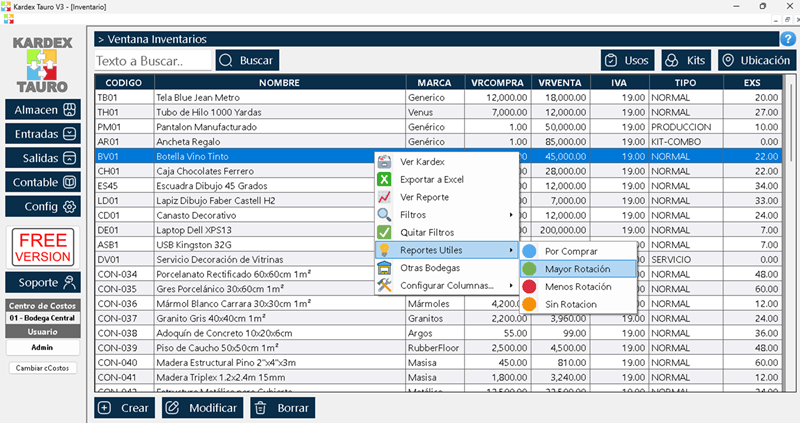
A well-used accounting program does not eliminate source documents: it organises them and turns them into almost automatic entries. When the business issues a sales invoice, the system generates the document with its numbering, removes the merchandise from inventory and prepares the revenue entry; when a cash receipt is recorded, the system updates the customer's receivable. Programs such as Kardex Tauro follow the same logic: every document that is issued or received is linked to its entry, and at the end of the month the information is already ready for the accountant.
What the program cannot do is invent a support that never existed. The supplier invoice for a purchase made elsewhere, the receipt of the customer who paid in cash and the bank document must reach the system or be attached to it. The good news is that Kardex Tauro, like other management programs, allows inventory control, accounts receivable and payable and cash movements to be kept on the basis of those documents, so accounting is fed by real and verifiable papers.
Accounting and tax rules vary by country and by business size. This lesson explains the general principles of source documents; to apply criteria specific to your location, consult your accountant and the regulations in force.
Downloadable template: Purchase book template in Excel — the Excel template that goes with this lesson.