Profit vs cash flow: why an inventory business can die while making money
Profit vs cash flow: why an inventory business can die while making money
A business can be making money and, at the same time, run out of cash to pay its bills. It sounds like a contradiction, but it happens every day in thousands of shops: the income statement shows a profit, the books are in order, and yet the owner cannot cover payroll, rent or the next purchase of goods. The explanation is that profit and cash are two different things measured under two different rules. This lesson explains that difference, shows with a numerical example how a month can end with a profit and with a badly negative cash balance, and gives practical actions so that an inventory business does not die while making money.
Earlier in this manual, inventory was studied from the angle of the financial statements: how it is valued, how it appears on the balance sheet and how its movements show up in the period flows. This lesson looks at the same scene from the angle of the owner who lives the day to day: the gap between what accounting says the business earned and the money the owner can actually touch. To understand that gap, you need to know two clocks that do not always tell the same time: the accrual clock and the cash clock. While both clocks show the same hour, everything looks easy; when they move apart, surprises appear.
Profit is an idea, cash is a fact
Accrual accounting is the basis on which the income statement is built. Under that basis, sales are recorded when they are invoiced, not when they are collected; expenses are recognized when they are incurred, not when they are paid; and the cost of goods sold is deducted when the goods are delivered, not when they were bought. The idea is that the result of the period should reflect the economic activity of the business: how much it sold, how much that selling cost and how much it spent to operate, regardless of whether the money has already arrived or already left. That is why the profit of a month can include sales from which not a single dollar has been collected yet.
Cash, on the other hand, knows nothing about accruals. Cash only understands real movements of money: money comes in when the customer pays and goes out when the business pays the supplier, the employee, the landlord or the utility company. A credit sale of one thousand dollars does not move the cash box on the day it is invoiced; it moves the cash box on the day, weeks later, when the customer pays. In the same way, buying inventory for cash moves the cash box immediately, even though the goods have not been sold yet and even though, for accounting purposes, that purchase is not yet an expense but an asset waiting on the balance sheet.
Put simply: profit is an idea built with accounting criteria, and cash is a fact that can be counted in bills. Profit tells you how much value the business generated during the period; cash tells you how much money is available to pay what is due today. A business needs both measures, but only the second one pays the bills. Whoever confuses the two ends up believing he is rich on paper and poor in reality, or the other way around, and neither belief helps to make good decisions.
Why the inventory business is the classic case
In a service business the gap between profit and cash is usually small: the firm invoices, collects and pays in short cycles. In a business that buys and sells goods, the gap becomes a canyon, because inventory reaches into the cash box long before profit even exists. Four features explain why the goods business is the classic case of this problem:
- You buy inventory before you sell it. The cash goes out first and the profit arrives later, if it arrives at all. Every cycle starts with money leaving to pay for goods that are still sitting on the shelves or in the back room.
- If you sell on credit, profit is born today and cash arrives later. When you invoice, accounting recognizes the sale and its gain immediately, but the customer's money may take thirty, sixty or more days to arrive, and sometimes it never arrives.
- If the business grows, every cycle demands more cash. Selling more means buying more inventory; buying more inventory means committing more of your own money, because the goods are paid for before they turn into collected sales.
- Inventory that does not turn is frozen money. The cash has already left, the goods rest on the shelf without generating a single sale, and meanwhile the expenses keep running.
These four features combine and reinforce each other. A business that sells a lot on credit and grows quickly needs more and more cash to support more inventory and more accounts receivable. If that cash is not available, the business falls into the paradox in the title of this lesson: the statements show growth and profit, but the cash box empties. To see it clearly, nothing works better than an example with real numbers from a full month.
A month with profit and no cash: the example
Imagine a shop that sells goods. During the month it invoiced sales of $15,000,000, all on credit: the goods left the store, the invoices were handed over and the customers were left owing money. The cost of that merchandise sold was $9,000,000, and the month's expenses, including rent, utilities, salaries and other items, added up to $3,000,000. With those figures, the month's income statement shows a profit of $3,000,000. So far, a great month: the business made money, at least on paper.
But look at what happened to the cash in that same month. To replace what was sold, the shop bought new inventory for $12,000,000 and paid for it in cash. It also paid the $3,000,000 of expenses. On the income side, it collected only $6,000,000 from customers, including payments for sales of this month and of previous months. The following table compares the two stories of the same month, the story of the result and the story of the cash:
| Item of the month | Income statement | Real cash flow |
|---|---|---|
| Sales invoiced on credit | $15,000,000 of revenue | $6,000,000 collected from customers |
| Cash purchase of inventory | Not an expense yet, stays as an asset | Minus $12,000,000 leaving the cash box |
| Cost of goods sold | Minus $9,000,000 | Already included in the month's purchase |
| Expenses of the month | Minus $3,000,000 | Minus $3,000,000 paid out |
| Result of the month | Profit of $3,000,000 | Cash down by $9,000,000 |
The table does not lie: both results are true and belong to the same business in the same month. The income statement says the operation generated a profit of $3,000,000, because under accrual accounting the credit sales count as revenue of the period. The cash flow says the cash box ended $9,000,000 poorer, because more money went out than came in: $15,000,000 were paid out between purchases and expenses and only $6,000,000 came in from collections. If the business has no reserves and no available credit, it cannot pay what it owes, even though its papers say it is making money.
Notice one important detail: the profit of $3,000,000 is represented in reality by merchandise on the shelves and by accounts receivable from customers, not by cash in the box. The business did create value: it has more inventory to sell and customers who owe it money. But that value is not yet liquid money. As long as the goods are not sold and the accounts are not collected, the profit lives only on paper, and anyone who tries to pay the payroll with the paper profit will discover that paper cannot be torn into bills.
Why profit and cash move apart
The underlying reason is that profit is calculated under accrual rules and cash moves under cash rules. The income statement adds up invoiced sales without asking whether they were collected; the cash flow only counts money that actually came in. The income statement deducts the cost of goods sold no matter when the merchandise was paid for; the cash box records the outflow on the day the purchase is paid, which usually happens long before that merchandise becomes sales. These are two different pictures of the same month, and neither one is wrong: each one answers a different question.
In an inventory business there is also a force that widens the gap: working capital. The cash of the business not only has to fund the month's expenses; it also has to fund the inventory waiting its turn to be sold and the credit sales waiting their turn to be collected. When the business grows, that inventory and that receivables portfolio grow too, and every extra dollar trapped inside them is a dollar that is not available to pay bills. That is why the businesses with the best sales are often the ones that run out of air the fastest: growth eats the cash before it gives it back as profit, and the owner discovers that earning more can cost more money than he had.
What to do so the business does not die with profits
The solution is not to sell less or to stop growing. The solution is to govern the cash with the same discipline used to chase profit, and to watch both clocks at the same time. These are the practical actions that separate the businesses that survive from those that go bankrupt with profits on their books:
- Collect faster. Invoice on the very day of the sale, ask for advances on large orders, offer a small discount for early payment and chase overdue accounts with a fixed calendar. Every day that a sale waits to be collected, the business is lending money without interest.
- Do not overbuy. Buy against orders and against the real turnover of the inventory, not against the excitement of good sales. It is better to run short and restock quickly than to end up with the cash converted into stagnant merchandise.
- Separate the paper profit from the available money. Do not distribute or spend the profit that has not yet entered the cash box: that money is sitting in receivables and inventory, and if you spend it, the business loses its working capital just when it needs it most.
- Watch the cash flow every week. Project the inflows and outflows of the next four to eight weeks: how much you expect to collect, how much you must pay for purchases, payroll and expenses, and what gap is left. Seeing the gap in advance allows you to cover it on time, by asking a supplier for more time, taking a loan or requesting an advance from a large customer.
- Use the supplier's terms as an ally. If the supplier gives you thirty days to pay and your customers pay in thirty days, the cash box does not have to finance the whole cycle alone: trade credit becomes part of the working capital of the business.
The following table summarizes the quick diagnosis that every owner should know how to make: when the cash hurts, the symptom says a lot about the cause, and the cause points to the right action. It is an exercise that takes a few minutes and saves months of anxiety.
| Symptom | Typical cause | Action |
|---|---|---|
| I sell a lot and there is no money to pay | Receivables are growing: credit sales that are not collected | Collect faster, ask for advances and chase overdue balances |
| The shelves are full and the cash box is empty | Overbuying of inventory | Buy against orders and according to the real turnover of the goods |
| Profit grows and cash does not | The gain is trapped in inventory and accounts receivable | Separate the paper profit and review the cash flow every week |
| Every new sale demands more money | Growth consumes working capital | Get supplier terms and finance the full cycle, not just the purchase |
The conclusion of this lesson fits in one sentence: a business does not die from lack of profit, it dies from lack of cash. Profit is the thermometer of the value the business generates; cash is the oxygen that keeps it alive. An inventory business can show years of profits and go bankrupt in a single season if the money stays trapped in goods that do not turn and in customers who do not pay. That is why the owners who survive crises are not the ones who sell the most, but the ones who know their cash flow best and make decisions by watching it often.
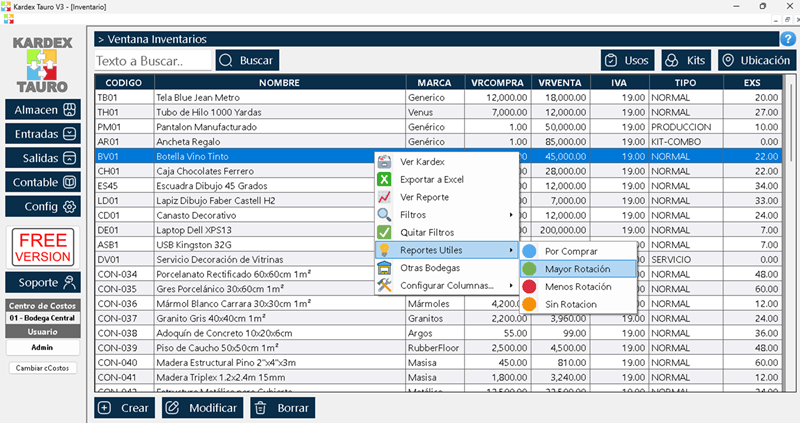
The good news is that cash can be governed with information and habits. Recording sales, purchases and collections in an orderly way, reviewing the movement of money every week and making purchase and credit decisions by looking at the cash, not only at the income statement, is a routine that any business can adopt. Tools like Kardex Tauro help keep that control of the inventory and of the movement of the business, but the most important decision belongs to the owner: understanding that earning and having cash are not the same thing, and governing the business by watching both clocks at the same time. With that view, profit stops being a decorative number and becomes what it should be: available cash to grow in peace.
Downloadable template: Cash flow statement template in Excel: indirect method — the Excel template that goes with this lesson.